






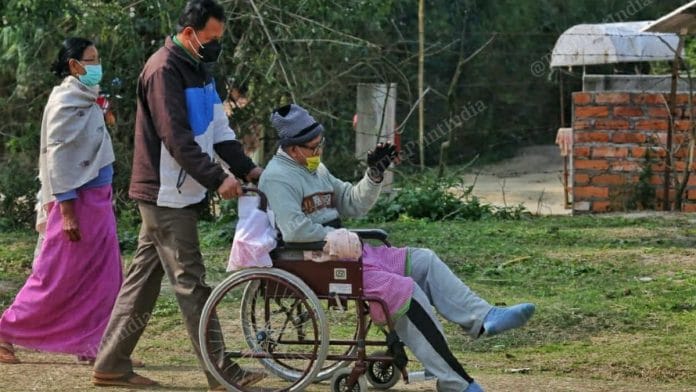



The late 1990s and early 2000s marked a turning point for disability rights activism in India. Two landmark victories defined that era: The passage of the Persons with Disabilities Act 1995, and the inclusion of disability within Census 2001 schedules, the first such attempt in Independent India.
The 1995 Act was India’s first disability legislation, a foundation that empowered advocates to demand rights through law. Yet it carried a fatal weakness—though it mandated reservations and accessibility, it had no penalty for non-compliance. And so, progress still required protest. As disability rights activist, Javed Abidi, often told me: “It is what we could manage at the time but it lacked teeth.”
Which is why, only a few years later, activists rallied again—lobbying, organising, demanding that citizens with disabilities be counted. Their persistence led to a meeting with Prime Minister Atal Bihari Vajpayee and with his assent, disability was finally included in Census 2001.
Sadly, as it was a last-minute decision, enumerators lacked training and awareness on disability. The result: A grossly inadequate count of 2.19 crore people or 2.13 per cent of the total population at the time.
When Census 2011 approached, expectations were higher. Yet the numbers remained implausibly low: Just 2.21 per cent of India’s population being 2.68 crore people.
To better understand why low disability numbers are a problem for a developing nation, we need to contrast our percentages with the 2011 World Health Organization-World Bank estimate: 15 per cent of the world’s population lives with disability.
The United States, the United Kingdom, Australia and Germany are among developed nations whose national disability estimates are broadly aligned with global figures.
A pivotal argument, which Javed Abidi put forward, echoes in my head: Are people with disabilities only being born in wealthy nations? Or is India still failing to recognise disability?
The answer lies in our methods.
Also read: 80% Indians with disabilities have no health insurance, says study
Flawed methodology
India continues to rely on a narrow, medicalised definition focused on visible impairments. Many disabilities, especially psychosocial, neurological, chronic, or pandemic-related conditions remain uncaptured. Compounding the problem, India has no national disability survey to supplement census data. In fact, even though health and disability are intrinsically related, National Family Health Survey (NFHS) 6, 2023-2024 dropped disability questions altogether, enhancing the data vacuum.
The consequences are severe as Census 2011 data is now 14 years out of date. Covid-19 alone has increased the number of people with disabilities through long-term illnesses, chronic conditions and post-viral disabilities. Yet policymakers still operate as if disability is marginal, because the data says so.
The Rights of Persons with Disabilities (RPwD) Act 2016, the final major policy reform Javed Abidi championed, expanded the recognised disability categories from seven to 21, aligning India with the UNCRPD. The Act led to the establishment of institutions such as the Chief Commissioner for Persons with Disabilities (CCPD). He called it a “game-changer” as the new law was not “toothless”
Javed Abidi passed away in 2018, in my arms, before he could push for the implementation of the RPwD Act or see whether the census would finally do justice to his decades of advocacy!
Today, as Census 2027 approaches, my fear is simple: India may once again disappear its citizens with disabilities through data as we still use old methods to count. This is despite the fact that new disabilities have been codified into the law, and Covid-19 has most definitely exacerbated the invisible, unaccounted numbers.
An RTI response recently revealed a startling reality about Census 2027 preparedness:
- No allocated budget
- No training plan
- No awareness programme
- No disability enumeration manual
- No mandated training hours for enumerators
This response by the Census Commission baffled me as I was sure to have seen training manuals and disability specific awareness programs being conducted by sector stalwarts. However, a few phone calls within the sector revealed that such programmes majorly utilised privately raised money rather than state funds. It puts the onus to prepare for the Census, the largest enumeration process in the world, on civil society.
If inclusion relies on NGOs privately fundraising through corporates, the State continues to outsource responsibility rather than institutionalising inclusion. Charity cannot and should not replace rights.
Some believe that accurately counting citizens with disabilities threatens scarce resources. But disability cuts across caste, class, gender and geography. Reservations for persons with disabilities are horizontal, not competitive with other groups. Counting the most marginalised strengthens social equity without weakening others’ claims.
Also read: Making doctors prove their disability all over again isn’t how you curb fake certificates
13 measures
Census 2027 will be only the third enumeration process in Independent India to count disability. We still have time to get this right, but political will must move now if we want to truly embody “Sabka Saath Sabka Vikas” as stated numerous times by the Prime Minister Narendra Modi.
Alongside fellow activists, we at Javed Abidi Foundation (JAF) have sought a meeting with the Census Commissioner through a detailed representation and RTI-based findings. Our recommendations focus on 13 urgent accountability measures:
- Dedicated disability budget line: Within the overall Census allocation
- Comprehensive training plan: Scope, timelines, trainers, coverage
- Disability-specific training modules: Developed by experts funded by the commission
- Anti-stigma awareness initiatives: Especially in rural and low-literacy areas
- Mandated minimum training hours: Devoted exclusively to disability inclusion
- Technical Advisory Committee (TAC) transparency: with named disability experts
- COVID-19 impact questions: Capturing long-term disabling conditions
- Inclusive questionnaire design: Multiple selections, aligned with RPwD Act and international standards
- Accessible enumeration formats: Braille, large-print, ISL, screen-reader-friendly
- PwD representation as enumerators and supervisors: At least 4 per cent as under RPwD Act
- Intersectional data disaggregation: Gender, caste, age, rural/urban, income
- Monitoring and evaluation mechanisms: PwD-led accessibility audits
- Digital and tech innovations: Accessible tools tested by the sector
Our approach is rooted in co-creation, not confrontation. The disability sector stands ready with expertise however the State must match it with commitment. Because data is not a mere statistic. It is recognition, justice and belonging.
Without accurate enumeration, policy remains incomplete and India continues to make millions of its own citizens disappear, not by neglect, but by design. Therefore Census 2027 is not just a headcount, it is a test of whether people with disabilities count at all.
Shameer Rishad is the convenor of the Javed Abidi Foundation (JAF). He can be reached on X and Instagram @rishadshameer. Views are personal.
(Edited by Theres Sudeep)