






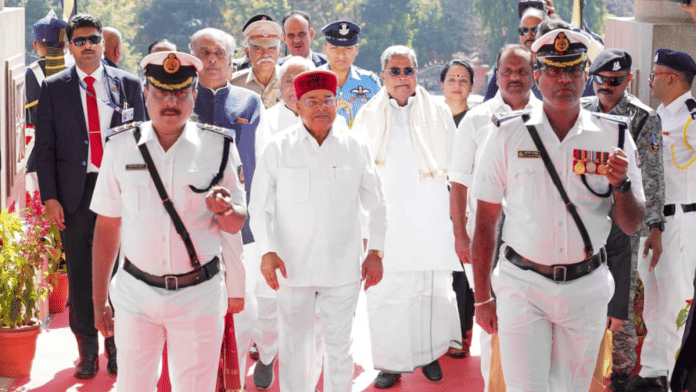



Governors of Tamil Nadu, Kerala and Karnataka made headlines on the opening days of their Assembly sessions this year, when they were scheduled to address the first sittings of the new legislative year. Walkouts are a democratic right of the Opposition, but when governors, who are constitutional heads of states, trigger or stage disruptions, the questions become different.
All three states are ruled by parties that are part of the INDIA bloc and are politically opposed to Prime Minister Narendra Modi. The governors of Kerala and Karnataka hail from the RSS-BJP ecosystem, while the Tamil Nadu governor is often accused by the DMK and its allies of acting as a “spokesperson for the BJP-RSS”.
Relations between the chief ministers and governors in these states have been strained for some time. Kerala Chief Minister Pinarayi Vijayan and Tamil Nadu Chief Minister MK Stalin have, on multiple occasions, boycotted their respective governors’ “At Home” receptions on Independence Day and Republic Day. There is little direct communication between the chief ministers themselves, let alone between Lok Bhavans and the elected governments.
The timing is also politically sensitive. Kerala and Tamil Nadu are heading into election cycles. More significantly, the governments of all three states have approached the Supreme Court, seeking clarity and relief on what they see as governors overstepping their authority — particularly by delaying assent to Bills passed by the legislatures and stalling appointments, including those of vice-chancellors.
In Karnataka, Governor Thawarchand Gehlot, a senior BJP leader, did not deliver the customary address to the Assembly after disagreements over the draft speech prepared by the Siddaramaiah government. He objected to certain paragraphs that criticised the Narendra Modi-led Union government, leading to an unprecedented situation that the ruling Congress party described as a constitutional impropriety.
In Tamil Nadu, Governor RN Ravi rejected to read the speech on Tuesday, alleging disrespect to the National Anthem, and saying the Stalin government’s speech ignores atrocities against Dalits, sexual violence against Dalit women, and rising suicides that a Lok Bhavan statement said has led to the state being described as the “suicide capital of India”. The DMK strongly objected to these references, calling them politically motivated.
In Kerala, Governor Rajendra Vishwanath Arlekar attended the Assembly and read out the address drafted by the government, but omitted several paragraphs. The skipped sections included pointed criticism of the Centre’s fiscal policies and a reference to the state approaching the Supreme Court over the prolonged pendency of Bills passed by the legislature.
A pattern older than the present conflict
Governor–chief minister tussles, ideological differences and public sparring are not new to Indian federal politics. What the BJP is doing today is not very different from what the Congress did for decades when it dominated the Centre.
In 2011, when Gujarat Chief Minister Narendra Modi launched his Sadbhavana (communal amity) Mission and went on a three-day public fast, then Governor Kamala Beniwal sought an audit of the expenses incurred by the state government. She wrote to a senior official under the subject line, “Related to expense from the public exchequer and financial irregularities of BJP CM Narendrabhai Modi.” This was the kind of harassment that BJP governments faced at the hands of Congress-appointed Governors.
During PV Narasimha Rao’s tenure as prime minister, M Chenna Reddy was appointed governor of Tamil Nadu, a move widely seen as aimed at creating friction with then Chief Minister Jayalalithaa. Reddy later granted sanction to prosecute her, forcing her to step down, an outcome that benefited the DMK politically.
In contrast, during the tenure of Kodardas Kalidas Shah as governor and M Karunanidhi as DMK chief minister, relations were cordial. Karunanidhi even publicly praised Shah, famously noting that both shared the initials “K K”. If the same governor later took positions adverse to the state government, the DMK would invoke CN Annadurai’s sharp critique of the office itself: “Why does a goat need a beard, and why does a state need a Governor?” (In Tamil: ஆட்டுக்குத் தாடி எதற்கு? நாட்டுக்கு கவர்னர் எதற்கு? Aatukku thaadi edharkku? Nattukku governor edharkku?)
Former Andhra Pradesh and Telangana governor ESL Narasimhan once told this columnist that he too faced similar issues during his tenure. His approach, he said, was simple—invite the chief minister for tea or lunch, explain constitutional concerns, and work out acceptable changes in the speech. He said he never had a serious confrontation with elected leaders such as Chandrababu Naidu, YS Jagan Mohan Reddy or K Chandrasekhara Rao.
Around the same time, President Droupadi Murmu, while addressing a governors’ conference, stressed that the smooth functioning of institutions is essential for public welfare and development. She underlined the governor’s role as a link between the Centre and the states, and spoke of strengthening cooperative federalism through coordination and dialogue. Governors, she said, must set an example through their conduct.
Addressing the opening session of the Assembly is a constitutional requirement. Yet, in a political environment marked by strong central leadership under Narendra Modi and Amit Shah, governors are often seen as enjoying greater political backing, and sometimes as receiving informal encouragement to challenge elected state governments. This is precisely the charge levelled by the southern states.
Are chief ministers in Tamil Nadu, Kerala and Karnataka overreacting after repeated frustrations, including limited relief from Supreme Court rulings so far? Is there any functional communication channel between governors and chief ministers in these states? The honest answer is no. Both sides have resorted to passing Assembly resolutions seeking the President’s intervention or the recall of governors.
Whichever side one supports, the larger picture is worrying. Regional parties are struggling to project a strong, unified Opposition leadership in Parliament to articulate Centre-state tensions. At the same time, there is no towering leader in New Delhi today who can persuade warring occupants of Lok Bhavans and state secretariats to talk with the elected heads of the states.
R Rajagopalan is a veteran journalist and a political analyst. He tweets @RAJAGOPALAN1951. Views are personal.
(Edited by Prashant Dixit)