






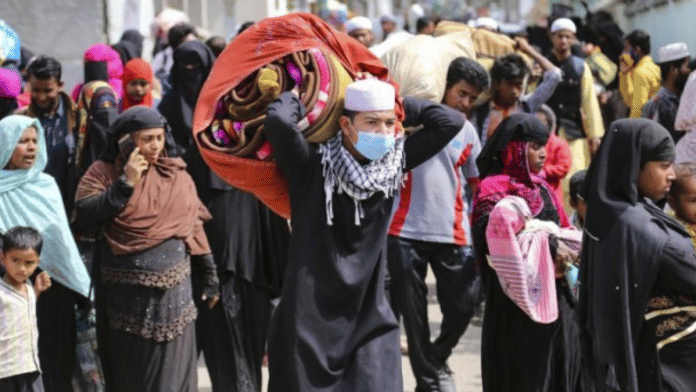



It is widely acknowledged that Myanmar’s National League for Democracy, led by Aung San Suu Kyi, and the country’s military were repeatedly at odds over questions of authority and governance. The 2021 military coup was the breaking point. But within the labyrinth of their complex relationship, there was one area where their views converged—the Rohingyas.
Their consensus on the Rohingya issue ensured that irrespective of international pressure neither side ever considered reforming the 1982 Citizenship Law. The law, which was designed by the military, was kept intact by the Suu Kyi government, despite its political capital to initiate change.
The 1982 Citizenship Law defines belonging in Myanmar through ethnicity rather than residence or birth. Full citizenship is reserved for groups officially recognised as “national races”, defined as communities believed to have settled in the country before 1823.
The state maintains a fixed list of 135 such groups, and the Rohingyas are not included. This exclusion is decisive. As the Rohingyas are not indigenous, the legal framework treats Rohingyas as permanent outsiders. This has caused much debate around the world at different points of time. Especially in 2017 when Myanmar’s military operations pushed more than 7,30,000 Rohingya across the border into Bangladesh. Aung San Suu Kyi was in power then. But this was not without reason.
Arakan Rohingya Salvation Army (ARSA), a militant organisation, attacked Myanmar police and military posts in 2016. In 2017, ARSA, in the devastating Kha Maung Seik massacre, brutally killed ninety nine Hindu women and children whose mass graves were found later. These events led to retaliation by the Myanmar military, which, in turn, led to UN bodies and human rights groups condemning Myanmar military actions calling it genocide. Intriguingly, none of these organisations labelled the Kha Maung Seik massacre as genocide.
With much of the Rohingya population residing in Bangladesh, their displacement has been taken up many times before including by the UN security Council. At the time, the UNSC was not able to proceed further as it was blocked by China and Russia on the grounds that the Rohingya issue is an internal matter.
However, this week, once again, the issue has come to the forefront, with proceedings beginning against Myanmar through the International Court of Justice (ICJ) in the Hague alleging genocide against the Rohingyas. Perhaps what is most striking is that the case has not been filed by Bangladesh, where the majority of the Rohingya population has taken shelter resulting in far reaching political , economic and security consequences for the country. Instead the applicant is The Gambia, a small West African state with no geographic connection to Southeast Asia.
On 11 November 2019, The Gambia took Myanmar to the International Court of Justice, invoking the 1948 Genocide Convention. The case argued that Myanmar had failed in its obligation to prevent and punish acts of genocide committed against the Rohingya in Rakhine State. The filing was grounded in the events of 2016 and 2017. The oral hearings in the Rohingya genocide case before the International Court of Justice are scheduled to last three weeks, opening on 12 January 2026 and concluding on 29 January 2026. Once the hearings conclude, the court will move into deliberations, with a final judgment expected several months later.
Also read: Our hearts beat for US deportees but turn against Rohingyas entering India. That’s hypocrisy
Lessons for India
Interestingly, the legal case brought by The Gambia against Myanmar at the International Court of Justice has been supported not as a bilateral effort, but as a collective initiative of the Organisation of Islamic Cooperation (OIC). Support for The Gambia has come through OIC resolutions, political endorsements, and financial assistance for legal proceedings.
Several OIC members including Turkey, Malaysia, Indonesia, Pakistan, Saudi Arabia, and Qatar have publicly backed accountability efforts for crimes against the Rohingya in international forums and have endorsed the ICJ case through official OIC statements.
Crucially, no OIC member has joined the case as a formal co-applicant. This was a deliberate decision. By allowing The Gambia to serve as the sole litigant, the OIC ensured that the case reflected a broad multilateral consensus without forcing individual states to absorb the diplomatic or strategic costs of direct legal confrontation with Myanmar.
Nevertheless, any sort of international interference and forceful repatriation of the Rohingyas may have widespread repercussions. While Rohingya camps in Cox’s Bazar in Bangladesh have seen financial aid coming in from Islamic countries and international aid agencies as well as high level diplomatic delegations from countries like Turkey, there has been no commitment from their side to rehabilitate the Rohingyas in their own countries. Rohingyas present in countries that are members of OIC are treated as migrant workers or undocumented foreigners, with entry governed strictly by labour visas.
None of these countries have opened a pathway for humanitarian resettlement, reflecting concerns about demographic balance and precedent-setting migration. In Saudi Arabia hundreds of Rohingyas have been held in detention centres like the Shumaisi detention centre in Jeddah. Activists have reported that detainees were treated like criminals, including being handcuffed. Saudi Arabia also seeks to deport the Rohingyas to Bangladesh.
The reality is that Rakhine state now largely controlled by the Buddhist Arakan Army will not allow the Rohingyas back unless their Arakan identity supersedes their Rohingya identity. There also have been continuous clashes with various Rohingya groups and the Arakan Army on the Bangladesh Myanmar border. The Myanmar Military will also have concerns about the radicalisation of the Rohingyas in Cox’s Bazar. They have, on multiple occasions, reiterated that the 2016-2017 clashes were counter terrorism operations against Rohingya militant groups.
The only country remaining, which is likely to be impacted with any change in status quo of the Rohingyas, is India. It has borders with both Myanmar and Bangladesh. India has been very clear on the Rohingya issue. It will under no circumstances provide refuge or patronage to the Rohingyas primarily because of the “serious security threat” that they pose, as filed in an affidavit in the Supreme Court by the Government of India.
There have been reports of linkages between Rohingyas living in India on forged documents and extremist groups like Jaish-e-Mohammed (JeM), Lashkar-e-Taiba (LeT), as well as Pakistan’s ISI. In 2017, al-Qaeda operative Samiun Rahman was arrested in Delhi for radicalising Rohingya youth. There has been alleged involvement of Rohingyas in areas like Nuh and Mewat in Haryana during large scale riots. India’s Ministry of Home Affairs has categorically termed them illegal immigrants and has called for their deportation.
Complicating matters more, there have been reports of the formation of the “Four Brotherhood Alliance”, comprising of Arakan Rohingya Salvation Army (ARSA), Rohingya Solidarity Organisation (RSO), Islami Mahaz, Arakan National Defence Force (ANDF), and the Arakan Rohingya Army (ARA). The alliance also known as the Rohingya Army announced its formation in Cox’s Bazar last year. It is alleged that they are being trained by ISI.
Whatever the verdict may be of the ICJ, it is quite unlikely that the Rohingyas may be repatriated to Rakhine state any time soon. The OIC countries will continue to limit their involvement to pursuing legal cases and giving humanitarian aid.
India needs to be strategically cautious and worry about its porous borders. The Kha Maung Seik massacre is indicative enough of the sentiments that the Rohingyas hold for Hindus.
Rami Niranjan Desai is a scholar of Northeast region of India and the neighbourhood. She is a columnist and author and presently Distinguished Fellow at India Foundation, New Delhi. Views are personal.
(Edited by Theres Sudeep)