






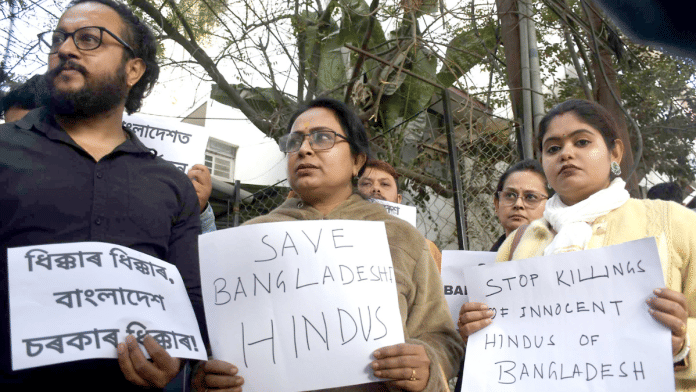



For Bangladeshi Hindus, the country’s largest religious minority facing targeted attacks since the fall of the Sheikh Hasina government in August 2024, the national election scheduled for 12 February holds little meaning. All the community hopes for is that the next elected government will contain the sharp rise in communal violence.
Their natural choice, the Bangladesh Awami League that spoke for a secular idea of Bangladesh, is barred from participating in polls. This leaves the 7.95 per cent or 1.31 crore Bangladeshi Hindus with a hard choice: vote for the country’s second-largest political party, the Bangladesh Nationalist Party (BNP), or the largest Islamist political party, the Bangladesh Jamaat-e-Islami.
There are 49 other political parties to choose from, but they are either in alliance with the BNP or Jamaat, or electorally insignificant. If past history and recent developments are anything to go by, choosing between the BNP and the Jamaat is a choice between the proverbial devil and the deep blue sea.
Also read : Bangladesh’s February elections are in the Jamaat’s hands. They want a ‘unity government’
New year, new horrors
For many Hindus in Bangladesh, the political response to the recent wave of violence has added to the uncertainty about the future. The way the two main parties have handled attacks on the community is shaping how they see the February election.
“What political preference can we Hindus possibly have?” said Ritwik Das, 16, the younger brother of factory worker Dipu Chandra Das, whose public lynching and burning on 18 December over blasphemy claims made global headlines, speaking to ThePrint from his home in Mymensingh.
Though too young to vote, Das said that even for Hindus who are of voting age, incidents like the killing of his elder brother have left a deep sense of hopelessness.
“What right do we have anyway to make political choices? No political party is talking about what happened to Dipu in its election speeches. We just want to earn our living and have the right to live,” he said.
The violence against Bangladeshi Hindus has not abated since the international outrage over Dipu Chandra Das’s killing. The new year brought with it a litany of new horrors. Khokon Chandra Das, a Hindu businessman from Shariatpur district, faced a similar ordeal.
Khokon died of burn injuries sustained during a mob attack on New Year’s Eve while returning home from his medicine shop near Keurbhanga Bazar. He was stabbed, doused with petrol and set on fire. He tried to escape by jumping into a pond but suffered severe burns and died three days later at Dhaka’s National Burn Institute. In the 35 days until 5 January, 11 Hindus were reportedly killed in communal attacks in Bangladesh, with no sign of the violence slowing.
Bangladeshi-Swedish political commentator Priyanka Ahnberg told ThePrint that the targeting of Hindus was a deliberate political strategy ahead of the 12 February polls, not an unintended byproduct of unrest.
“For Bangladeshi Hindus, the elections are overshadowed by fear — from Jamaat’s radical mobilisation and the BNP’s old tactic of enabling violence to garner votes. The most unfortunate part is that Hindus will have to choose between these two parties or their allies if they come out to vote [at all],” she said.
Bangladeshi journalist Sahidul Hasan Khokon said both parties were sending out warnings about what would happen to Hindus if they did not vote in their favour.
“In 2001, the BNP-Jamaat alliance came to power in Bangladesh defeating Hasina’s Awami League. The anti-Hindu massacres that took place for months after that have few parallels in Bangladesh’s independent history,” he said. With the Awami League now barred from the race and both the BNP and Jamaat seeking the Hindu vote, pre-poll violence is being used to scare Hindus into voting for them, Khokon added.
Also read: Khaleda Zia’s death brings back Bangladesh’s Minus Two formula. Is Tarique Rahman the answer?
BNP or Jamaat?
A registered Hindu party will be contesting the national polls in February. After the Bangladesh Election Commission cleared the nominations of its nine candidates, leaders of the Bangladesh Minority Janata Party (BMJP) said they were looking to form an alliance with a larger party. Reports suggest the BMJP is in talks with the Bangladesh Jamaat-e-Islami, believing it would better protect minority interests than the BNP.
Jamaat, meanwhile, has fielded a Hindu candidate for the first time. The dramatic decision to nominate Krishna Nandi from the Khulna -1 (Dakope-Batiaghata) constituency reflects the party’s evolving strategy of expanding its appeal beyond its traditional base.
The BNP has also fielded two Hindu candidates: Nitai Roy Chowdhury from Magura-2 and Gayeswar Roy from Dhaka-3.
Hindu rights activist Rupan Guha told ThePrint that through these gestures, parties are simply paying lip service to minority concerns.
“The share of Hindu candidates out of 300 seats is 0.67 per cent. At a time when the world is talking about Hindu persecution in Bangladesh, is this the number of seats the two major parties should allocate to Hindus? Also, if you see the behaviour of the BNP and Jamaat even during poll season, their intentions would become crystal clear,” Guha said.
Concerns have grown after senior BNP leader Mirza Fakhrul Islam Alamgir recently dismissed the killing of Hindus as “small incidents” and a “media creation”. At the same time, there is fear among Bangladesh’s secular voters as well that Jamaat would push to impose Sharia law if it comes to power.
“Jamaat has time and again openly advocated Sharia law. What hope does a Hindu have in Bangladesh under such law? What hope does Bangladesh have of remaining a secular country?” said Sahidul Hasan Khokon.
The atmosphere of intimidation was on display recently when Annapurna Debnath, a Hindu district commissioner, was subjected to communal abuse and threats after she revoked the nomination of a Jamaat-e-Islami candidate over allegations of dual UK-Bangladesh citizenship. Protesters hurled slurs at Debnath and demanded her resignation, shouting that she “cannot remain here.”
Bangladeshi journalist Probir Kumar Sarker told ThePrint that what happened to Debnath reflected the daily reality of Hindus in the country. Sarker alleged he was forced to resign as news editor of the Dhaka Tribune last November for being Hindu and for speaking about atrocities against minorities.
“The Islamist mob came looking for me at my house twice. I was issued regular death threats on social media. I had to leave Bangladesh with my wife and child. After the elections, I fear a mass exodus of Hindus from Bangladesh,” he said.
With their right to life and dignity under threat, Bangladeshi Hindus see little to hope for from the February polls.
Deep Halder is an author and a contributing editor at ThePrint. He tweets @deepscribble. Views are personal.
(Edited by Prashant Dixit)