






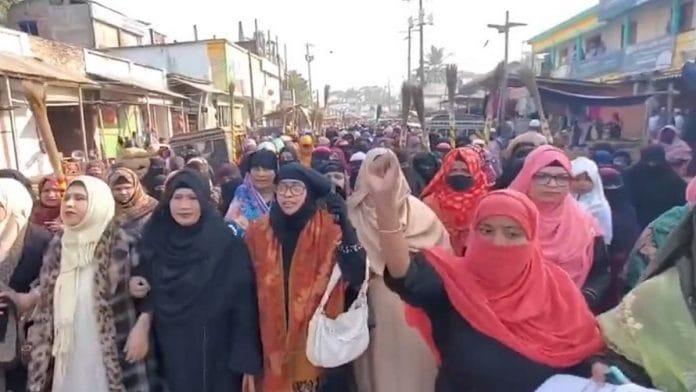



In Bangladesh’s deeply polarised political landscape, the biggest enemy for the Jamaat-e-Islami ahead of the February 12 national election is no longer the Bangladesh Nationalist Party (BNP). It is the women of Bangladesh, who are now up in arms against the Jamaat’s ameer, or party leader, Dr Shafiqur Rahman, for allegedly comparing working women to ‘prostitutes’.
In a country where women outnumber men — of the total population, 8,73,90,000 are women and 8,42,00,000 are men, according to the Population and Housing Census 2022 — the current controversy can cost the Jamaat dear in the upcoming polls.
Though the post was deleted from Rahman’s X account and the Jamaat Ameer claimed his account was hacked, the BNP was quick to make it an election issue, with activists of the party’s women’s wing, the Jatiyatabadi Mahila Dal, marching in Dhaka and displaying broomsticks as a symbol of protest against the ameer’s comment on February 2.
On his part, BNP chairman Tarique Rahman has urged women voters to give a befitting reply to the Jamaat-e-Islami through the ballot for the “insulting and shameful remarks” made against women by the ameer.
But it is the women of Bangladesh who have taken the lead. They have come out on the streets and inside university campuses in large numbers, circulated memes, and appeared on talk shows to protest against the Jamaat chief’s alleged comment. It has led to a national debate on the future of women in a country that is fast sliding towards radicalism.
Sadly, the debate may be happening a bit late in the day and in a new Bangladesh, women remain at risk of being further marginalised.
Also Read: Bangladeshi Hindus have nowhere to go in the election. Choice is between fear and fear
Working women and ameer
Even before the controversial X post, the Jamaat ameer had been criticised for his views on women during an interview with Al Jazeera.
When asked if a woman could become the head of the Jamaat, Shafiqur Rahman said, “It’s not possible. It’s not possible because Allah made everyone in their own entity. Because you will never be able to bear a child.”
He went on to say: “We will never be able to feed our breast to a child. This is God given. And there are some differences between men and women. What Allah made, we cannot change.”
On how many women the Jamaat has nominated for the national election on February 12, the ameer said: “In the parliamentary election, not a single one. But we are preparing.”
When the interviewer pointed out many countries, including Bangladesh, have had women leaders, Shafiqur Rahman said: “Few countries.”
And then came the controversial X post on January 31, when he allegedly posted: “We believe that when women are pushed out of the home in the name of modernity, they are exposed to exploitation, moral decay, and insecurity. It’s nothing but another form of prostitution. Social media vulgarity, workplace harassment, and commodification of women are not signs of progress — they are symptoms of moral collapse.”
Amid the backlash, Rahman said on February 4 that his X account was hacked four days ago to circulate false information. “After my account was hacked, a group allegedly launched online attacks, reportedly chanting ‘tai re nai re’,” he said.
With only a few days left before the polls, it has become a war of words between supporters of the Jamaat and the BNP over whether the ameer’s X account was indeed hacked or if Rahman posted the tweet himself.
BNP’s Tarique Rahman has emphatically said the ameer’s account was not hacked, citing expert opinions that such an account cannot be compromised in the manner claimed. “They have only one identity, they are liars,” Tarique Rahman said at an election rally in Khulna city.
The internet, meanwhile, has exploded with memes.
Also Read: Bangladesh’s February elections are in the Jamaat’s hands. They want a ‘unity government’
Can humour cure misogyny?
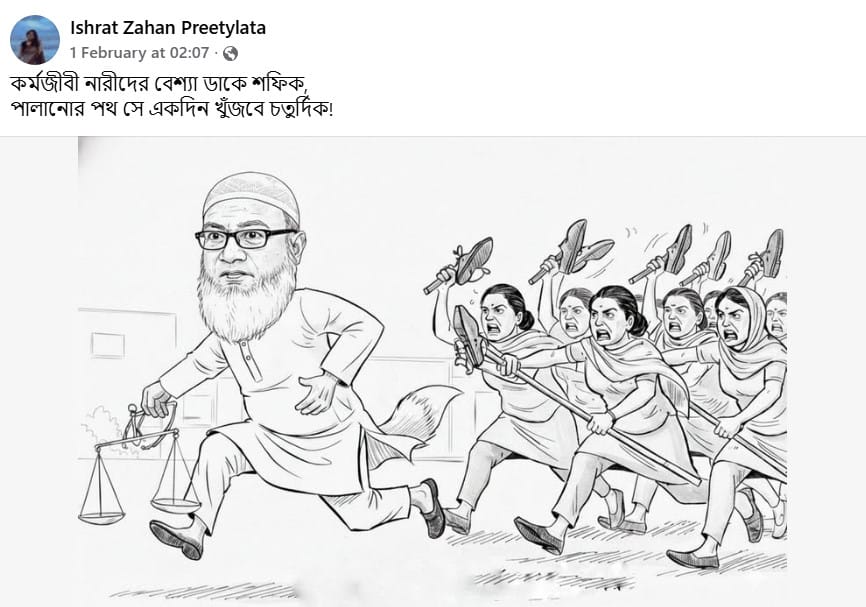
Sharing a now viral cartoon of the Jamaat ameer running for cover as hordes of angry women try to hit him with chappals, visual artist Ishrat Zahan Preetylata wrote on Facebook that Shafiqur Rahman would have no place to hide.
Bangladeshi model and TV presenter Maria Kispotta shared a picture of herself in a swimsuit on Facebook and wrote: “If Jamaat comes in power I won’t be able to post swimsuit pictures anymore so, I thought I would post all the bikini swimwear and lingerie pictures I have of mine before they take over everything.”
Former National Citizen Party leader Neela Israfil put out a vlog saying the Jamaat ameer suffers from “insecure masculinity disorder” and is a “mental patient”. She said the ameer does not want women in Parliament so that their own chances of being in power become stronger.
Beyond cartoons, protest posts, and political blame games lies a deeper question: is the Jamaat ameer’s alleged post an indication of the shape of things to come for Bangladeshi women?
Bangladesh has been grappling with a disturbing surge in sexual violence since the fall of the Sheikh Hasina regime in August 2024. The spike has ignited nationwide protests and student-led campus demonstrations, with many calling out the interim government’s inaction and police failure. Rights groups have described the situation as a “pandemic-level crisis”.
This past July, Dr Shamsad Mortuza, professor of English at the University of Dhaka, wrote in the Daily Star that when the language of revolution echoes the act of assault, one needs to be wary.
“What exactly are we revolting against when we characterise every ideological adversary in terms of sexual violence? We are in danger of replacing and articulating one kind of tyranny with another,” Mortuza warned.
Sexual violence apart, moral policing by vigilante Islamist groups has stopped several women’s football matches, making international headlines.
“If women want to play football, they should cover their entire body, and they can play only in front of female spectators. Men cannot watch them play,” Maulana Ashraf Ali, leader of the Islami Andolan Bangladesh in the Taraganj area of Rangpur, told the BBC.
Not just on playgrounds, but even in corporate spaces, women have come under increasing restrictions. In July 2025, Bangladesh Bank issued an advisory to female employees instructing them to wear sarees and salwar-kameez with scarves. The guideline also restricted short-sleeved or short-length dresses and leggings. The bank said failure to comply would invite disciplinary action, although it later withdrew these guidelines for ‘modest’ dressing after online criticism.
“Religious minorities, artistes, journalists, and women in particular have come under the Islamist radar since the fall of the Hasina regime,” a Bangladeshi actress who has also worked in Bengali cinema in West Bengal told ThePrint on condition of anonymity. “Hasina had many flaws, but she understood the need to push more and more women into work spaces. It is the opposite now.”
For Bangladeshi journalist Sahidul Hasan Khokon, the issue is no longer just political. He told ThePrint that religious conservatism has been allowed to take deep roots in Bangladeshi society, and women are the worst sufferers.
“Bangladesh was known to the world as a Muslim-majority country that was moderate, secular, and had been led by not one but two women prime ministers. It is now vying to become like Afghanistan, where religious preachers dictate our lives,” he said.
The Jamaat ameer’s alleged X post is thus symptomatic of a larger malaise. An election result may not necessarily fix the problem.
Deep Halder is an author and a contributing editor at ThePrint. He tweets @deepscribble. Views are personal.
(Edited by Asavari Singh)