









India’s Defence Acquisition Procedure is no longer in its first act. A draft DAP 2026 revision, released during the Ministry of Defence’s declared Year of Reforms, is now open for stakeholder comment and is intended to replace DAP 2020 once approved, with implementation aligned to the FY 26-27 capital procurement cycle. It promises faster acquisition, closer alignment with Atmanirbhar Bharat, and a shift in emphasis from “Made in India” to owning design and intellectual property in India.
DAP 2020 marked a move away from routine nomination-driven procurement by creating competitive categories, prioritising indigenous design, and formalising development support through defined Make I/II/III frameworks. These categories govern how indigenous design, development and prototyping are funded and executed. Since its introduction, the framework has been amended and refined.
The draft DAP 2026 sharpens definitions, strengthens indigenous design and content requirements, and codifies development pathways with greater precision, combining what amounts to a second‑generation acquisition regime.
The acquisition framework, as amended and refined over the past few years, is already in operation. Naval construction, artillery, missile, and radar programmes have progressed through the new categories and approval pathways. Major combat-air platforms, however, have historically still been within a narrower institutional circle, with Hindustan Aeronautics Limited (HAL) serving as the default integrator.
Although the draft DAP 2026 proposes that aerospace systems be governed under a separate, dedicated procedure, the logic embedded in DAP 2020 already provides the governing architecture for complex indigenous development.
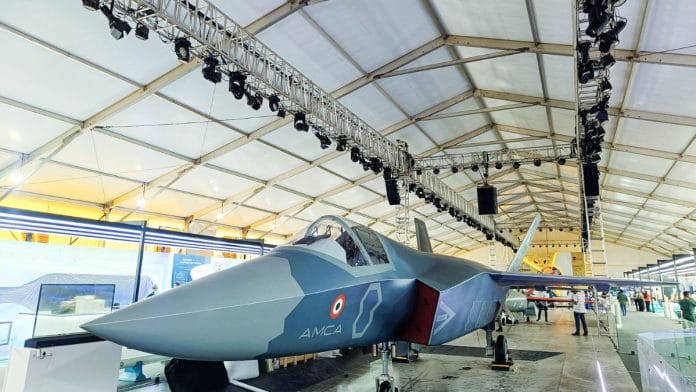
The Advanced Medium Combat Aircraft (AMCA) is the first Indian fighter development programme where that competitive and developmental logic is being applied in a genuinely comprehensive way. Indigenous design is explicitly prioritised, and development has been structured under the Make-I (government-funded) provisions. Private industry has been given a clearer institutional route into a domain long dominated by public-sector nomination.
AMCA therefore demonstrates that the framework is not merely theoretical; it is already being operationalised.
The 2026 draft does not overturn the 2020 architecture. It hardens it. Definitions are sharper. Indigenous design criteria are more rigorous. Intellectual control and ecosystem discipline are more clearly codified. It is, in effect, a reform of the reform.
AMCA is therefore not simply another programme. It is the first fifth-generation combat aircraft that illustrates the hardened logic of DAP 2020 and its 2026 refinement.
Also read: India’s defence acquisition framework is designed to prevent wrongdoing, not deliver outcomes
Continuity with sharper edges
The planning spine remains familiar. Long-Term Capability Plans flow into Annual Acquisition Plans. Projects begin with “Acceptance of Necessity”, where the state formally decides that a capability is required, and goes ahead through technical evaluations, field trials, and commercial negotiations before contract approval.
The structure endures. What has changed is not the skeleton but the muscle.
The definition of an Indian vendor is being more tightly linked to Indian ownership and control. Indigenous design is no longer loosely invoked but explicitly tied to ownership of design artefacts, source material, and upgrade rights. Indigenous content thresholds are reinforced through stricter certification and audit-style verification. Strategic partnership models are being reframed with clearer expectations around ownership and ecosystem depth. Make I/II/III programmes are structured with defined funding caps and milestone-linked development sequencing that broadly correspond to stages of technology readiness.
By way of illustration: If AMCA’s flight-control software is to qualify as an Indigenous Design, India must own not only the compiled code but the underlying source code, the development environment, and the right to modify it. If control laws must later be rewritten to integrate a new sensor or weapon, that authority must reside domestically. Similarly, an aero-engine assembled in India around a foreign-owned core would not meet the Indigenous Design test unless ownership of that core is fully transferred. Indigenous Content requires real manufacturing depth, not merely final assembly.
The framework now provides sharper tools and fewer ambiguities. Whether those tools are fully used is the central question.
From nomination to competitive integration
For decades, major combat aircraft production followed an implicit pattern. Designs developed in state laboratories were handed out, largely by convention, to a designated public-sector manufacturer. Concentration promised coherence. Sovereignty was equated with state control.
That model delivered capability. It also produced bottlenecks.
AMCA reflects a deliberate departure. The state retains formal design authority through the Aeronautical Development Agency (ADA), but the industrial integrator is to be selected competitively. Firms have been screened at the Expression of Interest (EoI) stage on financial strength, capacity, and organisational readiness. Media reports indicate that private-sector consortia are prominent among those shortlisted, and HAL has been excluded.
This is not cosmetic. Integration authority for a flagship aerospace programme is no longer assumed. It must be earned.
The 2026 draft reinforces this shift. Vendor registration, categorisation matrices and Indigenous Design tests allow integrator selection to be tied not merely to price and capacity, but also to demonstrable design ownership and ecosystem depth.
If AMCA were to drift back toward nomination, it would do so in visible tension with the framework itself. The Naval Utility Helicopter experience under the earlier Strategic Partnership model showed that competitive routes can be reopened in favour of a public-sector integrator. The revised framework does not make such drift impossible. It makes it harder to justify quietly.
Against that backdrop, the issue is not only who integrates AMCA, but how design authority itself is organised. Vesting formal authority in a single agency, i.e., ADA, brings clarity and accountability, and DAP 2026 strengthens that position through clearer definitions of Indigenous Design and more structured development pathways.
But centralisation carries its own risks. When configuration control, systems integration expertise and decision-making bandwidth are concentrated too narrowly, momentum can slow precisely when pressure builds. The framework may secure ownership; it does not automatically create resilience.
In aerospace, resilience comes from distributed depth. Airworthiness, for instance, is overseen by a single authority such as CEMILAC but executed through multiple regional centres. Design governance works the same way. Multiple certified design teams, independent technical review layers, specialised laboratories and, where necessary, carefully scoped international expertise can strengthen a programme without diluting domestic control.
The objective is not to weaken sovereignty. It is to ensure that no single institution becomes a bottleneck in a project of national consequence.
Acquisition versus development
The central distinction in aerospace is between acquisition and development.
Routine acquisition involves known designs and predictable risks. Development involves discovery. It exposes integration conflicts, reveals software bottlenecks, surfaces material limits and compels redesign. Prototypes are not early production units. They are instruments of learning.
DAP 2020 acknowledged this by strengthening the Make in India category to support early-stage development. The 2026 draft codifies it further. Technology Readiness Levels are specified. The feasibility and project definition stages are sequenced. The draft further structures development pathways around TRLs and sequenced stages, and it gives more explicit space for staged or spiral capability build-up, with commercial evaluation de-emphasised in early technical validation phases.
The architecture now clearly recognises that development is different.
For AMCA, this matters. If the final choice among technically qualified bidders were to default purely to lowest-cost logic, the framework would not compel that outcome. Multi-factor commercial evaluation incorporating Indigenous Design and technology absorption is explicitly permitted. Price need not stand alone.
If cost becomes decisive in isolation, it will reflect governance choice, not procedural limitation.
Also read: India’s defence needs financial institutions. Great powers build credit, not just arsenals
Reform through leverage
Public debate often focuses on the final commercial stage. Reform power lies earlier.
Acceptance of Necessity is where operational requirements are framed. In plain terms, this is where the armed forces define what the system must do: Range, survivability, payload, integration compatibility and growth margin. It is also where categorisation is justified using technology readiness, manufacturing readiness and indigenous design deliverability.
At this stage, evaluation models, Indigenous Design credit and risk-sharing structures can be embedded. Once a Request for Proposal (RFP) is issued and bids are opened, flexibility narrows considerably.
The revised framework makes this pre-proposal leverage more explicit. If AMCA is to reflect reform intent, discipline is unavoidable.
Design ownership and sovereignty
Building something at home does not automatically make it sovereign. The real question is who controls the design logic over time.
Under the revised framework, Indigenous Design requires ownership of drawings, source code, development environments and upgrade rights. A licence to use is not the same as the right to modify or export.
For a fifth-generation aircraft, this is decisive. Mission software governs sensor fusion. Electronic warfare libraries shape survivability. Flight-control laws determine behaviour at the edge of the envelope. If those layers are not owned, the aircraft’s evolution is shaped elsewhere.
Indigenous Content pulls manufacturing depth inward, encouraging the production of structures, harnesses, and avionics modules rather than relying on imported black boxes. AMCA is perhaps the clearest opportunity so far to see whether these principles are applied with seriousness in aerospace.
At the same time, neither Indigenous Design nor Indigenous Content makes India immune to global supply chains. Engines, semiconductors, specialised materials, and advanced design tools remain tied to international networks influenced by export controls and geopolitical strain. The framework can expose those dependencies. It cannot eliminate them.
Also read: Rafale dilemma sums up India’s defence paradox—security vs self-reliance
Governance beyond cost
The revised framework strengthens milestone-linked funding and configuration control. It makes staged funding and configuration control more explicit and auditable and tightens the discipline around specification changes and planned upgrades. Spiral upgrades reduce arbitrary requirement drift.
These are meaningful improvements.
One challenge remains cultural. Aerospace development often involves learning-driven delays that strengthen long-term reliability. Bank Guarantees and Liquidated Damages protect the exchequer from contractor default; they are familiar tools in a compliance-oriented system. But development risk is different from compliance risk, and the two should not be conflated. These instruments cannot substitute for sovereign risk management in complex research and development. Not every delay reflects failure. Some are the costs of experimentation and innovation and recognising that distinction requires institutional maturity.
The innovation flank
Large programmes do not mature in isolation. They depend on smaller innovation streams.
The revised framework mainstreams mechanisms such as iDEX and the Technology Development Fund, alongside low-cost acquisition routes. These pathways can mature specialised materials, artificial intelligence applications, and electronic modules before integrating them into a complex platform such as AMCA.
Used intelligently, they create an innovation ecosystem that supports the core aircraft without destabilising it.
Fiscal continuity and credibility
Procedure cannot substitute for fiscal stability.
The framework strengthens linkages between long-term plans and annual acquisition schedules. It enhances visibility. But prototype approval is only the beginning. Series production will demand continuity over decades.
If capital commitments fluctuate under short-term pressure, industrial logic will weaken regardless of procedural strength.
As argued earlier in ThePrint, in a piece on the need for a dedicated defence financial architecture, and another examining why AMCA requires structured competition beyond a single integrator, reform must extend beyond rules. It requires credible long-horizon capital funding instruments aligned with industrial scale. Such institutions can act as stabilising checks, pacing ambition and ensuring continuity when pressures mount.
The revised framework at least makes discontinuity harder to obscure. Accountability becomes clearer. Industry will notice.
The institutional test
The deeper question is institutional. Has India moved from episodic acquisition to sustained capability building?
DAP 2020 marked a conceptual shift. The 2026 revision hardens it. Indigenous Design, Indigenous Content, spiral development and civil-military integration now frame the system.
AMCA is the first combat-air programme where these strands converge in practice.
If it delivers genuine architectural control, disciplined competition and stable funding, it will validate the reform path. If it reverts to assembly without ownership, cost-dominant selection or fragmented financing, it will show that procedure alone cannot overcome institutional habit.
The tools are sharper. The space for ambiguity has narrowed. Yet tools are not capabilities. Research depth, industrial scale, and financial instruments must still catch up.
Airpower itself is evolving. Unmanned systems, artificial intelligence, and distributed networks will reshape the battlespace. But the underlying test remains constant. Can the state align technology, finance, industry, and military requirements over decades? Can it retain design control while absorbing innovation? Can it carry a complex programme forward without resetting each cycle?
AMCA sits at that intersection. It is not only about fielding a fifth-generation aircraft. It is about demonstrating institutional steadiness in managing high-end aerospace capability.
It will not resolve the Air Force’s immediate squadron gap, nor is it meant to. AMCA is a long-term investment and, in many ways, a national laboratory for mastering advanced aerospace integration while catalysing a broader industrial base. It may not satisfy short-term arithmetic. It could, however, prove central to building durable strength over time.
The author is a former Flag Officer Naval Aviation, Chief of Staff at the integrated HQ Andaman and Nicobar Command, and Chief Instructor (Navy) at DSSC Wellington. He tweets @sudhirpillai__Views are personal.
(Edited by Theres Sudeep)