





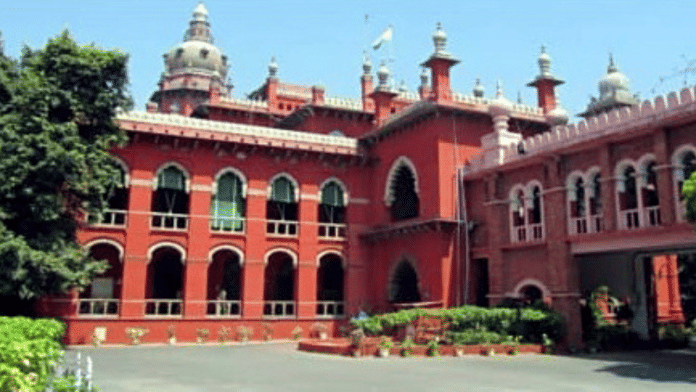



New Delhi: Can a High Court judge who despite a transfer order doesn’t join the new posting can participate in the collegium meetings of parent HC?
This legal question arose before the Madras High Court where a lawyer questioned the collegium’s recommendation to elevate 13 lawyers to the Bench. According to the petitioner, the collegium did not seek views of Justice Nisha Banu, the second senior most judge after Chief Justice Manindra Mohan Shrivastava and also a member of the collegium.
Though Justice Banu was transferred to the Kerala High Court in October, she had not joined there until 19 December. She took oath only after the President, after consulting Chief Justice of India (CJI) Surya Kant, fixed a deadline for her to join the Kerala HC. Even as Justice Banu continued to be in the Madras HC, she remained on leave.
The petitioner, A. Prem Kumar, a lawyer based in Tiruvannamalai district, pointed out that out of the total working strength of 75 judges, the Madras HC has been functioning with only 55 judges. In December alone, there were 20 vacancies for the posts of judges.
Underlining the importance of an independent judiciary, which remains free from pressure, influence or control by others, the plea said that the collegium must ensure that every recommendation reflects constitutional morality, rather than political or personal interference.
Stating that the Madras HC collegium is itself “fundamentally flawed”, the plea argued that the Chief Justice should have taken into consideration the fact that being the second senior most judge of the Madras HC, Justice Banu had not joined the service despite her transfer order until 19 December.
The Madras HC collegium, consisting of CJ Shrivastava, recommended the names of 13 lawyers as judges, in the absence of Justice Banu’s involvement, despite her not having assumed charge of her office, it contended.
“Therefore, the recommendations made by not including the second senior most judge of the Madras High Court is totally erroneous and contrary to the procedure established by law,” the plea said.
It relied on a 1997 ruling of the Kerala HC, where it was held that until the judge enters the office of the transferee court, he/she is considered a member of the original court.
Pointing out that judicial appointments to a superior court is not just the prerogative of an individual but instead a “collaborative and participatory process” involving all collegium members, the plea says that the underlying principle is that the process must reflect a collective wisdom, drawn from various perspectives.
The plea also said that Justice Banu, who was at the time holding the position of the Madras HC judge, did not participate or consult with the recommendation of the names.
Further, the plea pointed out that all candidates recommended for judgeship by the HC collegium were “backed by strong political interference”, while adding that all of the recommendees were from the Centre or the former ruling party of Tamil Nadu government.
For instance, E. Manoharan was a former government additional pleader during the previous government’s tenure, while another candidate, N. Ramesh, was the standing counsel for Enforcement Directorate.
Arguing that the entire selection process is strongly backed by the ruling party in Delhi, the plea said that the Madras HC collegium’s recent recommendations are persons “who have strong political affiliations with the ruling party”.
This, it argued, could lead to an outcome where fairness is compromised in the selection process and overshadowed by favoritism and bias, which in turn affects the independence and credibility of the judiciary.
Kumar also requested for a direction to the government and the court registrar that barred them from accepting the recommendations based on the minutes of meeting of the Madras HC collegium.
(Edited by Tony Rai)