





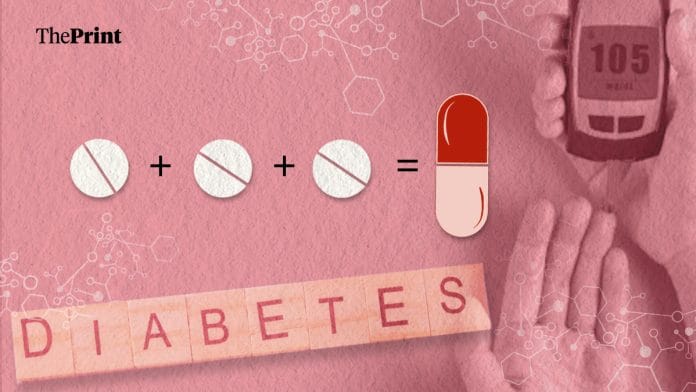



New Delhi: Can three individually approved diabetes medicines be combined as a single pill and sold as “convenient” treatment? The Delhi High Court says that the resultant pill has to be treated as a “new drug” that must independently prove it would not harm patients.
Restoring the Centre’s April 2025 ban on certain type 2 diabetes drugs, the high court ruled on 9 January that the government is entitled to step in at the stage of “likely risk”, without waiting for patients to suffer actual injury, hospitalisation, or death.
In a second round of litigation, a Division Bench of Justices Anil Kshetarpal and Harish Vaidyanathan Shankar set aside a 2019 single-judge order that quashed the ban and allowed sale of the banned drug combinations.
The division bench ruled that judges are “institutionally ill-equipped” to decide on appropriate dosage of medicines or scientific weight of research papers. It added that since an expert panel (Drugs Technical Advisory Board Sub-Committee) had already analysed and concluded the banned combination drugs were risky, the single-judge bench should not have substituted “expert assessment” with its own “judicial reasoning”.
The single-judge bench, it said, had exceeded the “permissible limits of judicial review”.
By analysing scientific data without a scientific expert (independently), the single judge had acted as an “appeal” over an expert body—challenging the expert’s decision. This is prohibited under constitutional law.
Also Read: Big pharma pivoting to more lucrative obesity segment, Indian drugmakers eye insulin market
What are these drugs? Why were they banned?
The case concerns fixed dose combinations (FDCs)—a formulation containing two or more active pharmaceutical ingredients (APIs) in a single pill.
While they are often marketed for the “convenience” of patients who would otherwise have to take multiple tablets, the division bench of the Delhi HC noted that health experts have long raised alarms about “irrational” combinations that lack scientific justification or pose hidden risks.
Dr Anoop Misra, chairman of Fortis C-DOC Hospital for Diabetes and Allied Sciences said three drug combinations are not “rational”.
He explained how each drug has different characteristics and adverse effects profile, and should ideally be given separately to see if it causes any side effects. Doses of each can be given separately, according to blood sugar levels. Further, he added, increasing three drug combinations automatically increases the dose of all three, which could be dangerous. “The only positive point is convenience”, he said, noting that he never uses FDCs.
All three for blood sugar control act through different mechanisms, and the excess of any of them can cause side effects, Dr Misra said.
The specific FDCs under challenge combined three anti-diabetes drugs namely Glimepiride, Pioglitazone and Metformin.
On September 7, 2018, the central government issued two notifications banning these triple-drug combinations.
2016: Centre’s ban and SC’s directions
The issue goes back to 2016, when the central government first banned 344 FDCs following recommendations by the Kokate Committee, which found many of them to be “irrational”.
Pharmaceutical companies challenged the ban in various high courts, and the matter eventually reached the Supreme Court.
In Union of India v. Pfizer Limited (2017), the Supreme Court ordered a fresh, detailed review. It directed the Drugs Technical Advisory Board (DTAB) to form a sub-committee and examine each drug on three specific parameters: Is it likely to involve risk to humans? Does it lack therapeutic value? And does it contain ingredients without therapeutic justification?
2018: Expert committee flags safety risks
Following the Supreme Court’s order, a DTAB sub-committee heard submissions from drug manufacturers as well as public health groups such as the All India Drug Action Network (AIDAN).
After examining 395 scientific publications, the committee recommended a complete ban on the triple-drug combinations.
Its conclusions were based on two key concerns. The first was the risk of hypoglycaemia. The use of all three drugs together could dangerously lower blood sugar levels, the committee said.
Secondly, there was no combination-specific safety data since manufacturers relied on the safety of individual drugs but failed to produce clinical data showing that the three-drug combination was safe in the form of a single pill. The expert committee noted that such combinations were not accepted by international drug regulators.
2019: Single-judge bench sets aside ban
In February 2019, a single-judge bench of the Delhi High Court quashed the government notifications, calling the ban “arbitrary”.
The judge reasoned that all three drugs were individually approved and recommended in standard diabetes treatment guidelines.
Noting that the risk of over- or under-prescription exists with all FDCs and cannot alone justify a ban, the judge said taking one pill instead of three offered significant convenience to patients.
The matter was sent back to the DTAB for reconsideration, effectively allowing the drugs to remain on the market in the meantime.
2026: Division bench overturns order
Meanwhile, the central government and AIDAN challenged the single-judge bench ruling before a division bench.
In its detailed 46-page judgment, the division bench firmly rejected the reasoning of the single-judge bench.
The court held that the single-judge bench’s approach was “fundamentally flawed”.
“It cannot be presumed, as a matter of law or science, that individual drug components would behave, interact, or manifest identical safety profiles when administered in combination… Such a presumption is antithetical to the regulatory framework,” the division bench noted.
Under existing law, an FDC is treated as a “new drug”, and manufacturers have a mandatory statutory obligation to independently establish its safety and efficacy—an obligation they failed to meet.
Interpreting Section 26A of the Drugs and Cosmetics Act, 1940, the division bench held that the government does not need to wait for deaths or hospitalisations before acting. The division bench said, “The statutory standard prescribed under Section 26A of the Drugs Act does not require the establishment of actual or proven harm to human beings…
“The focus of the inquiry, therefore, is not on demonstrable injury but on the potential or foreseeable risk arising from continued use of the drug.”
The division bench dismissed the “convenience” argument that had swayed the single-judge bench. It ruled that while taking one pill is easier for a patient, “convenience cannot supplant considerations of safety”.
Ultimately, the high court allowed the appeal by the government and AIDAN, setting aside the 2019 ruling and restoring prohibition on the manufacture, sale, and distribution of these triple-drug combinations with immediate effect.
(Edited by Amrtansh Arora)
Well summarised