





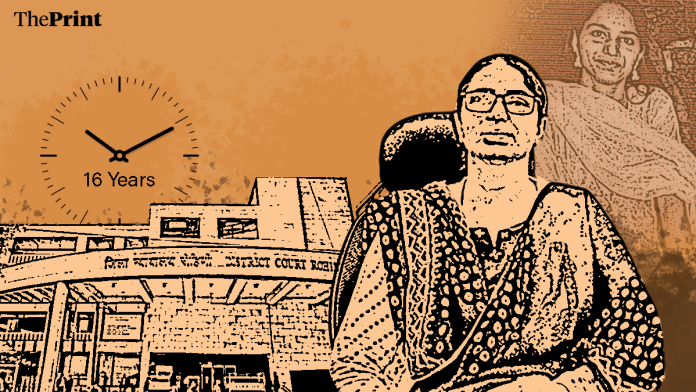



New Delhi: In the last sixteen years, while those accused of orchestrating an acid attack in Panipat went on to get married and move on with their lives, Shaheen Malik had to rebuild hers—in courtrooms and hospital wards, between surgeries, statements and appeals.
“I don’t think people accept the victim. They accept the culprits. They (accused) are free. Settled. And moving ahead… while I am still proving what was done to me,” Malik told ThePrint.
Malik was 26 years old, when she was targeted in an acid attack outside her office in Panipat, Haryana. The years after were marked by a trial that involved a delayed investigation, threats and repeated judicial interventions.
Now 42, Malik hopes her ordeal will come to a close. The court of Additional Sessions Judge Jagmohan Singh in Delhi is expected to pronounce its verdict in Malik’s case on 24 December.
A shift for independence
Malik was raised by a “conservative” Delhi-based family, she said, like all the others that “don’t want girls to go out of the house or get jobs”. Still, she managed to move to Panipat in 2009 after getting a job as a student counsellor at a university there. She also got enrolled in an MBA course—a step she’d long wanted to pursue.
She was working and studying simultaneously when her boss, she said, became “intrusive” and “possessive” about her. He would threaten and assault her, she said.
Malik said everyone else at the office knew of her boss’s actions, including his wife. The couple would often fight about her, she said.
Because she still had to get her MBA degree, Malik chose not to leave Panipat. After feeling trapped for months, she finally put in her papers on 1 November, 2009. Her notice period was to end on 1 December.
Also Read: Forced acid ingestion survivors’ fight for recognition as PwD before SC. ‘How do I show my insides?’
‘I didn’t know it was acid’
Eleven days before her last working day at the Panipat university, on 19 November, Malik left her office to go to her rented house. She observed a youngster standing beside her, waiting to cross the road–his face partially covered with a handkerchief–but didn’t make much of it.
Moments later, he poured a liquid on her. “I had never worked with acid in my life… Within seconds, the burning began,” she said.
Malik felt as if her skin was on fire. She doesn’t believe she can feel that way again. “I get goosebumps thinking of how I had screamed then,” she said.
She managed to get back to her office, where someone said it looked like an acid attack. Unable to open her eyes, her boss, and two others from work drove her to a local hospital. There, her clothes were cut off before treatment could begin, she recalled.
Malik had to ask a stranger for help to call her family and inform them about the attack. Soon after, she was shifted to a Rohtak hospital where her family arrived. Then she was taken to a Delhi hospital. Admission was delayed because it was a medico-legal case and the hospital asked for Rs 10 lakh. Somehow, her “middle-class family managed to get her admitted”, she said.
The next day, Haryana Police officers came to record her statement while she was in the ICU. At the time, she couldn’t imagine who would harbour such enmity towards her, except her boss and his wife. Perhaps in shock and still unable to see, she told police someone from her office had done this and she could identify them.
Police wrote in the FIR that Malik could identify the culprits, but did not name any suspects.
No one contacted her for another month, and on 1 January, 2010, the day she was supposed to be operated on, Malik asked her father to call the police. When officers arrived, she named her boss’s wife, whom–she alleged–was jealous and hostile towards her.
That was the last she heard of her case, until March, when police filed an ‘untraced’ report, effectively “burying her case”, she said.
Malik said she kept calling police, but was always told they were busy with “serious” cases. Four years went by like this. “They say that when all doors are closed, only God’s door is open. In those four years, I endured everything… the strength to live as well,” she said.
Survival & a breakthrough
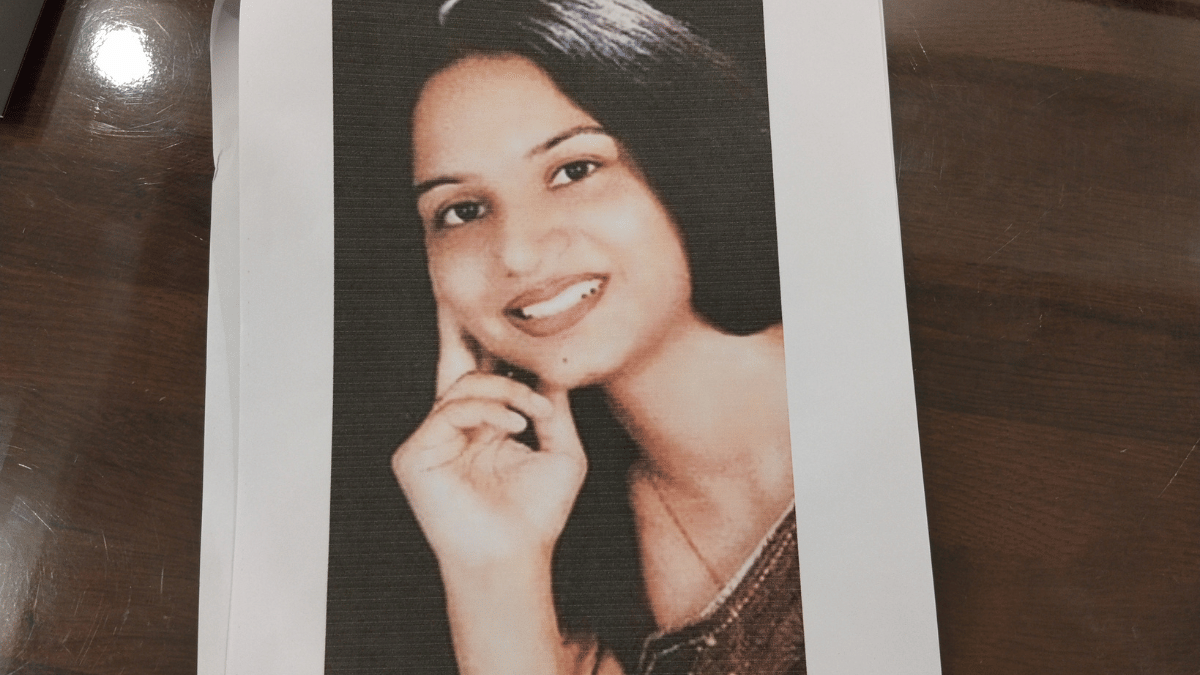
Over the years, Malik was operated on multiple times—18 in all. She couldn’t see for two-and-half years after the attack, till doctors managed to save one eye. The other was too damaged.
Malik survived only by keeping faith.
“I thought I might not get justice in this world. Maybe, I would get it in God’s world,” she said.
“My entire support system was my Allah, in front of whom I cried and sought things. And I kept getting them. So, I’m a strong believer. Especially after the acid attack… because the strength to live a second life came from there only.”
In 2013, while struggling with medical expenses and constantly feeling like a burden on her family, Malik wrote to the Haryana government, seeking compensation as an acid attack survivor.
That letter, Malik said, showed her how the world works “miraculously”.
It reached the hands of Chief Judicial Magistrate Dr Parminder Kaur, who called Malik the next day.
Malik said she thought nothing of the three missed calls from Dr Kaur at first. She had no expectations.
But Dr Kaur wanted to know more about Malik’s case. The judge provided security to Malik to visit her in Haryana.
Malik opened her heart out—for the first time in four years since the attack—sobbing the entire time. Dr Kaur asked Malik if she wanted to reopen the criminal case. She agreed, telling the judge that more than compensation, she wanted perpetrators of the attack to be punished.
According to the charge sheet, Malik’s boss, his wife, and a minor cousin of the main accused were involved in planning the attack. They allegedly paid a student to throw the acid on her.
Dr Kaur called the police and told them to get their things in order in two days. “Post Dr Kaur’s orders, the accused were arrested but they were so influential that they got bail,” Malik said.
Her boss, she said, was in jail for less than 24 hours and his wife got bail in 40 days.
“My lawyer in Haryana was harassed and the lawyer’s family was threatened, after which they decided not to continue, and suggested that I seek a transfer for the case,” Malik said.
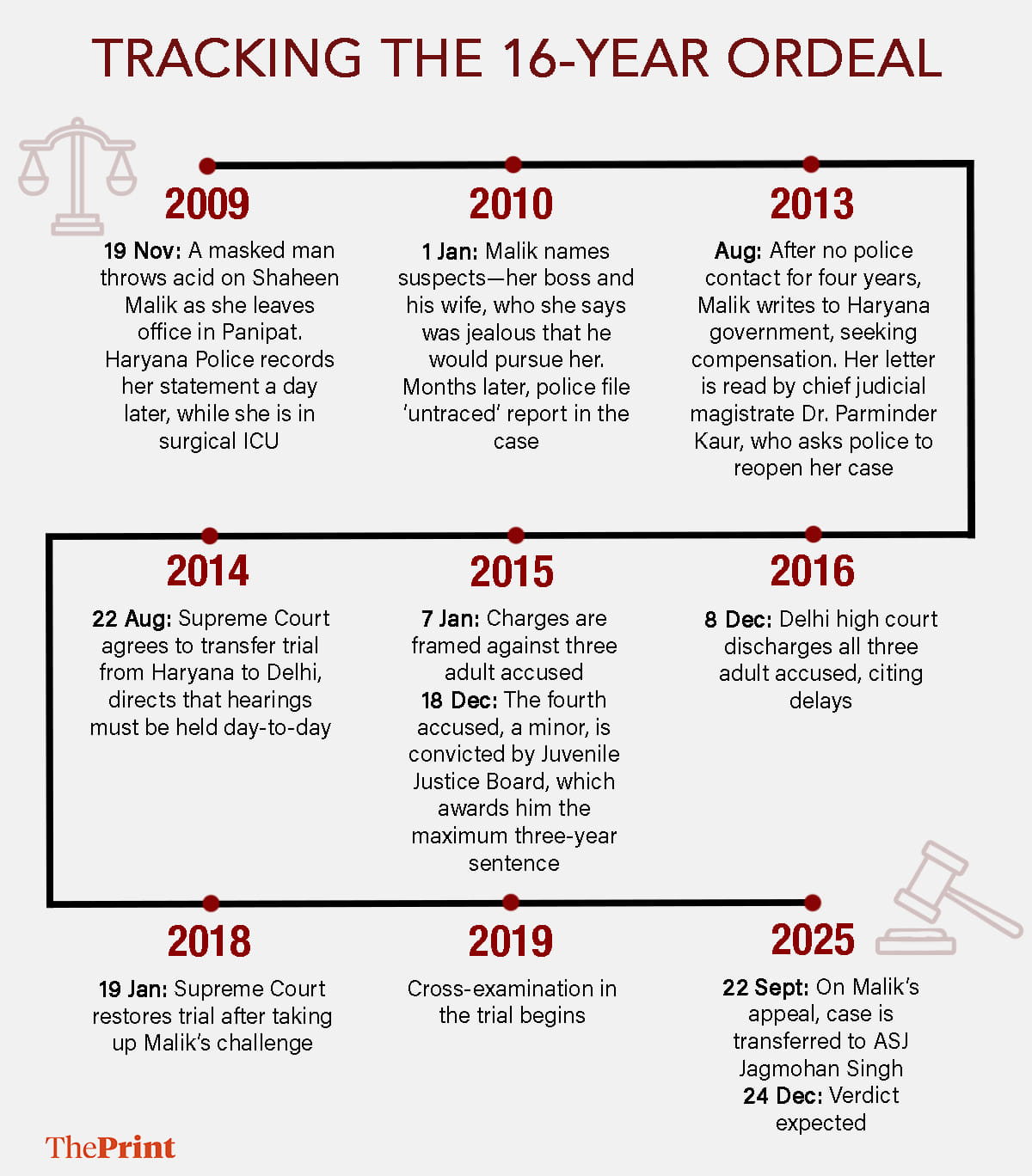
Acting on the advice, Malik approached the Supreme Court, which, in August 2014, allowed the case to be transferred to Rohini Courts in Delhi. The top court also directed that hearings must be conducted on a day-to-day basis, but the order wasn’t followed.
Now in a Delhi court, Malik’s stand that action wasn’t taken against the accused was backed by a report from Dr Kaur too.
The minor cousin of another accused was tried separately by the Juvenile Justice Board and convicted in December 2015. He got the maximum sentence of three years for a juvenile. But the case against the others, Malik said, has dragged on “despite their ties with the minor”.
Appeal and a discharge
Charges against the adult-accused, framed on 7 January, 2015, were under IPC sections for attempt to rape, rape, criminal intimidation, kidnapping for ransom, wrongful confinement, attempt to commit culpable homicide, causing hurt by use of acid, and criminal conspiracy. Malik can recite them by memory – “326, 308, 120B, 506, 376(1) read with 511, 364A and 342”.
The accused challenged these charges before the Delhi High Court, which in late 2016, set them aside, citing a four-year delay in filing a proper complaint.
“This was so shocking for me. I was totally broken,” Malik said.
But she was adamant too. Malik challenged the high court’s decision before the Supreme Court, which in 2018 – almost a decade after the attack – restored trial in the case.
‘How does one remember everything 10 years on?’
Malik’s examination had concluded in 2016, but her cross-examination by the defence began only in 2019. Her questioning is now spilled across 35 pages of court documents.
“How does one remember so many minute details,” Malik asked.
In court, Malik said she saw no signs of remorse among the accused.
Her former boss’s wife, she said, keeps “staring—as if wondering why I was still alive”.
During the trial, allegations of intimidation surfaced again.
In a 2020 testimony, Dr Kaur—by then an additional district judge in Sonipat—told the court a man claiming to be the brother of one of the accused and a member of the Panipat Bar forcibly entered her chamber in 2013. Dr Kaur had to be escorted out of the chamber by her security detail.
In September 2025, Malik moved another transfer plea, asking for a change in the judge because she didn’t feel that the court was “sensitive” enough, and was trivialising her case. Her plea was accepted and the principal district and sessions judge transferred the case to ASJ Jagmohan Singh.
“The court has been comforting for the first time,” Malik said.
Final arguments, ongoing since last year, concluded this month, and the verdict is due on 24 December.
Trial in the case involves in-camera proceedings, which essentially means that the hearings were held behind closed doors to protect sensitive information and dignity of the survivor.
The defence counsel did not respond to multiple requests by ThePrint for comment on the case and the allegations.
16 years on
The minor, convicted for the acid attack, is now married and lives in Panipat. The student allegedly paid to carry out the attack is married too, and settled in Delhi. Malik’s former boss and his wife stay in Panipat. Both of them are employed.
Knowing this, Malik said, makes her wonder what justice is. “Will they face any punishment? How many years? And how many years will I (suffer),” she asked.
On her quest to get justice, there were days that Malik would leave for court around 8am and return home by 10 pm, only to realise that she hadn’t even had a sip of water all day.
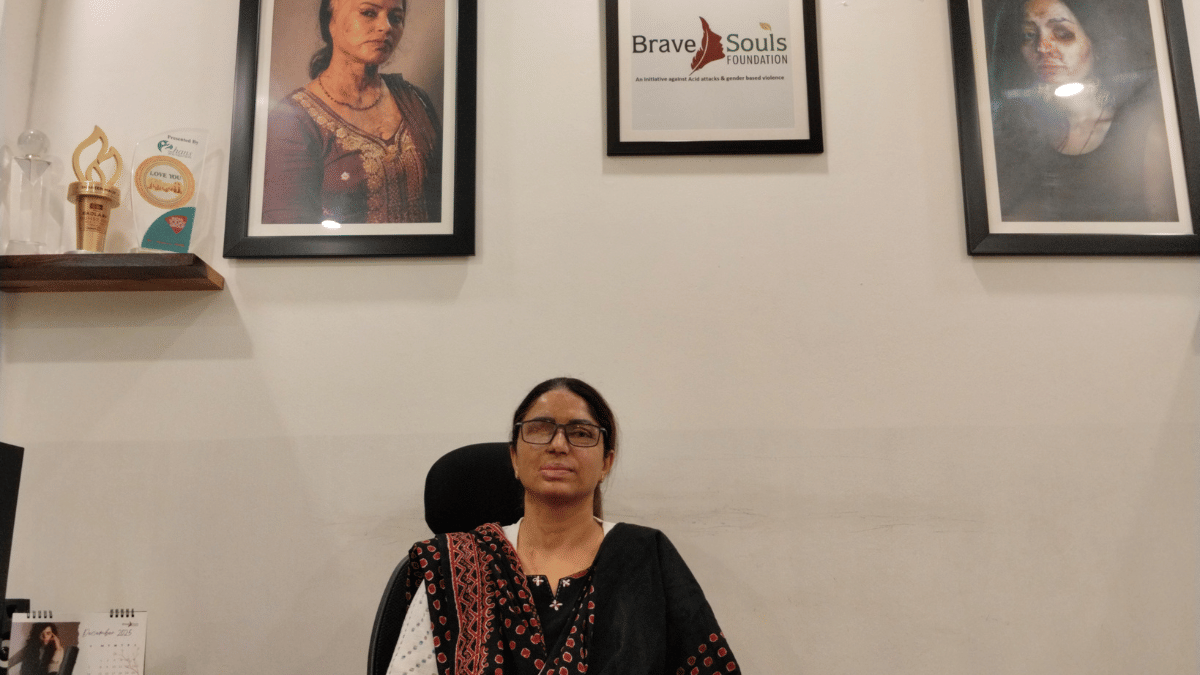
In 2021, Malik found the Brave Souls Foundation to support acid attack survivors. “The main problem I encountered was funding. I had some savings, but after that, people helped me,” she said.
“There are good people in the world who want to help you—like they helped me. The only thing one has to do is to gather the strength to put forward a hand asking for help,” Malik said, adding that she hoped no one else would have to see courts and hospitals like she has had to.
“Today, I can see from one eye and I can fight for other women. Whatever they wanted to do to me, they couldn’t. That itself is my win,” she said.
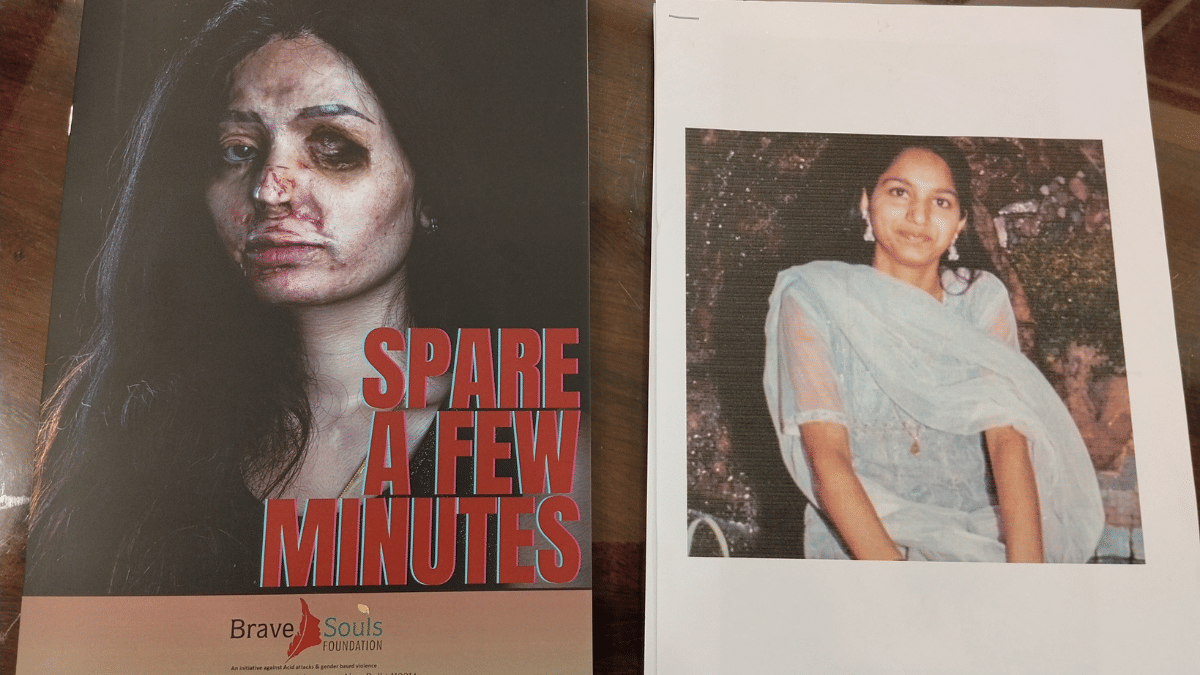
Last week, while hearing a public interest litigation (PIL) on including acid ingestion survivors under the disability law, a Supreme Court bench led by Chief Justice of India Surya Kant referred to Malik’s pending trial and remarked, “What a mockery of the legal system.”
As she waits for the verdict, Malik believes the ruling won’t just be about her.
“If this ends in life imprisonment, it won’t be my win alone. There are thousands of women watching,” she said. These include 300 acid attack survivors associated with Brave Souls Foundation.
who now stay in her foundation’s shelter home, ‘Apna Ghar’, in Delhi’s Jangpura.
“I feel excited to come to work in the morning. If someone gets compensation, I get motivated. I feel as if I have achieved something in life,” she said.
(Edited by Prerna Madan)
Also Read: An acid attack survivor could not blink for bank KYC. Then she moved Supreme Court