








New Delhi: As hustle culture flows past its peak, the romanticisation of always being on-the-go, fuelled solely by coffee and passion, and never saying no to work, have come to be questioned. The conversation has turned to prioritising mental health, to taking a step back from the unending race, and creating boundaries between work and personal life.
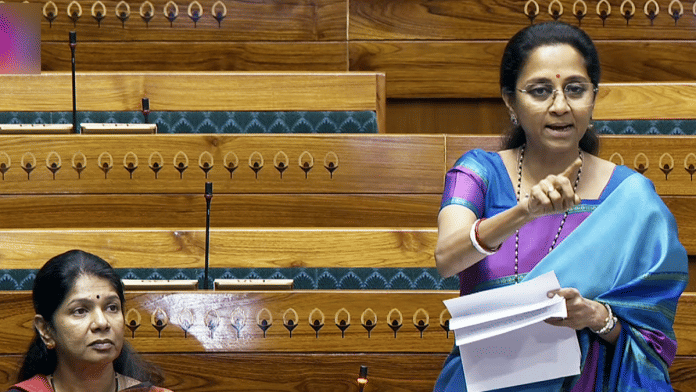
At a time when the chief executives of big companies are advocating longer work hours, NCP-SP MP Supriya Sule Friday tabled in Lok Sabha The Right to Disconnect Bill 2025, a Bill aimed at promoting work-life balance for Indians.
According to the Bill, the ‘right to disconnect’ means that while the employer may contact the employee after work hours, the latter is not obliged to reply. Furthermore, it proposes that a refusal to be available round-the-clock not result in disciplinary action.
The Bill’s ‘Statement of Objects and Reasons’ says: “Studies have found that if an employee is expected to be available round the clock, they tend to exhibit risks of over-work like sleep deprivation, developing stress and being emotionally exhausted. This persistent urge to respond to calls and emails (termed as ‘telepressure’), constant checking of emails throughout the day, and even on weekends and holidays, is reported to have destroyed the work-life balance of employees.”
What’s in this Bill
While the Bill proposes to give employees the right to refuse work-related communications outside work hours without the fear of being penalised, it also takes into account the competitive needs of companies.
To strike a balance, the Bill proposes to provide for out-of-work periods in which companies may contact their employees. Each registered company is required to create Employees’ Welfare Committees, consisting of their own personnel, to facilitate negotiations between the two and help build a consensus.
The Bill also considers the existence of diverse work cultures across various fields, which may necessarily require employees to maintain communication with work outside of working hours.
Thus, it proposes that rules and protocols regarding the Right to Disconnect can be negotiated at the level of individual companies.
It further says that employees should be entitled to overtime pay should they choose to respond to work communications in their off-duty hours.
If companies do not adhere to the provisions of the proposed act, they be liable to pay a penalty at the rate of one per cent of total employees’ remuneration, it adds.
The Bill further makes provision for setting up ‘digital detox centres’ by the state governments to provide counselling to citizens for “reasonable personal use” of digital and communication tools.
To ensure the implementation of its provisions, it seeks to establish an Employees’ Welfare Authority, a collaboration between the Ministry of Electronics and Information Technology, the Ministry of Communications and the Ministry of Labour and Employment.
Right to Disconnect around world
In 2017, France became the first country in the world to formally recognise a right to disconnect. Its law mandates that employers must allow their workers to exercise their right to disconnect outside regular work hours as well as during holidays and periods of rest and illness.
In some places, the employees are even forbidden to connect to work during certain hours of the day.
After France, many countries including Belgium, Argentina, the Philippines, and Australia jumped on the ‘right to disconnect’ bandwagon.
The laws in most of these countries are based on the France model. Australia is the latest country to have adopted the right to disconnect, doing so in 2024.
It is interesting that even in New York, the “city that never sleeps”, a Bill was introduced in 2018 allowing employees the right to disconnect from work communications, though it could not become a law.
Sule has been a vocal advocate of the right to disconnect. She has twice earlier introduced similar bills—once in the 16th Lok Sabha, and then again in the 17th, that is the previous House.
In 2024, she had reacted strongly to the tragic passing of Anna Sebastian Perayil, a 26-year-old chartered accountant who died just four months into her new job allegedly because of work related stress.
“If we are to prevent a repeat of this terrible incident, it is essential that the government not only be far more stringent in the enforcement of our existing labour laws, but also take cognisance of the rapid digitisation of workplaces and introduce measures to protect the wellbeing of our citizens rather than merely condemning the isolated incident and acting as if buck stops at someone else but the Govt,” she wrote on X in September, reacting to the incident.
Niyati Kothiyal is a TPSJ alum, currently interning with ThePrint.
(Edited by Ajeet Tiwari)
Also Read: Sharad Pawar’s NCP to join JPC on bills to sack jailed PM, CMs & ministers in break from Oppn ranks