








By Sakshi Dayal
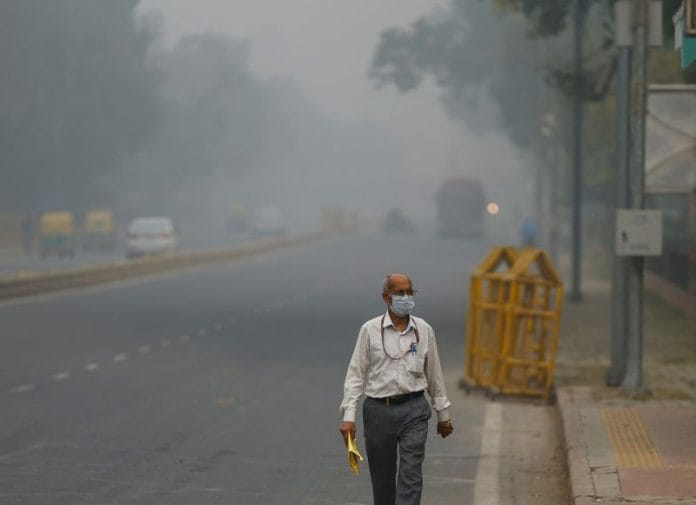
NEW DELHI (Reuters) -The toxic smog that has enveloped India’s capital worsened on Wednesday morning as temperatures and wind speeds dropped, reducing visibility and affecting flights.
Delhi overtook Pakistan’s Lahore as the world’s most polluted city in Swiss group IQAir’s live rankings, but officials from the weather department said meteorological conditions also contributed to the “dense to very dense fog”.
The Indian capital battles severe pollution every winter as cold air traps dust, emissions, and smoke from illegal farm fires.
Authorities have on occasion closed schools, and placed restrictions on private vehicles to curb the problem.
Pakistan’s Punjab province, which shares a border with India, has also banned outdoor activities, closed schools and ordered some shops, markets, and malls to close early.
The India Meteorological Department terms fog that reduces visibility to 50-200 metres (164-657 ft) as “dense” and less than 50 metres as “very dense”.
Low visibility procedures were initiated at the Indira Gandhi International Airport, authorities said, and news agency ANI reported at least eight flights were diverted.
Dense fog was expected to continue over northwest India for the “next 2-3 days”, IMD said.
High humidity, which causes droplet formation, and lower wind speed and temperatures caused the fog and poor visibility, said an IMD official who did not want to be named.
The minimum temperature dropped to 17 degrees Celsius (63 degrees Fahrenheit) on Wednesday from 17.9 C the day before, and visibility was 0-50 metres between 6 a.m. (0030 GMT) and 9.30 a.m. (0400 GMT), officials said.
IQAir, which classifies an air quality index (AQI) score above 301 as “hazardous”, said Delhi scored more than 1,000 on Wednesday morning.
The concentration of PM2.5 – particulate matter measuring 2.5 microns or less in diameter that can be carried into lungs, causing deadly diseases and cardiac issues – was more than 120 times the World Health Organisation’s recommended levels, it said.
India’s pollution authority, however, said the AQI was around 350, below its threshold of 400 for “severe” pollution.
The variation reflects different scales to convert pollutant concentrations into AQI, said climate expert Gufran Beig, Chair Professor at the National Institute of Advanced Studies and founder of SAFAR, the federal government’s air quality monitoring agency.
(Reporting by Sakshi Dayal, Additional reporting by Mubasher Bukhari in Lahore; Editing by Christian Schmollinger, Nicholas Yong and Alex Richardson)
Disclaimer: This report is auto generated from the Reuters news service. ThePrint holds no responsibilty for its content.