





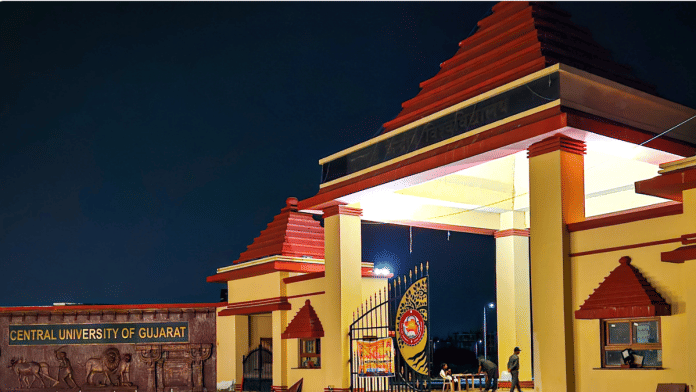



Mumbai: A first-year student at Central University of Gujarat in Vadodara has alleged he and four others were subjected to caste-based abuse, assault and harassment by PhD students at their hostel last month—in charges that the varsity denied and said were linked to a political dispute.
The alleged incident occurred on the night of Republic Day at the Sabarmati Boys’ hostel on the campus of the centrally funded university, located about 17 kilometres from Vadodara city. The controversy has reignited debate over caste discrimination in higher education institutions as authorities and the complainant offer contradictory accounts of what happened.
The complaints come amid renewed debate over caste discrimination on university campuses. The University Grants Commission this year notified guidelines to tighten anti-discrimination norms, but these sparked protests from sections of upper castes and were subsequently put on hold by the Supreme Court.
The framing of the guidelines was prompted by an ongoing case in the Supreme Court filed in 2019 by Abeda Tadvi, mother of Payal Tadvi, and with Rohith Vemula’s mother, after the two students died by suicide due to alleged caste discrimination.
Also Read: New UGC rules on hold: Why Supreme Court believes they are ‘regressive’, can deepen caste divisions
The complaint
Rajkaran Singh, a first-year BA Social Management student from Haryana who belongs to the Od caste—part of the Scheduled Castes as per the Central list—said the confrontation began around 11.30 pm on 26 January over pamphlets lying in the hostel corridor. Singh said the incident escalated into an assault involving dozens of students.
“I was using my phone in my room, when I heard commotion outside my room,” Singh told ThePrint.
“When I stepped out I saw a couple of students asking about some yellow pamphlets that were lying around in the corridor. They began alleging that I had dropped them outside. I told them I was not involved and asked them to check the CCTV footage,” he said.
Singh alleged that around 30-35 people gathered. Two day-scholars who did not live in the hostel entered late at night and began pushing and abusing him and four other students, he said. It continued for several hours, with the harassment lasting until the morning, he alleged.
“They dragged me and my friends, the five of us, towards the bathroom and assaulted us,” Singh said, adding that “the two appeared to be intoxicated”. Liquor is banned in Gujarat.
In an e-mail complaint sent to the dean of student welfare, provost, registrar, vice chancellor and security officer on 28 January, Singh named seven students of the university. He wrote that one of the PhD students used “extreme obscene and dehumanising language, and repeated ‘hum tumhaare muh mein mutenge’ along with threats of expulsion and career destruction”.
Another first-year student, according to Singh’s complaint, said: “You people live in the hostel for free, we pay and feed you,” and referred to Singh as “chhoti jaat” or “neeche jaat” (lower caste).
“A few other students used filthy, obscene and verbal abuses like that I would not even like to repeat,” Singh said. He claimed that security personnel and caretakers present during the incident “only stood and watched, without interfering” and alleged CCTV cameras were not operational.
“I suspect that the CCTV was shut down about an hour before the incident,” he said.
University denies caste angle, cites political rivalry
Professor Atanu Bhattacharya, Vice-Chancellor (in-charge) of Central University of Gujarat, told ThePrint in an official statement that there was “no caste-based discrimination found in the case”.
“The case is related to a mutual dispute between students. As soon as the university administration came to know about it, a meeting of the board of proctors was immediately called. Also, the case was forwarded to the Disciplinary Committee, where it was thoroughly investigated. The case was also referred to the SC/ST cell after a student alleged caste discrimination in the case,” Bhattacharya said.
“In the investigation, it was found that there was no caste discrimination in the incident. Cell Nodal Officer and Proctor Prof. Rajesh Makwana investigated the case thoroughly. He concluded on the basis of statements of all concerned students and CCTV footage that there is no caste-based discrimination in the case,” the V-C said.
Professor Makwana, the university’s proctor and liaison officer for students belonging to Scheduled Castes, Scheduled Tribes and Persons with Disability, characterised the incident as stemming from political rivalry between student groups affiliated with Congress (NSUI) and the BJP (ABVP).
According to Makwana, the trouble began when yellow pamphlets related to an NSUI event were placed outside the rooms of ABVP students in the hostel.
“The ABVP students got angry and stormed towards the NSUI students to ask them who did this and asked for an apology to close the matter. But it quickly escalated with abusive language and physical violence, and some students got hurt. As the proctor of the university, I am in-charge of the proctorial board, which convened the next day to get to the bottom of the story,” Makwana said.
Makwana, who said he belongs to the Scheduled Caste community himself, told ThePrint he had assured Singh of support if any caste discrimination was found.
“I called Rajkaran and told him, look, I belong to the Scheduled Caste myself. So, I told him that if there is a single case of caste discrimination, I will stand with you. There is no doubt about it,” Makwana said.
He added, “But this is not the case. In this matter, with the primary and secondary data collected, my personal opinion and that of our committee is the same. It is not caste-based, but it is a fight between the two in the context of political issues.”
Makwana said he “personally ordered for the CCTV footage the following day and watched the videos of the incident”. He denied that the CCTV cameras were not working, and said he had gone through videos taken by other students on their mobile phones of the clash.
On 29 January, Makwana said he called the students involved and staff members present during the incident and recorded their statements.
The footage and statements were submitted to a disciplinary committee formed two days later, comprising the proctor, provost, heads of departments, security officers, the hostel warden and caretaker. Professor Seema Rawat chairs the committee, which has held meetings over the past two weeks.
“We seem to have reached a conclusion, and the disciplinary committee will disclose the findings and results any day now,” Makwana said.
Dr Gajendra, warden of Sabarmati Hostel, told ThePrint he was not authorised to answer questions about the incident.
Student claims intimidation, demands independent probe
Singh alleged the harassment continued beyond the night of the assault. “They tell us that we can complain anywhere and nothing will happen to them,” he said, alleging that he and his friends received phone calls warning them against pursuing the complaint.
Singh said he and his friends had filed complaints a day after the incident, and gave their statements on 4 February, but no action has been taken since.
“Even after we gave our statements, no action has been taken. The students we complained against are moving around normally. While we have suffered, we are being told to wait for the committee’s report,” he said.
Singh said the campus environment had become hostile. “It has become difficult for us to study here. We feel isolated and insecure,” he said.
He added that the other four students “come from a very backward background with not much support and therefore don’t find it easy to voice themselves”.
The five students involved in the complaint belong to different social categories—reserved, OBC and general—and are enrolled in the Social Management and German departments at the university.
“My parents are supporting me and have asked me to file a police complaint if the university does not deliver justice. We have been asked to wait a couple of more days. If we don’t hear anything till then, I am ready to file a complaint with the police,” Singh said.
He questioned the impartiality of the university’s inquiry. “I find that Professor Makwana is biased and believe that the university is trying to protect those boys like they always do, and those boys end up getting away with it. I demand for a separate independent committee by the central government,” Singh said.
The Od community, to which Singh belongs, traditionally work as masons, carpenters and stone workers. The community is based in Gujarat, Rajasthan, Haryana, Uttar Pradesh and Uttarakhand.
(Edited by Prerna Madan)
Also Read: ‘Why are we having a forum on caste?’ Audience unsettles Dalit writers at Delhi book launch