





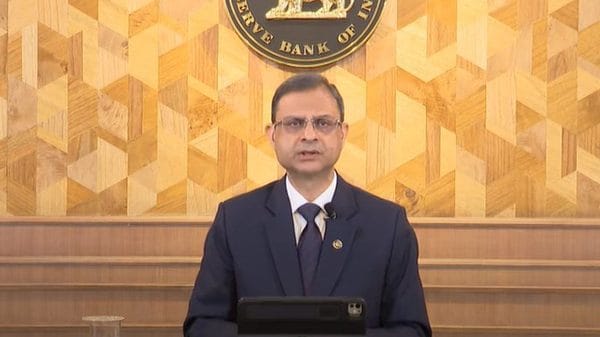



The Reserve Bank of India’s Monetary Policy Committee reduced the repo rate to 5.25 per cent on December 5, marking its first cut after keeping rates unchanged for two consecutive meetings. Governor Sanjay Malhotra said the six-member panel voted unanimously to reduce the benchmark rate from 5.5 per cent while retaining its policy stance at neutral. With the adjustment, the standing deposit facility rate is now 5 per cent. The marginal standing facility rate and the Bank Rate stand at 5.5 per cent.
How has the RBI revised its GDP growth forecast?
The MPC revised its GDP growth projection for the current financial year to 7.3 per cent, up from 6.8 per cent earlier. The central bank also lifted its quarterly estimates, projecting 7 per cent growth for Q3 compared with 6.4 per cent previously, and 6.5 per cent for Q4 versus 6.2 per cent earlier.
Malhotra said the full-year upgrade amounts to “about half a per cent” compared with earlier forecasts. For the next financial year, the RBI projects real GDP growth at 6.7 per cent for Q1 and 6.8 per cent for Q2. The central bank assessed risks to growth as “evenly balanced.” “We approach the new year with hope and vigour to further accelerate growth in the economy,” he said.
RBI GDP projections:
• FY26: 7.3 per cent
The latest revision comes after the economy outperformed the RBI’s own expectations in the second quarter. Against the central bank’s projection of 6.8 per cent growth for July-September period, the Indian economy expanded at 8.2 per cent, the fastest pace in six quarters.
In its October review, the RBI had retained its projection for real GDP growth for 2025-26 at 6.8 per cent, with quarterly estimates of 7.8 per cent for Q1, 7 per cent for Q2, 6.4 percent for Q3, and 6.2 per cent for Q4. It had also projected real GDP growth for Q1 of FY27 at 6.4 per cent.
Why has the RBI cut its inflation forecast sharply?
The RBI expects inflation to be softer than it had projected in October, largely due to a fall in food prices. CPI inflation for the current year is now pegged at 2 per cent, marking a downward revision of about 0.6 percentage points.
Quarterly forecasts show inflation at 0.6 per cent in Q3 and rising to 2.9 per cent in Q4. For Q1 and Q2 of FY27, CPI inflation is projected at 3.9 per cent and 4 per cent, respectively.
Malhotra noted that underlying inflation pressures are lower than headline readings suggest. He pointed out that higher precious metal prices alone contributed roughly 50 basis points to the current inflation figure.
“Rural demand continues to be robust. Urban demand is recovering steadily. Investment activity remains healthy with private investment gaining steam on the back of expansion in non-food bank credit and high capacity utilisation, which is of the order of about 35 per cent,” the RBI governor added.
By special arrangement with Business Standard