








New Delhi: The Kerala High Court has stayed the release of the film The Kerala Story 2: Goes Beyond, after hearing the petition challenging its censor board certification on Thursday. The filmmakers are now going to approach a higher bench of the court against the order.
They are set to file the appeal late Thursday. The producers will be requesting an early release of the detailed order to enable them to challenge it without any delay.
Staying the original scheduled release date of 27 February, the single-judge bench of Justice Bechu Kurian Thomas asked the censor board to re-examine the issue, adding that ‘it didn’t abide by the rules’.
“Dissemination of content which has a tendency to create discord, disturb law and order, and even undermine social harmony cannot come within the gamut of freedom of speech and expression enshrined in Article 19(1)(a) of the Constitution of India,” the Court added.
‘Stay was needed’
After the judgment was rendered, the producer’s counsel presented a ruling, pointing out that the stay cannot be granted when parties are asked to go before the statutory authority. However, the court stated that the movie’s stay was needed, taking into consideration the circumstances of the case.
“Petitioners have pleaded sufficient locus standi and also have sufficient private interest. Matter has been posted as per the roster as well. Notwithstanding the shortage of time, considering the urgency of the matter, though this Court had offered to view the movie to appreciate the allegations vis-à-vis the allegations depicted, the 3rd respondent (producer) evaded the same,” the court said.
Trailer sparked controversy
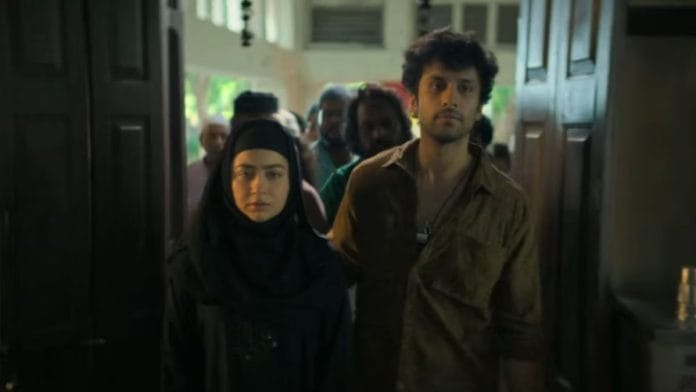
The Kerala Story 2 is directed by Kamakhya Narayan Singh and produced by Vipul Amrutlal Shah. The movie alleges that young Hindu women are being lured into interfaith marriages, are assaulted and are forced to convert to Islam. The film’s trailer sparked controversy after its release on 17 February.
“The verdict is a welcome necessity. As a constitutional court, exercising the power of judicial review, it has the duty to ensure that the statutory requirement under section 5B of the Cinematograph Act, 1952., that mandates that the contents of the film do not militate against public order, a ground that is also a restriction to freedom of speech and expression under Article 19(2) of the Constitution of India,” said Abhilash M.R, an advocate at the Supreme Court.
The prequel of the film, Kerala Story, faced a similar backlash, and many litigations were filed in courts back then, too.
The court wanted to watch the movie before deciding on the case, but the producer was not keen, and the counsel submitted that the matter could be argued on its merits.
“Kerala lives in total harmony. But you have portrayed that this is happening all over Kerala. There is a wrong indication and can also incite passion,” the high court had orally remarked.
(Edited by Saptak Datta)