








New Delhi: The Competition Commission of India (CCI) Wednesday ordered an investigation into InterGlobe Aviation Ltd (IndiGo) for alleged abuse of its dominant market position, following widespread flight cancellations last December.
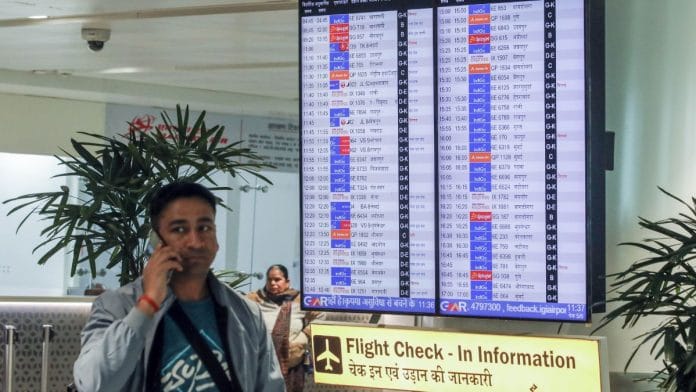
IndiGo’s cancellations of at least 4,500 flights and subsequent price surges following a scheduling crisis left thousands of passengers stranded two months ago. On 22 January, the central government informed the Delhi High Court that it had imposed a penalty of Rs 22.2 crore on carrier for failing to comply with the new Flight Duty Time Limitation (FDTL) rules.
Based on market data provided by the Directorate General of Civil Aviation (DGCA), the CCI said IndiGo might have created an “artificial scarcity” by withholding significant scheduled capacity, thereby limiting consumer access to air travel during peak demand.
The order noted that passengers who had booked tickets were left with no real choice but to accept last-minute cancellations and seek alternatives on their own at significantly higher prices.
“Given IndiGo’s dominant position, consumers were effectively locked in and lacked viable alternatives,” the Competition Commission said. It added that this appeared to violate Section 4(2)(a)(i) of the Competition Act, which prohibits imposing unfair or discriminatory conditions in the purchase or sale of goods or services.
The CCI’s order stems from a complaint filed by Bengaluru-based Kartikeya Rawal, who alleged that IndiGo cancelled his return flight from Delhi just hours before departure in December 2025.
Rawal claimed that upon seeking alternatives, IndiGo charged fares significantly higher than the average, and he eventually paid Rs 17,000 for a journey originally booked for Rs 7,173.
IndiGo’s conduct of cancelling its own flights and then overcharging customers, he argued, constituted an abuse of dominance.
DGCA data
The CCI then sought detailed market structure data from the DGCA, which showed the airline’s “dominant position” because of its large fleet and extensive network.
The DGCA reported that IndiGo’s passenger market share stood at 63.0 percent in 2024-25, up from 61.6 percent in the previous year.
More critically, the DGCA provided data on Available Seat Kilometres (ASKM), which measure an airline’s total passenger capacity. IndiGo consistently controlled approximately 60-61 percent of total domestic ASKM.
The CCI observed that this reflected “not only passenger volumes but effective control over market capacity and supply-side conditions”.
The most striking evidence of IndiGo’s market power came from the DGCA’s identification of routes where the airline operates as the sole carrier. The DGCA data revealed that IndiGo was operating as the sole carrier on more than 330 routes in late 2025.
Specifically, the data showed exclusive operations on 333 routes in September, 346 in October, and 339 in November 2025.
Out of approximately 835 direct routes between two cities in India, IndiGo operated on 643.
The competition regulator noted that this “structural presence on a large number of monopoly routes constitutes a relevant indicator of market power”.
Furthermore, IndiGo’s fleet of over 400 aircraft surpasses its nearest competitor, Air India, which operates approximately 191 aircraft, highlighting the monopoly.
The DGCA also provided revenue and profitability details that highlighted a pronounced asymmetry in the market. While most other airlines continued to incur losses, IndiGo’s data showed it was the only major airline reporting substantial and sustained net profits in 2023-24 and 2024-25.
The CCI noted that this “persistent profitability reflects superior financial resilience and economic strength” compared to rivals whose ability to compete is “materially constrained”.
The commission then turned to the alleged abuse. The order highlighted that the December 2025 disruptions were not “isolated” incidents as IndiGo reportedly cancelled 2,507 flights and delayed 1,852 others, affecting more than three lakh passengers.
Before the CCI, IndiGo argued that since the civil aviation sector is governed by a specialised, “self-contained” legal framework under the Bhartiya Vayuyan Adhiniyam, 2024 (BVA) and the Aircraft Rules, 1937, the DGCA has exclusive authority to address issues like excessive pricing.
However, the competition watchdog rejected this “exclusive jurisdiction” claim. It said that while the DGCA manages technical and supervisory aspects such as safety, licensing, and tariff transparency, its role is not a substitute for the complex economic analysis required to determine an “abuse of dominant position” under the Competition Act.
The commission’s right to investigate was further solidified by the DGCA’s own admission that it lacks the specific “economic regulatory powers” needed to assess market dominance or competitive effects.
The CCI has now directed its director general to conduct an investigation into the matter and file a report within 90 days.
While the CCI clarified that this order is not a final expression of opinion, it said it found the evidence of market distortion sufficient to warrant a high-level probe into the airline’s practices.
(Edited by Sugita Katyal)
Also Read: IndiGo fined Rs 22 cr by DGCA over December flight disruption chaos, lapses in planning & management