





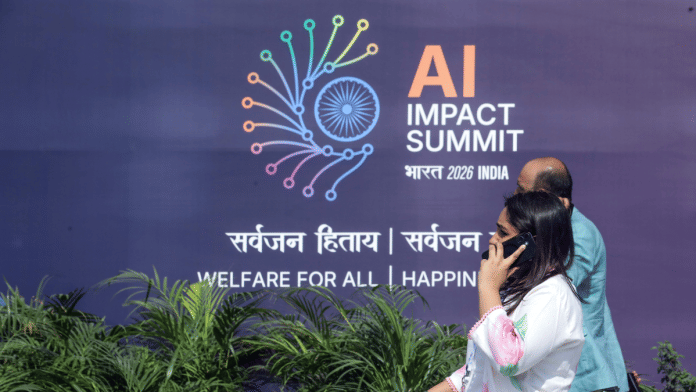



New Delhi: The Union government has asked all ministries and departments to lay out detailed roadmaps for using artificial intelligence in governance, setting a March deadline for submissions and triggering a flurry of activity across the bureaucracy.
In a communication sent during the India AI Impact Summit 2026, Cabinet Secretary T. V. Somanathan wrote to secretaries, directing them to prepare comprehensive notes on how AI is currently used in their ministries and how it can be deployed in the near future.
ThePrint has learnt the message was circulated while the summit was underway in New Delhi, prompting departments to convene urgent internal consultations, and that there is a parallel push to build capacity within the bureaucracy. Officials are being encouraged to enrol in AI and digital governance courses at the IITs, among others.
The summit, held at Bharat Mandapam from 16 to 20 February this year, concluded with a Delhi Declaration—a strong message from top leadership on scaling responsible AI adoption. In his inaugural address, Prime Minister Narendra Modi outlined India’s MANAV vision for ethical, inclusive, and citizen-centric AI, stressing that artificial intelligence must democratise opportunity and deliver measurable societal impact.
According to multiple senior officials, the cabinet secretary’s note “seeks far more than a status update”. Ministries must detail existing AI applications, identify short-term pilot projects for quick rollout, and lay down their long-term strategic plans to embed AI into public service delivery, scheme implementation, and internal administrative system operations.
This is the second directive on AI within weeks.
Ahead of the summit, ministries were instructed to ensure that deputy secretaries attend the event and its exhibition and submit detailed takeaways by 27 February. Officials said the twin instructions signal a “concerted effort” from the top to mainstream AI within government functioning, rather than treating it as a peripheral innovation exercise.
With the March deadline approaching, departments have begun structured engagements with their Information Technology wings and National Informatics Centre to map current usage and assess scalability. Several ministries are already using generative AI tools, including ChatGPT and similar large language models, to draft internal notes, prepare presentations, and synthesise research inputs.
One senior official involved in drafting a ministry’s submission said the exercise had “forced departments to formalise what had so far been informal or ad hoc usage”.
ThePrint has learnt that there is also a parallel push to build capacity within the bureaucracy, with officials being encouraged to enrol in AI and digital governance courses at institutions, such as the Indian Institutes of Technology (IITs).
Officials indicated that the notes will likely cover both backend automation and citizen-facing services.
Internally, AI is being explored for document management, communications support, workflow streamlining and data analytics. On the service delivery side, proposals under discussion include AI-enabled grievance redressal systems, predictive monitoring of welfare schemes, real-time dashboards and sector-specific tools in health, agriculture, and education.
Former MeitY secretary Ajay Prakash Sawhney said that India cannot afford to be hesitant about AI, warning that the country must also account for the opportunity cost of inaction.
“What are we losing by not using AI or being scared of the challenges?” Sawhney asked ThePrint, contending that the losses from delays could be far greater than the risks of responsible adoption.
While acknowledging the need for safeguards, he maintained that “the capacity for care is inbuilt in bureaucrats,” and that AI deployment in government would naturally proceed with due caution. What is needed, he also stressed, is sustained investment in training and capacity building so officials are equipped to use the technology effectively.
Pointing to India’s growing sovereign AI capabilities, Sawhney cited the work of Bengaluru-based startup Sarvam AI, which builds large language models tailored to Indian languages and public-sector needs.
Its Indus model and related applications are designed to operate across multiple Indian languages and contexts, reflecting a broader push to create domestically developed AI systems that can be governed and scaled within the country.
With such homegrown models now emerging, Sawhney suggested that the focus should shift from debating whether to use AI to determining how best to deploy it responsibly for national development.
In a 22 February interview with ThePrint, Ajay Kumar, Chairman of the Union Public Service Commission (UPSC), said that artificial intelligence cannot replace bureaucrats. He emphasised that the shift towards digital governance would not be a “digital transition from zero to one,” but rather a process of continuous evolution. Kumar noted that the future will require more bureaucrats—technologically savvy ones who adapt to emerging tools and systems.
(Edited by Madhurita Goswami)
Also Read: UPSC changes rules on number of attempts for selected candidates. Window has narrowed