





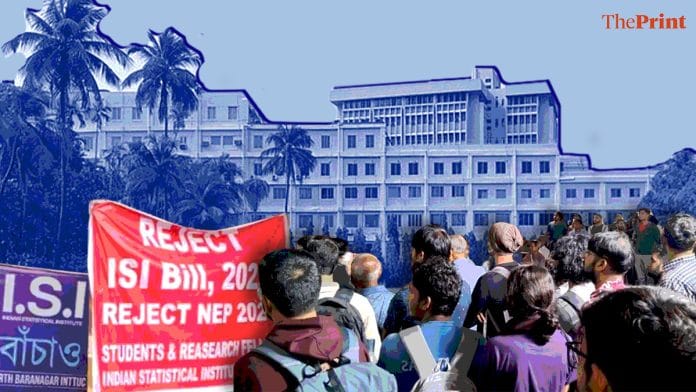



New Delhi: Ninety-four years after its founding, the Indian Statistical Institute (ISI) faces a dispute over its autonomy as a section of faculty, students and alumni oppose a draft Bill they say would give the government excessive control over the pre-Independence institution.
The Ministry of Statistics and Programme Implementation (MoSPI) released the draft legislation in September, seeking to repeal the ISI Act of 1959 and introduce sweeping changes to the institute’s governance. The government has defended the proposed reforms, citing a review committee’s findings that flagged inefficiency, weak accountability and resistance to reform at the institute.
Opposition has manifested through protests both on and off campus, with critics warning that the draft ISI Bill, 2025, could dilute academic autonomy and democratic decision-making. The controversy also acquired a political dimension after students met Congress leader Rahul Gandhi earlier this month to raise concerns over what they described as growing centralisation in higher education governance.
Established in 1931 from a small statistics laboratory at Presidency College set up by P.C. Mahalanobis—known as the father of Indian statistics—the ISI is now headquartered in Kolkata, with centres in New Delhi, Bengaluru, Chennai and Tezpur.
The institute has grown from a handful of students to over 1,100 today, with around 250 faculty members. It has produced world-renowned scholars such as C.R. Rao, whose work underpins modern statistical theory; S.R. Srinivasa Varadhan, an Abel Prize-winning mathematician noted for his contributions to probability theory; Raj Chandra Bose, a pioneer in combinatorial design theory; and Neena Gupta, a mathematician recognised for solving long-standing problems in algebraic geometry.
Indian Statistical Institute was placed 75th in the 2024 National Institutional Ranking Framework (NIRF), and ranks among India’s top research institutes.
Also Read: Centre backs Andhra’s PPP push to build new medical colleges—the model & political row over it
Proposed overhaul of Indian Statistical Institute
At the heart of the controversy lies the proposed restructuring of ISI’s governing bodies. The draft Bill seeks to convert ISI from a registered society into a “statutory body corporate” governed by an 11-member Board of Governors (BoG).
If the Bill goes through, this board will replace the existing 33-member Governing Council, which currently serves as the institute’s highest decision-making authority and has a majority of elected members from within ISI.
The board would include a chairperson, representatives from MoSPI, the departments of science & technology and Finance Ministry, four eminent persons nominated by the central government, and three institute representatives. The registrar would serve as a non-member secretary. The BoG would exercise broad powers over the institute’s affairs, including appointing a panel to select the director—authority that currently rests with the Governing Council.
The draft Bill also proposes changes to the Academic Council, the body responsible for academic matters. At present, all faculty members are part of the council, which has final authority over academic decisions.
Under the Bill, the Academic Council will be reconstituted to include the institute’s director, deans, heads of divisions and centres, and other nominated members. It would only make recommendations to the BoG, which would take the final call.
Another provision of the draft Bill that drew sharp criticism is the review of revenue generation through student fees and commercialisation of research. Faculty members and students argue that such measures could fundamentally alter ISI’s academic character and push it towards a corporate model.
Growing resistance
Following the draft Bill’s release, academics, faculty, students, alumni and others signed an online petition in November, warning that the proposed legislation could erode the autonomy of the pre-Independence institution.
A senior professor at ISI, requesting anonymity, said the Bill risks changing the institute’s core purpose. “The legacy of ISI has always been science in service of society. The proposed changes shift the focus towards corporatisation and revenue generation,” the professor said.
In a statement shared with ThePrint in November, MoSPI officials had said that the fourth ISI review committee under the chairmanship of Dr. R.A. Mashelkar, which submitted its report in 2021, identified several structural issues in the ISI governance.
“In this backdrop, a brainstorming session was organised by the MoSPI in collaboration with the ISI on 5 July 2025 at Jawaharlal Nehru Centre for Advanced Scientific Research, Bengaluru, under the Chairpersonship of Dr. K. Radhakrishnan, chairman, ISI Governing Council to deliberate on pathways that can transform ISI into a world-class centre of learning and research, as it completes 100 years in 2031,” the ministry had said.
History & legacy of Indian Statistical Institute
The institute emerged at a time when the British administration collected vast amounts of data but made limited scientific use of it.
One of ISI’s earliest and most consequential contributions was its work on large-scale sample surveys. In 1937, the institute conducted pioneering surveys to forecast jute yields in Bengal, demonstrating the efficacy of random sampling over full enumeration at a time when such methods were viewed with scepticism, according to historian Nikhil Menon in his book Planning Democracy: How a Professor, an Institute, and an Idea Shaped India.
The importance of reliable data became starkly evident during the Bengal Famine of 1943, which exposed the absence of accurate information on food production and distribution.
In December 1949, then Prime Minister Jawaharlal Nehru sought a nationwide system of sample surveys to assess India’s economy and social conditions. Within days, P.C. Mahalanobis designed the framework, and ISI took the lead in designing samples, preparing questionnaires and supervising data quality, Menon wrote.
This effort led to the creation of the National Sample Survey (NSS), India’s first large-scale household survey based on random sampling. NSS data has shaped policymaking on poverty, employment, consumption, health and education for over 70 years.
Professor Partha Pratim Majumdar, Emeritus Professor at the Indian Statistical Institute, recalled that Mahalanobis’ work in national development drew Nehru’s attention, leading to the Indian Statistical Institute Act of 1959.
“This led to the Act, introduced with the Prime Minister’s backing and after extensive parliamentary debate, formally declaring ISI an Institution of National Importance while safeguarding its autonomy,” he said.
A ‘unique’ institute
Current and former faculty members and students describe ISI as one of India’s most distinct academic institutions, where research freedom, rigorous training and financial support combine to create an unparalleled environment.
Bhaskar Dutta, Distinguished University Professor of Economics at Ashoka University, who taught at ISI from 1979 to 2002, called it a “unique institution” in India.
“ISI has some of the leading statisticians and probabilists in the country. The institute trains outstanding students, particularly through its Master of Science in Quantitative Economics programme. Many have gone on to pursue PhDs at top institutions such as MIT and Harvard,” he said.
On faculty autonomy, he added, “We had the independence we needed. No one interfered, though there were oversight bodies like the Academic Council, which is normal in every university.”
Students also benefit from financial support that allows them to focus fully on research.
A PhD scholar at ISI Kolkata said, “ISI is probably one of the last remaining institutions in India where students receive financial support from the undergraduate level onward, without paying any tuition fees. Undergraduates get Rs 5,000 per month, Master’s students Rs 12,400, and PhD students get fellowships like CSIR (Rs 37,000 for JRF and Rs 42,000 for SRF). There are no tuition fees at any level, and this allows students to focus fully on research rather than financial concerns.”
Economist Jean Drèze praised ISI’s record in nurturing luminaries such as P.C. Mahalanobis, C.R. Rao, K.R. Parthasarathy and Nikhilesh Bhattacharya. “These teachers and researchers are among the best in the world. Their scientific contributions were made possible by ISI’s congenial environment, itself a product of the institute’s autonomy and integrity,” he said.
Majumdar cautioned that the legislation could weaken the institute’s federal and democratic structure. “Whether regional centres will have any relationship with the headquarters, we do not know, because these details are not spelled out in the Bill, though certain hints are given,” he said.
He also noted that the proposed ‘top-down approach’ in appointments would erode participatory decision-making that has long defined the Indian Statistical Institute.
Students are similarly concerned about potential corporatisation. A PhD scholar, who wished not to be named, said, “If the institute starts charging tuition fees and introduces more self-financed courses, students may prioritise jobs and income over deep theoretical research. This could undermine the culture of academic freedom and intellectual exploration that ISI has long upheld.”
Dipankar Bhattacharya, national general secretary of the Communist Party of India (Marxist–Leninist) Liberation, emphasised the broader stakes.
“ISI has always thrived as a research-oriented institute with freedom and independence. Higher research in mathematics, statistics, computer science, and other disciplines cannot flourish without autonomy. This Bill risks replacing it with centralisation that could serve political or corporate agendas,” he said, urging civil society to support the institute in preserving its independence.
(Edited by Prerna Madan)
Also Read: Email ID ‘abc@gmail’, ‘111111’ as bank A/C—CAG flags gaps in Modi govt’s flagship upskilling scheme