








New Delhi: The best example of AI being utilised for public good is India, said Indian-American businessman, philanthropist and founder of Wadhwani AI, Sunil Wadhwani, while speaking at the Global Technology Summit Innovation Dialogue organised by Carnegie India in New Delhi last month.
Wadhwani AI is a Mumbai-based non-profit founded in 2018 that develops AI solutions for social good. Drawing on experiences with digital public infrastructure such as Aadhaar and UPI, Wadhwani said India has shown an ability to use technology at a population scale.
The country, he added, benefits from political leadership and an administrative ecosystem that is open to innovation, as well as early efforts to build research and training capacity in AI.
At the summit, senior policymakers and international representatives offered a preview of how New Delhi wants to shape the global AI conversation.
The event saw AI leaders and government officials from multiple countries coming forward and sharing ideas on how artificial intelligence, with proper access, can revolutionise people’s daily lives, proving to be a great boon.
At the summit, officials explained that India has constituted seven thematic working groups, referred to as “chakras”, to drive preparations for India’s AI Impact Summit in February. These groups are meant to translate high-level principles into actionable outcomes.
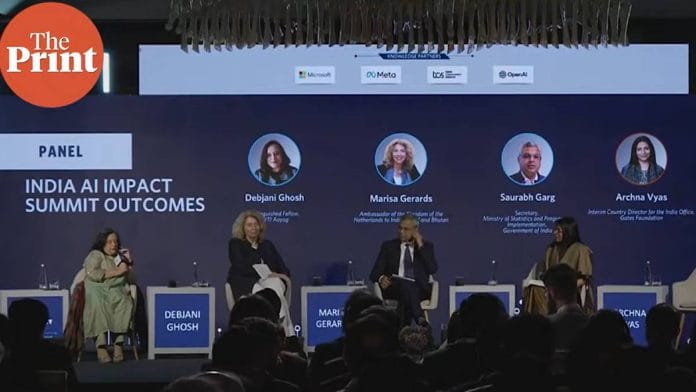
Speaking on a panel, Secretary in the Ministry of Statistics and Programme Implementation, Saurabh Garg, outlined the work of the group on democratising AI resources. The focus, he said, is on ensuring wider access and affordability across four core AI resources: compute, data sets, models and talent.
Co-chaired by Kenya and Egypt, the group has already seen participation from over 35 countries and several international organisations, reflecting concerns that current global AI capabilities remain heavily skewed towards a few economies.
A broader framing of India’s approach came from Debjani Ghosh, Distinguished Fellow at NITI Aayog, who is co-chairing the working group on economic and social development.
She contrasted India’s summit with earlier global AI gatherings. The first summit in the UK centred on safety, leading to the creation of AI safety institutes, while subsequent meetings in Korea and Paris focused on control and action. India, she said, is deliberately shifting the narrative.
The emphasis now is on impact, return on investment and tangible benefits for citizens, particularly in developing economies. Her working group, co-chaired with the Netherlands and Indonesia, brings together around 40 countries to identify inclusive pathways for accelerating development through AI.
The emphasis on practical outcomes was echoed by Netherlands’ Ambassador to India, Nepal and Bhutan, Marisa Gerards, who co-chairs the working group focused on social good and empowerment.
She highlighted India’s experience in using technology for large-scale social advancement and said the group is exploring concrete tools such as best-practice exchanges and incentive mechanisms to encourage innovation that delivers public value. Gerards also stressed on the importance of involving industry leaders alongside governments and research institutions in shaping AI’s future.
Expanding on the same, in a different panel, Wadhwani said that while AI is being developed at unprecedented speed, very few applications have truly scaled, particularly in the Global South.
In his assessment, technology itself accounts for only a fraction of success. The bigger challenge lies in deploying AI within real-world systems such as public healthcare, education and agriculture, where government workflows and frontline realities often determine outcomes. Many promising tools fail, he asserted, because they are not designed with these constraints in mind.
The summit also staged discussions around healthcare and innovation led by AI. It saw successful health start-up owners from across the world, including Thiago Rached, El Mahdi Aboulmanadel, Kidist Tesfaye and Benjamin Mwalimu, who participated in a panel to discuss how they built their start-ups and how they ensure smart use of AI in the healthcare and education vertical, while also ensuring user data protection.
The summit further addressed issues surrounding the safety threats around AI. The Netherlands ambassador highlighted that a lot of misinformation was being spread using AI and that governments must not let AI affect democracy and people.
The discussions at Global Technology Summit offered an early look at how India intends to steer the February AI Impact Summit.
ThePrint was the official digital media partner for the event.
(Edited by Nida Fatima Siddiqui)