





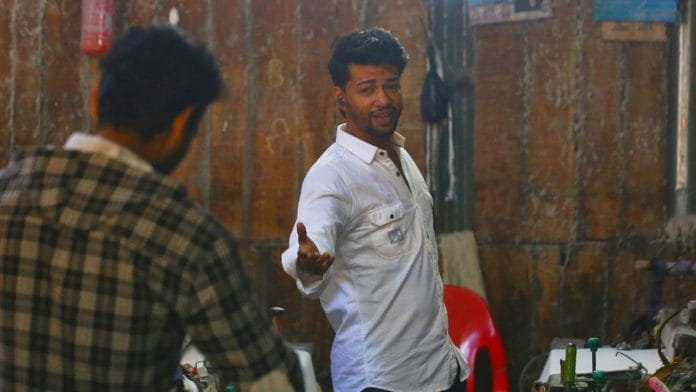



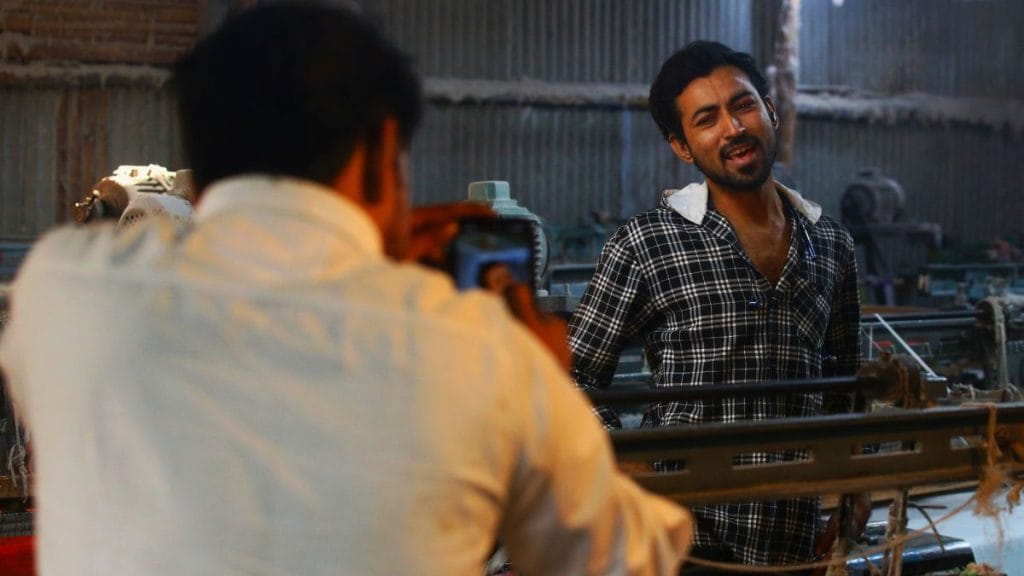
Malegaon: Inside a 200-year-old factory shed, choked with cobwebs and the deafening roar of powerlooms, four workers are getting ready. Before their 12-hour monotonous grind behind the machines begins, they steal a sliver of time. One flings his arms open like Shah Rukh Khan, another fixes his smile for the camera. A fifth worker keeps an eye on the door, watching out for the owner of the mill. In those hurried, hidden moments, the loom workers become performers – ready for their close-ups. The ‘Malegaon Boys’ are now ready for a brand makeover.
Loom labourers by day and performers by instinct, the town’s youth want to be part of internet fame. Under a dim, dusty bulb that never goes off, they cue up the soaring voices of Mohammad Rafi and Kishore Kumar and step briefly into a world far brighter and larger than the loom floor. Their Reels now draw lakhs of views. For the first time, they feel seen.
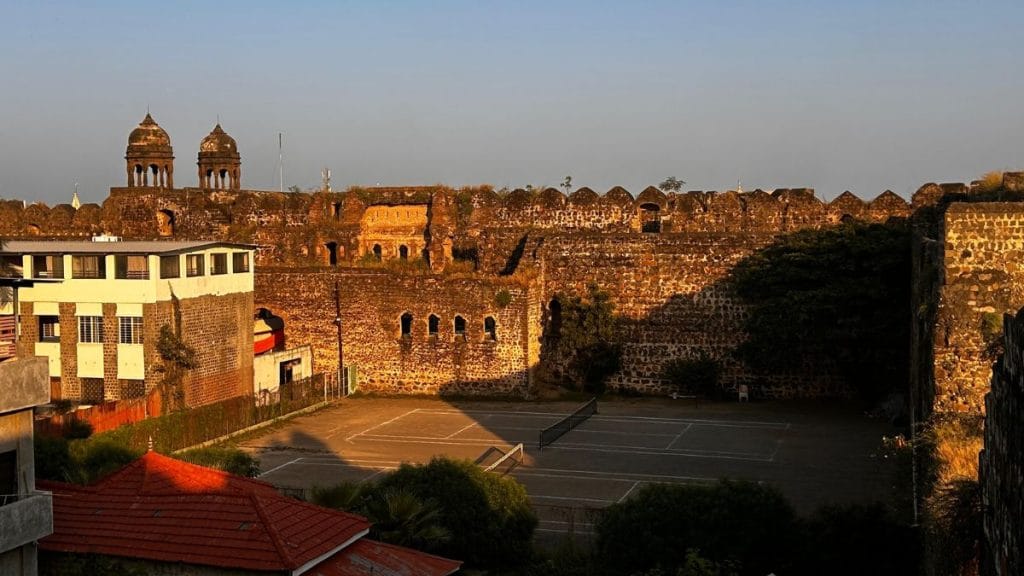
Malegaon is a textile town in Maharashtra, but also a metaphor in Indian popular imagination. It runs in two parallel universes on any given day. It is the Muslim-majority town of communal riots and bomb blasts – one that many Hindus warn each other about. But it is also a universe of endless and audacious possibilities – of textile hub ambitions, an alternative movie industry, of Supermen and Superboys, and now of Instagram Reels. And that ubiquitous Big Boss dream in the future. Every time India boxes Malegaon into a singular, fixed identity, the town tries to wriggle out through an escape room of its own making.
Today, another identity is blooming: An influencer town built on centuries-old machines.
“Powerlooms are the backbone of Malegaon, and now it is making us Instagram influencers,” Nihal Ansari, 20, the content creator who posted the town’s first loom Reel, said.
Loom meets Lens
Long before the Reels, Malegaon had its own language of cinema. The boys picked it up intuitively.
Shake-shake… pan… zoom… and bam!
It’s a camera ritual rooted in 90s filmmaking – a style once used in wedding videos and low-budget movies. Before a subject appears, the lens pans dramatically across objects to create a sense of anticipation. Outdated today, but in Malegaon, it has become a signature.
Aadil stretches his arms. Irfan adjusts the Dhoti – a small, boat-shaped shuttle used to feed thread in a traditional handloom – and pretends it’s a harmonium. He cuts the yarn with his teeth and replaces the Dhoti with a new one. In minutes, they act out their everyday labour with filmy flourish.
All this is shot in 10-15 minutes between work on the phone. The boys now know their beats, their frames, their lip-sync cues. They have become local stars.
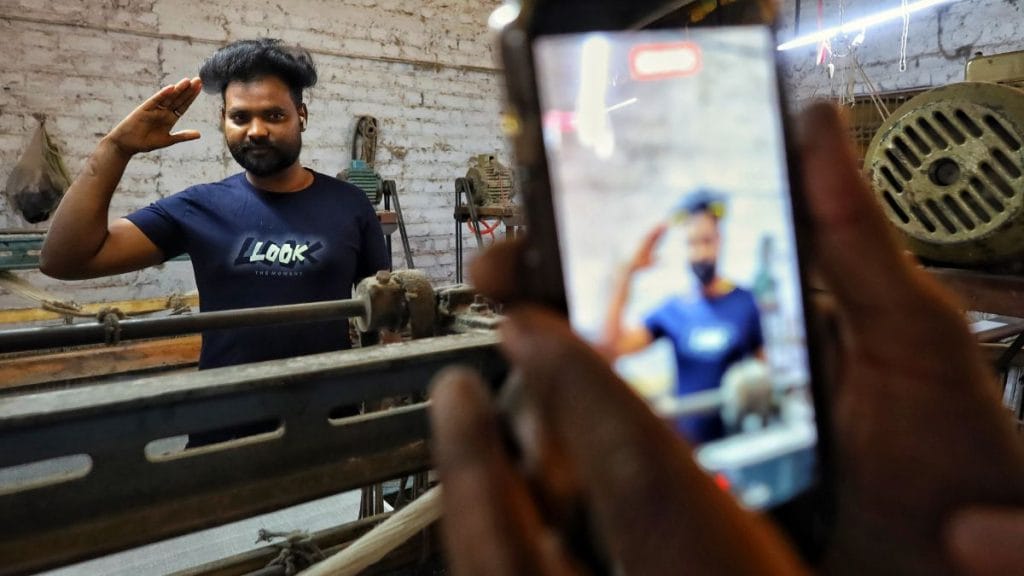
After hours on the floor, they sit together at night as Raees, the group’s in-house video editor, aligns cuts with the thump of looms. Beat-beat, first cut, second cut… done. A reel is up by dinner.
The comments pour in: “What are these machines?” “How old are they?”
“Hundreds of years old,” the boys reply.
The looms, stamped with names like “Cooper” and “Henry,” were brought from Bombay in the 19th century. Malegaon’s textile economy employs nearly 80 per cent of the town.
But it’s the town’s viral Reels that have travelled across the country. Around 50 per cent of the audience is from Malegaon; the rest are from Kolkata, Bengaluru, Delhi and Mumbai – four major metropolitan cities – according to data accessed by ThePrint.
The young influencers are tech-savvy. Most of them have not received any formal school education or media training. Using social media, they have taught themselves editing apps like CapCut and even AI to enhance photos. Video effects like blur, jump cuts, fade out and fade in – commonly seen in professionally edited videos – are routine in powerloom reels.
They use an iPhone 13 to shoot, sometimes a rented DSLR, because Nihal dismisses Android smartphones – which he used for two years – as “poor quality”.
Their social media photos are glossy and aspirational – worlds away from the loom floor they work on.
Riots, reels and reinvention
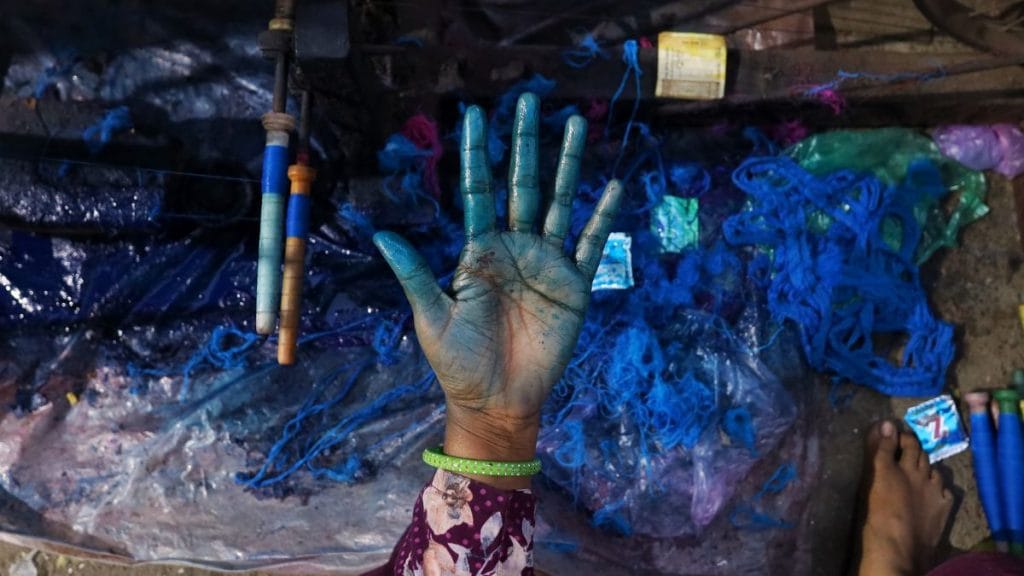
Malegaon’s aspiration to create and to be seen emerges from a town long burdened by stigma. The town’s Muslim-majority population has for years lived under the shadow of bomb blasts, communal flare-ups, and suspicion.
“For them, (the youth) a social media tool like Instagram Reels is a medium of expression,” Neha Dabhade, Executive Director of the Centre for Study of Society and Secularism, said. She points to Islamophobia as a major reason for the lack of development in the town.
On one side of the Mausam river – a predominantly Hindu area – are wide roads, better hospitals, and more banks. Repeated clashes with police, according to a local journalist, pushed Muslims inward into ghettos across the river. Their ‘amenities’ – or their lack thereof – include dingy lanes, waste-clogged drains, and often empty ATMs.
“ATMs are placed on the periphery of Muslim-dominated areas because of fears they’ll be looted,” journalist Aleem Faizi said.
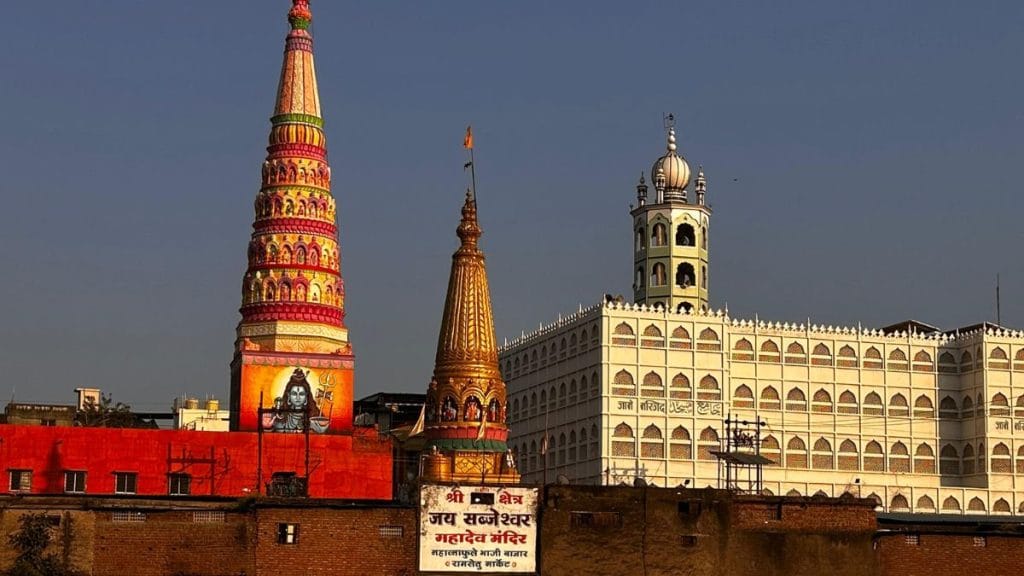
The blasts (in 2006 and 2008) and communal riots, she believes, have created an “image” for the town.
“The (Hindu) right wing has always associated Malegaon as a safe haven for Muslims, gradually associating it with the den of terrorism,” she said.
Despite the stigma, the youth’s decision not to migrate to bigger cities is striking. Most loom workers earn around Rs 18,000 to Rs 22,000 a month. The payment is weekly, and growth is stagnant. There are no benefits or promotions at the job. But the people of Malegaon are content. They want opportunity, but rooted in the soil they grew up in. And no one embodies this push-and-pull of aspiration more than the boy who started it all.
Also Read: Malegaon holds stories beyond its Superboys and Supermen. We’ve just begun looking
Nihal and the new wave
By 8 am, Malegaon’s looms have been running for hours. Rolls of cotton slide out in steady sheets, the clatter forming the town’s permanent soundtrack. Inside, Nihal Ansari has just begun his half-day-long shift and is jumping between six machines. He has no time to pause, no time to look at his phone.
But he waits for evening. He and his friend Osama have to shoot a promotional video at a local supermarket, Sasta Bazaar.
Nihal was the first to make a Reel inside a powerloom. He started in 2020 on Musical.ly, then moved to Instagram in late 2023. For months, nobody watched. Then, he filmed a few workers lip-syncing to KK’s ‘Ab To Forever’ (Ta Ra Rum Pum, 2007), their movements synced with the loom’s rhythm. Hesitant but encouraged by friends, he posted it. It was Jumma (Friday), the only day the looms fall silent.
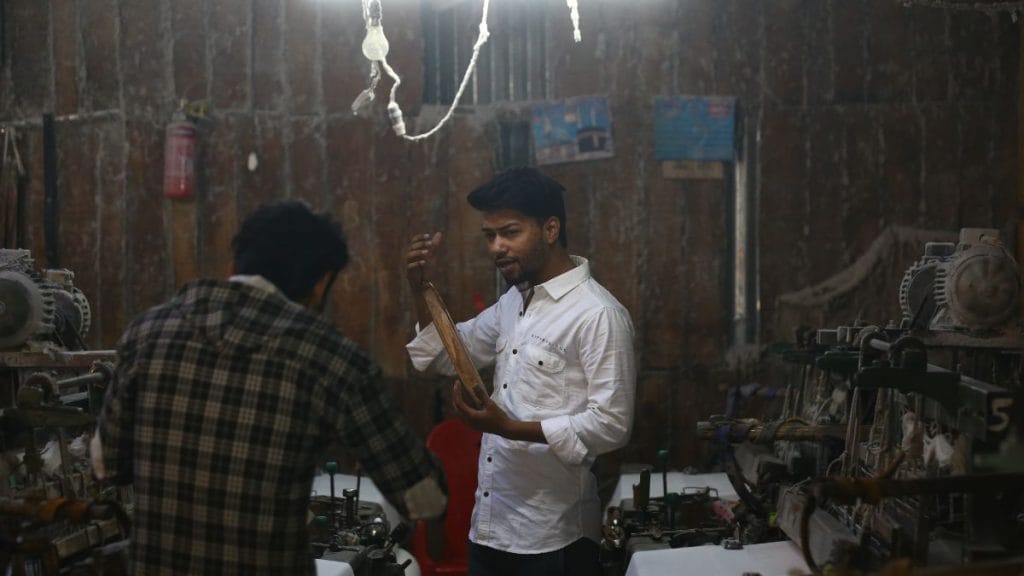
Nihal’s eyes are fixated on the views. Six hours later: 1,200 views. Twelve hours later: five lakh.
“Aisa laga jaise fakeer ko pulao mil gaya (It seems like a beggar has stumbled upon pulao),” he laughs.
Within months, he crossed 1 lakh followers and soon found a new source of income.
Local brands pay him Rs 2,500 for promotional clips. Some days it’s momo, other days crockery, but Nihal only promotes things that are “Made in Malegaon.” He even paid off the installments for his iPhone with the extra money.
Other loom workers followed. Soon there was one content creator in every factory.
But not everyone celebrated when Nihal’s videos went viral. A “Boycott Nihal” movement erupted online over a song choice for one of his videos. He was away in Karnataka, unaware, until friends informed him about swirling rumours that he had “run away”.
Crowds had gathered outside his house.
“I was scared to come back home,” he said.
But when Nihal did return a few days later, the same crowd asked for selfies. Fame, in Malegaon, is always on a tightrope.
Family approval still wavers. Many wives support their husbands, fathers, however, still need convincing. But the hunger to break out of the loom’s routine keeps pulling the boys back to the camera.
Renegades, then and now
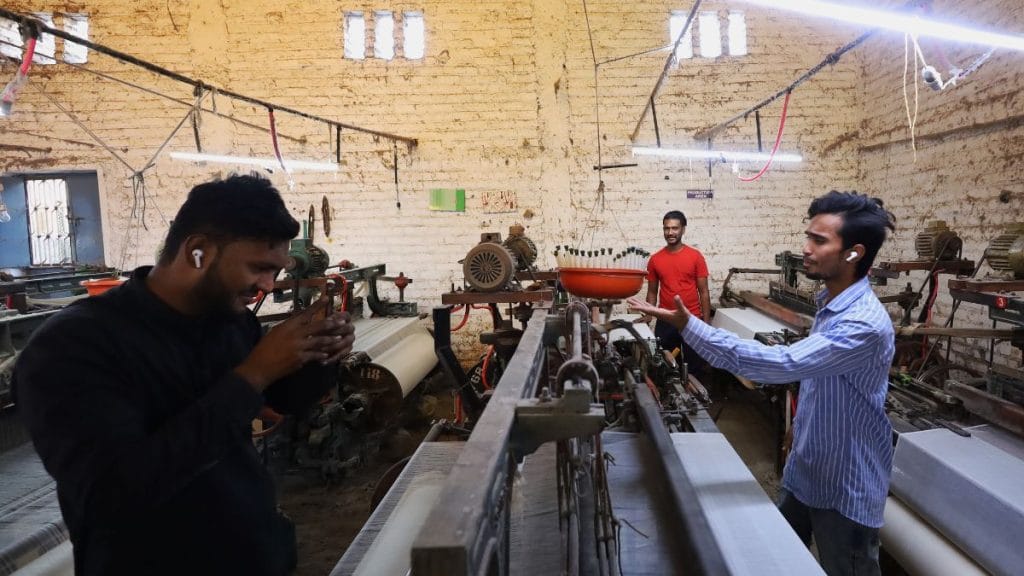
Raees, Irfan and Aadil work in different factories. They have just one dream – to be famous. They meet only after their bosses leave.
“The owner can come any time, so we have to be very careful. They do not like the work we are doing,” Raees said.
In the evening, the boys gather to shoot a video. The song has been decided – Udit Narayan’s ‘Tum Saath Hote Agar’ (Jurm, 2005).
Raees is exhausted after his grueling shift. But he eagerly waits for Irfan and Aadil, glancing at the door. They have a quick video to shoot. He hands over a pair of fake AirPods – one for himself, one for Aadil. One friend shoots, another – like routine – keeps watch.
Malegaon has always viewed music and content creation with suspicion – not quite art, not quite work. Many still believe life should remain within the loom’s predictable rhythm.
Decades earlier, the town had felt a similar creative spark when local filmmaker Nasir Shaikh and his friends churned out spoof films like Malegaon ka Superman (1997). For weeks, single-screen theatres ran packed, and a small town marred by doubt briefly saw itself as a movie hub. The fame travelled far – a documentary, international festival buzz, and eventually a Hindi feature film, Superboys of Malegaon (2024), followed. But the momentum ebbed as technology outpaced their shoestring industry.
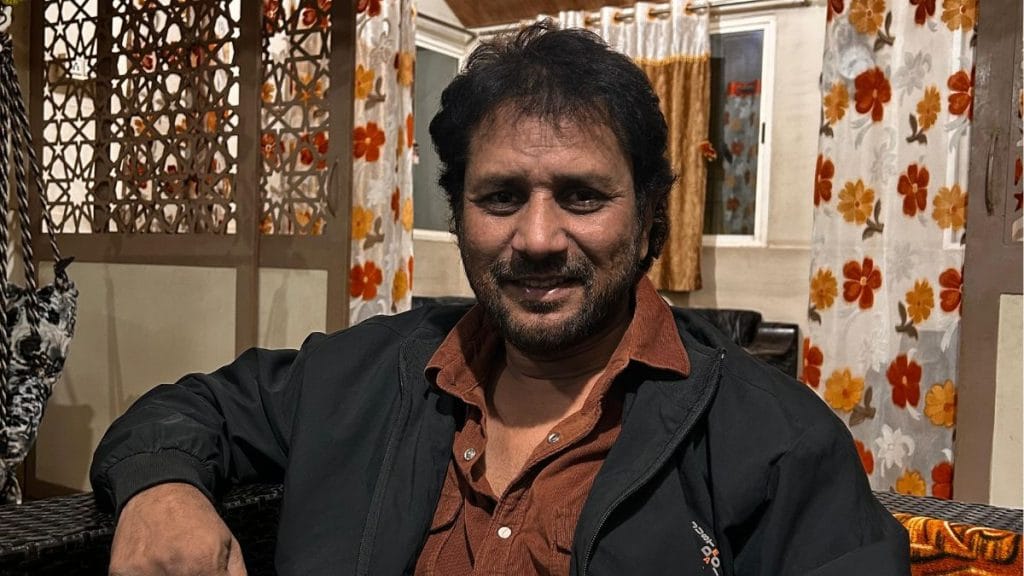
Filmmaker Faiza Khan, who chronicled that era in her 2008 documentary Supermen of Malegaon, remembers how even Shaikh, the town’s creative trailblazer, discouraged his own brother from joining films. “Too uncertain,” he would say.
Nasir also did not stick around for long in the movie business. He now owns a restaurant in the town.
But these have not deterred the youth of Malegaon who have grown up seeing factory workers, vegetable vendors, masons, and even IT professionals catapult to fame via Reels. So they tied their lungis up, buttoned up brand-new shirts, and hit the record button.
They sync the clack-clack, and thump-thump of their old machines on the beats of the chorus of ‘Mere Sapno Ki Rani’ (Aradhana, 1969) by Kishore Kumar. They act out the lyrics of ‘Paisa Bina Duniya Mein Roti Nahi Milti’ (Phande Baaz, 1978) as a worker holds a hundred-rupee note for the video.
The videos are aspirational for the youth; a path to fame without leaving home. They want to create, but from the same narrow lanes they were born into.
But outside Malegaon, another image persists.
“A Muslim from Malegaon is not seen from a fresh perspective… It becomes a double whammy,” Neha Dabhade said.
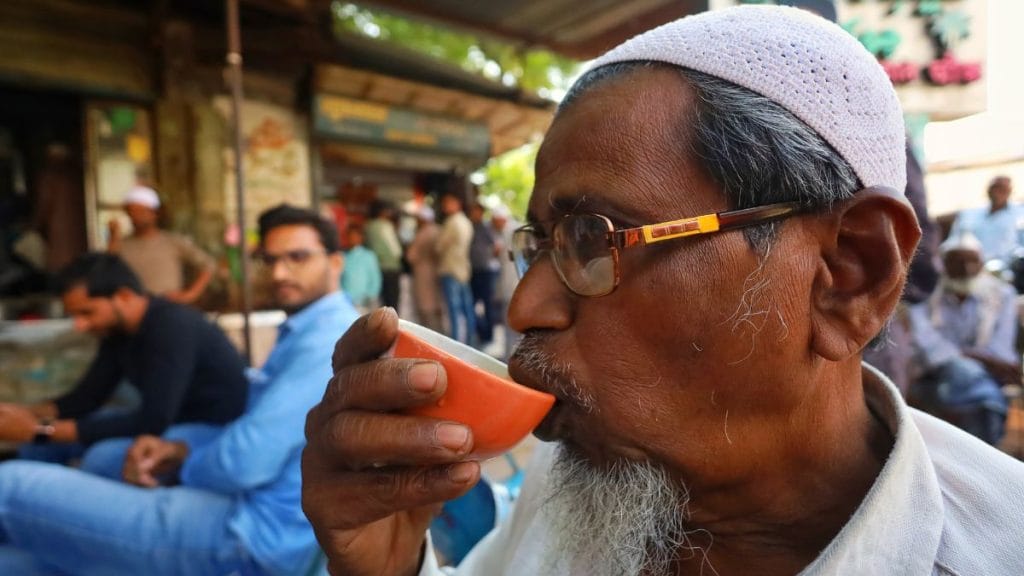
Serious issues, shaky views
Away from the stigma, fame has its own complications.
At the town’s chowk, a crowd beams with excitement. In a white shirt and black trousers, a local celebrity has just made an appearance. On a Honda Unicorn motorcycle, Nihal Ansari rides in. Scores of people stop him for selfies.
“Hum sab jaante hai Nihal bhai ko (We all know Nihal brother),” children laugh while running up to him for selfies.
He has inspired countless loom workers to follow his path despite obstacles. Yet serious videos, like those on substance abuse or violence against women, which Nihal wants to make next – rarely get traction. Entertainment still rules.
After the brutal rape and murder of a minor in the region, influencers shot awareness videos urging parents to talk to their children, and asking men to intervene. The videos were sombre and urgent but the views plateaued, drowned out by lighter powerloom skits.
“To bring attention to serious issues, I have to weave in entertainment,” Nihal said. So he experiments – mixing melodrama, familiar songs and quick cuts with messages about drugs or harassment.
The views slowly climb again.
Also Read: Bollywood bawarchi no 1. The rise of Dilip, Farah Khan’s cook
Abdul Rahman, a textile exporter, thinks the boys are on to something. “It cannot be only about music and dance. The creators need to show the problems of powerlooms too,” he said.
Across town, 21-year-old Sheikh Adil, sits in a small electronics shop, sweeps the floor and records it. He wants to make GRWM (get ready with me) and “day in my life” videos. But he too, like Nihal, wants to focus on serious matters.
“I think as content creators of Malegaon it is our duty to make people aware. It is not only always the police and administration’s job,” he said.
But the idea of doing something different from the mundane of the powerloom is still frowned upon. The creators have become renegades of Malegaon, much like Nasir Shaikh once was.
Fame, fear and the Feed
Fame for the locals came first with the indie filmmakers of the 90s, and now the reel-makers of 2025.
While Nihal dreams of entering the Bigg Boss house someday, the creators he inspired are trying to create another identity for the town – one of creativity, humour and resistance.
This desire is rooted in a sense of belonging. Malegaon’s story, they insist, must be told by those who refuse to leave it.
“I am tied to powerloom, to Malegaon,” Nihal said.
For Dabhade, the videos are more than performance – it is reclamation.
“Reels can be the strongest counter-narrative to the stories the right wing pushed for years,” she said.
The boys think this shift has begun, but they are also unsure how long it will last.
Nasir Shaikh believes there is a future for ‘Malegaon ki Reels’, but sounds wary. “My movies came and went with technology. Reels too will fade,” he said.
But until then, they are Malegaon’s newest escape hatch.
Behind every lip-sync, every edit, every pan-shot borrowed from 90s cinema, the ‘Malegaon Boys’ hold simple desires: Nihal wants to be the Shah Rukh Khan of the town’s creator world; Irfan imagines himself as Salman Khan; and on the loom floor, Aadil is already called Rajesh Khanna.
(Edited by Stela Dey)