





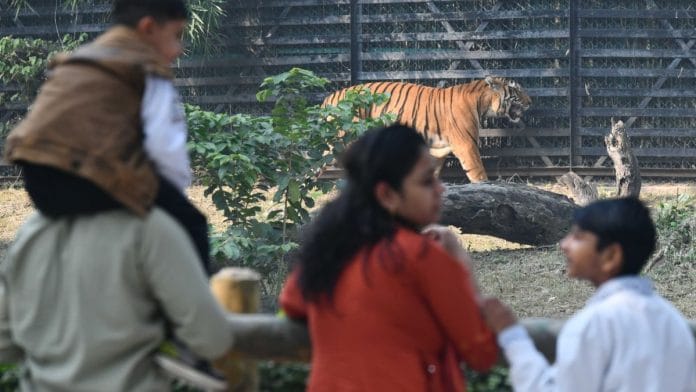



The jackal that accidentally entered a black bear’s enclosure after escaping from its dedicated cage at the National Zoological Park in Delhi was allegedly burnt alive by the park authorities. The alleged incident that happened over a month ago has put the biggest question mark on the functioning of a ‘model zoo’ in India’s capital. The National Zoo Workers’ Union, in a letter on Monday, 12 January, claimed that the Zoo Director and higher authorities were aware of this act of extreme cruelty.
The letter is only the latest in a series of controversies, allegations, and charges of animal mismanagement and cruelty levied against the National Zoological Park – Delhi’s only zoo, and the only park in the country managed by the Union Environment Ministry. Just in last one year, the Zoo lost its World Association of Zoos and Aquariums (WAZA) membership, has been accused of neglecting care of the African elephant Shankar and protected species such as Indian rhinoceros, five tiger cubs, and four-horned antelopes that led to their untimely deaths. To make matters worse, the park workers have been at loggerheads with the management over their hiring policies and training protocols, even as they function with just over 50 per cent capacity.
Speaking to ThePrint, Director of National Zoological Park Sanjeet Kumar said that no such incident of the jackal death had been brought to his notice, and that the number of jackals currently in the zoo matched their inventory records. He added that after receiving the letter, there’s no an inquiry into the incident under the Joint Director.
The zoo, which reopened in November after being shut for over two months due to the detection of avian influenza in its waterbird aviary, is the first choice of Delhi schools that often bring their students here. Over 8,000 visitors came here when it was reopened on 7 November. Designed to be India’s ‘model zoo’, the Delhi Zoo has, for years now, been struggling to prop up that image.
“If there are issues with zoos in any particular state, there is a proper protocol. The Central Zoo Authority pulls them up, and a chain of command goes all the way to the top of the state’s forest department,” two sources in the Union Environment Ministry told ThePrint. “But with the Delhi Zoo, there is no established chain of command.”
Animal rights activist Gauri Maulekhi filed a case against the zoo in 2018 regarding the manipulation of animal records and overall mismanagement of the zoo.
“One visit to the Delhi Zoo will tell you that it serves no worthwhile purpose. There’s no conservation since all captive breeding programmes failed, there’s no education because all animals are housed in unnatural enclosures, showing stereotypic behaviour,” said Maulekhi, animal activist and Trustee of People for Animals. “Above all that, they are also compromising animal welfare.”
While experts like Maulekhi call for a complete overhaul of the captivity agenda seen in zoos, sources in the Delhi Zoo talk about the problems in implementation stemming specifically from the zoo’s governance structure. They both agree, though, that things need to change in how the national capital takes care of its animals, and they need to change fast.
“The question definitely arises that if this is happening in a zoo in the political capital, what does it mean for the rest of the zoos in the country?” said Shubhobroto Ghosh, Wildlife Projects Manager, World Animal Protection, India.
The letter by the National Zoo Workers’ Union, addressed to the Union Ministry of Environment, Forests and Climate Change, has called for an independent inquiry into the matter as well as criminal proceedings against the responsible authorities.
“We have received the letter, and we are looking into the matter now,” said Clement V Ben, Member Secretary of Central Zoo Authority, the regulatory body for all zoos in the country.

Also read: NCPOR in Goa studies extremes—from Antarctica to deep ocean research
A death and a probe
On 22 November 2025, three to four jackals–Schedule I protected animals–escaped from their enclosures and were spotted by Delhi Zoo authorities within the premises. Two jackals were brought back by the staff in less than 48 hours while the other two were still being tracked using CCTV cameras and zoo staff armed with trap cages.
But according to the Workers Union letter, one of the escaped jackals accidentally entered the enclosure of the Himalayan Black Bear and burrowed underground. Instead of carefully rescuing the jackal, the workers alleged, “the Ranger-in-Charge, Manoj Kumar, devised a plan” that ended up killing the animal. The letter said it could have happened sometime between 14 to 20 December. The exact date is unclear.
“It is alleged that chilli powder was poured into the burrow and fire was ignited inside it, resulting in extreme cruelty and unlawful killing of the animal,” read the letter. “The workers were sent inside the burrow to retrieve the remains of the jackal and on the direct instructions of the ranger, the animal was clandestinely disposed of,” it added.
Since there was no postmortem conducted, there is still no clarity on what exactly caused the death of the jackal. Zoo staff that ThePrint spoke to, however, said that it was likely that the zoo staff was trying to draw the animal out of hiding. Instead, the fire and smoke suffocated the jackal.
The letter was addressed to the MOEFCC, since the National Zoological Park is a subordinate body under the Ministry. A copy of the letter was also sent to the Central Zoo Authority and the Wildlife Crime Control Bureau.
“No such incident was brought to my notice before this, and we have now ordered an investigation headed by the Joint Director of the Zoo,” Sanjeet Kumar, Director of Delhi Zoo, told ThePrint. “I cannot say anything before the investigation.”
The Workers Union, in their letter, have demanded an “independent inquiry team” for the matter, made up of officers outside the NZP. They had also asked that the involved officers be suspended immediately, and that criminal proceedings should be levied against them.
But according to a former staff member of the zoo, the Joint Director of the Zoo, who is appointed to head the investigation, is also in charge of the animal section at the Zoo. This fact could compromise the integrity of the enquiry process, added the former staff.
Also read: Uttarakhand forests are turning deadly for women. They’re victims of rising animal attacks
Previous controversies
Two weeks before the Workers Union letter on the alleged jackal death, a toxicology report found traces of rodenticides in the bodies of two four-horned antelopes that had died in the zoo on 11 December 2025. The report, compiled by the Indian Veterinary Research Institute (IVRI), said that these animals – Schedule I protected species – were exposed to aluminum phosphide or zinc phosphide, commonly known as rodenticides to kill pests.
Zoo officials did not respond to ThePrint’s queries after the report was made public. In September 2025, a rather high-profile elephant died at the park. An animal that for nearly three decades was the symbol of India-Africa relations. Shankar was a gift from Zimbabwe’s Robert Mugabe to then President Shankar Dayal Sharma in 1998. After the female elephant Bombai’s death in 2000, Shankar remained alone and aloof. The Delhi Zoo authorities was accused many times of mistreating Shankar, including keeping him in solitary confinement and chaining his legs. His case even reached the Delhi High Court in a petition filed by a Delhi teenager, and the Court eventually ordered an inspection of Shankar’s living conditions.
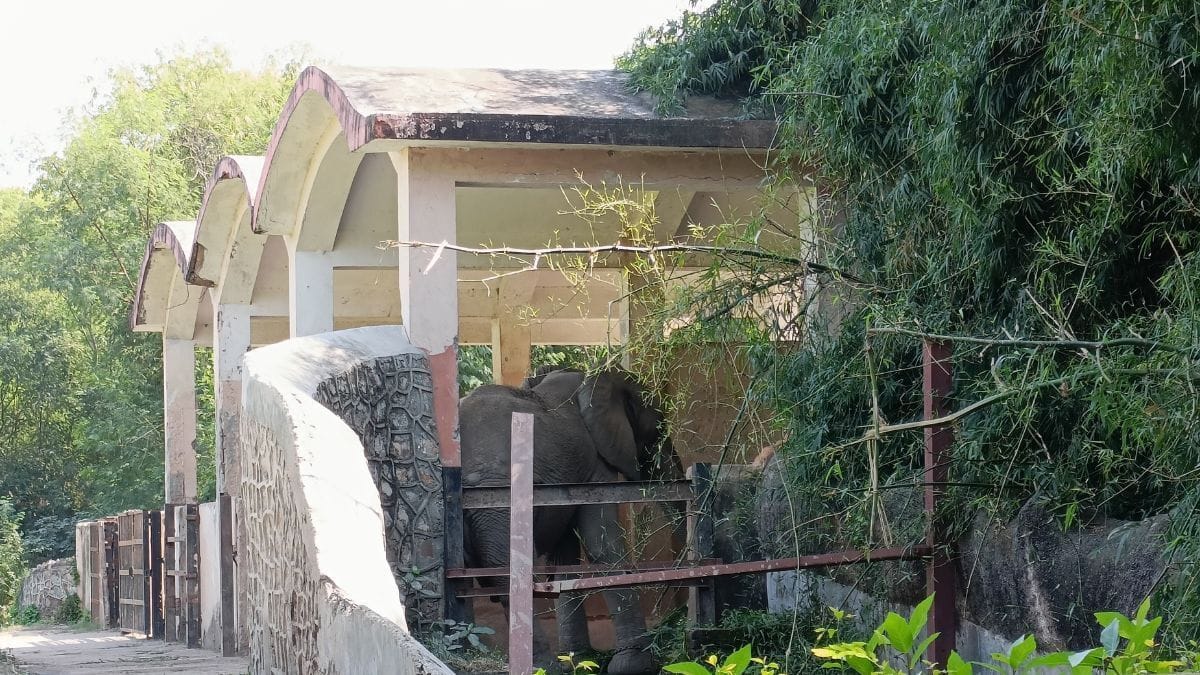
Shankar’s continued ordeal led to the Delhi Zoo losing its World Association of Zoos and Aquariums (WAZA) membership in late 2024. WAZA had received a complaint reporting an ethics violation in Shankar’s treatment. 11 months after the notice from WAZA, Shankar passed away on 17 September, 2025.
The Delhi Zoo told ThePrint a day after his death that he had not been eating properly for two days before he died, and that a probe was underway to determine the reason for his death. On 15 January 2026, Director Sanjeet Kumar said that the report of his death had been submitted to the Union Ministry, but no details were shared with the media.
Till his death, the Zoo could not find a mate for Shankar.
There were other notable deaths in the Delhi Zoo IN 2025, including a one-horned rhinoceros brought from Assam to mate with the female rhinoceros in Delhi Zoo. Brought to Delhi in September 2024 in good health, the animal died within four months by January 2025, due to ‘unnatural reasons.’ Later, the post-mortem revealed that the rhino was suffering from acute haemorrhagic enteritis, which could have been caused by an infection he got after coming to Delhi.
In August 2025, there was a ray of hope with the largest litter of six Royal Bengal tiger cubs born in the Delhi Zoo in decades. By the end of August though, this ray was snuffed out with only 1 cub out of the 6 surviving.
“A zoo isn’t a collection of patients, or a rescue centre. They’re healthy animals that don’t need regular treatment, but they do need to be looked after,” said Dr NV Ashraf, senior advisor at the Wildlife Trust of India. “This is where most zoos and managements fail – they’re unable to undertake the constant work of providing a basic level of food, care, and hygiene to the animals.”
Also read: Maharashtra’s Kham shows even ‘dead’ urban rivers can be revived—here’s the blueprint
A court case from 2018
In 2017, an inquiry panel set up by the Central Zoo Authority, accused several officials of the Delhi Zoo of negligence that led to the mysterious deaths—no post-mortems, illegal capturing of animals and false animal inventory records. The report was not made public. But ThePrint had accessed and reported on it back then.
Soon after, in May 2018, a PIL was filed in the Delhi High Court by Gauri Maulekhi, urging the court to take action against the mismanagement in the zoo and set up an independent inquiry panel. A high-level committee was eventually set up, comprising members of the Union Environment Ministry, which gave a slew of recommendations to improve the conditions in the Zoo.
From establishing a quarantine facility and rescue centre in the zoo, to constituting a Zoo Inventory Committee for conducting the annual census of animals, to even policies on free-ranging animals inside the Zoo, the committee’s recommendations spanned the breadth of issues plaguing the zoo’s management at the time.
One of the important recommendations, to do with shifting the administrative control of the Zoo, has still not been implemented.
“The MoEF&CC, while on the one hand is acting as operator of National Zoological Park, on the other hand it is a regulatory authority for CZA, which is the national authority for regulating all the zoos of the country,” read the recommendation. “This duality in role may lead to ambiguity in jurisdiction over management of NZP. Therefore, MoEF&CC may consider shifting the Administrative control of the NZP.”
Also read: The Guardian of the Aravallis and his 30-year fight
Problems with administrative control
The Committee’s recommendation to shift the Zoo’s administrative control “hit the nail on the head,” according to sources in the Environment Ministry. For years, senior officials in the ministry have also grappled with the question of ownership of the Delhi Zoo.
Unlike with every other zoo in the country, Central Zoo Authority and the Delhi Zoo are equally administered by the Union Ministry of Environment, Forests and Climate Change. To establish a “single line of control,” based on the committee’s recommendations, the MOEFCC will have to either hand over the Delhi Zoo to the CZA or constitute an independent society to administer the Zoo.
ThePrint has reached out to Ramesh Kumar Pandey, Additional Deputy General of Forests, MOEFCC, Wildlife Division, for comments over the phone and email. The copy will be updated as and when he responds.
“See, some zoos in the country are a source of pride for their states, but that’s not the case in the national capital,” said Ashraf. “I think somebody just needs to step up and clean up the system once and for all.”
Maulekhi and Ghosh, however, have a different point of view.
“It is a catastrophic failure of the Central Zoo Authority to try to make an outdated concept – zoos – somewhat relevant in this day and age,” said Maulekhi. “None of the zoos in India are acceptable, but the ‘model zoo’ in Delhi is, of course, a living testament to the failure of the concept,” she added.
After the controversies around the alleged death of the jackal and other allegations came to the fore, Ghosh too called for re-examining the concept of zoos.
“This spate of deaths and management lapses really makes you think about the rationale of captivity as an ongoing logic. Aren’t we beyond the time when animals are seen as amusement?”
(Edited by Anurag Chaubey)