





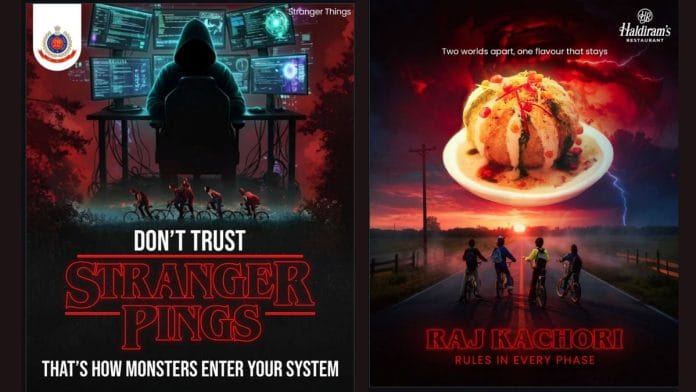



New Delhi: In 2016, a group of plucky teenagers from the fictional town of Hawkins took the internet by storm. Netflix’s gamble with the Duffer Brothers’ Stranger Things paid off and catapulted the then child actors to stardom. Nearly a decade later, the show is back for its fifth and final season, and the internet can’t get enough of it. From memes, theories, and trends, Stranger Things is everywhere.
From KitKat to Ambuja Cement, everyone is jumping on the ‘Upside Down’ bandwagon. While the show’s marketing is inherently reliant on nostalgia and the lure of times past, the current marketing trend is more focused on a struggle to stay relevant.
The final season will be released in three parts. The first four episodes hit the streaming platform on 26 November with the next three set for 25 December, and an epic finale set for New Year’s Eve.
Cashing in on the hype
‘Nostalgia marketing’ relies on using cues from the past to evoke emotions, a tool employed by the Netflix show, which is set in the 80s. The show evokes powerful sentiments and emotions across generations, leaving the room open for brands to monetise on its popularity by using similar aesthetics.
“Stranger Things has become marketing gold because it systematically triggers our most powerful nostalgic memories. From a psychological perspective, nostalgia is the warm glow of the past, conjured up into the present moment. This happens through what we call ‘rosy retrospection’: our brains naturally filter out negative memories faster than positive ones, so the older we get, the better the past looks,” said Matt Johnson, professor of Marketing Psychology at Hult Business School.
Boroline, India Post, Amul, and more have all joined the fight against ‘Vecna’. The Amul girl, as Eleven, has joined the Hawkins gang to fight the demons of the Upside Down, one buttery spoonful at a time. Meanwhile, Parle G is providing the perfect snack for surviving the topsy-turvy world, and if you need a break from the Upside Down, have a KitKat.
And for a little extra protection, Durex is there for all HawKINKS.
Much like Dustin’s Cerebro, a wide-range radio, India Post promises to keep you connected because otherwise ‘life would be Upside Down.’
The increase in a Stranger Things-focused marketing drive is also a push by brands to stay relevant. The phenomenon, known as ‘trend-jacking’, is a common practice.
Marketers often use these strategies to transport viewers back to their childhood, Dr Johnson said. “Brands understand that nostalgia marketing doesn’t just sell products; it sells emotional connections. When you put on those vintage-inspired sneakers or drink from a retro Coke can, you’re not just making a purchase. You’re buying a ticket back to a time your brain has convinced you was simpler, happier, and better.”
In fact, some brands like Swiggy Instamart have gone so far as to add a new user interface that allows the consumer to add items to their basket using ‘telekinetic’ powers.
Perhaps this is why it is commonplace to find Jindal Steel, Astral Pipes and Mahindra Thar in all dimensions. Almost making one wonder if they too were at Dr Brenner’s lab.
With market competition at an all-time high, adding visibility and staying on the consumer’s radar and interest is an essential marketing tool.
Also read: Kursi of power vs kursi of people—Nilkamal chair ad is clever in its politics
Upside Down legalese
While brands partnered with the media giant or the show can legally use the copyrighted material, most are just walking the fine line of infringement.
Brands can legally use the hype around a show or a movie to market their product, but cannot use the show’s actual name or images. In such cases, brands mostly rely on implied association by using certain colours (think, red and black clouds), or a certain theme (re: for all dimensions).
A Delhi-based lawyer ThePrint spoke to on the condition of anonymity, said, “In a world where every brand wants a taste of the Upside Down, the real question is: where does inspiration end and infringement begin?”