





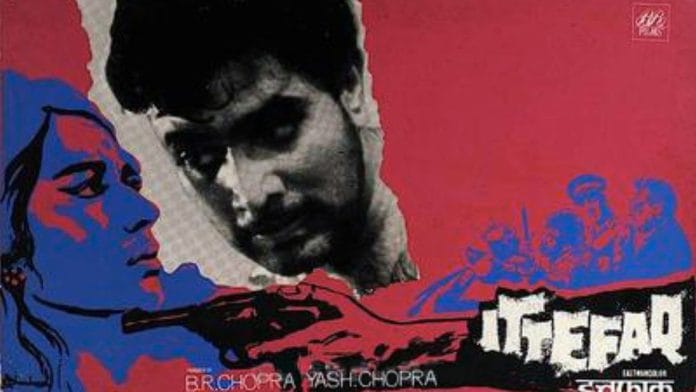



Not many know that Yash Chopra’s small-budget 1969 film Ittefaq gave a massive push to Rajesh Khanna. He had a string of flops leading up to the film.
Though his debut film, Aakhri Khat, was India’s Oscar submission for 1967, the subsequent ones—Raaz (1967), Baharon Ke Sapne (1967), Aurat (1967), and Shrimanji (1968)—flopped commercially.
Produced under the BR Films banner and shot in 28 days, Ittefaq was a thriller that had no songs, no dance, no big star, and no romantic arcs. Khanna played a painter, Dilip Roy, accused of his wife’s murder.
Suspicion hung over his every word and gesture.
Held by the police on the basis of circumstantial evidence, he had no way to prove his innocence. He escapes and stumbles upon the scene of a second murder. Solving these two murder cases forms the plot of the film.
The 95-minute-long film introduces suspects in the murder cases at appropriate points, keeping viewers on the edge of their seats right until the end. Yash Chopra kept the script tight. Not a single scene or character felt unnecessary. Be it the police inspector investigating the case or the woman claiming she witnessed one of the murders, each one played a pivotal role in the narrative.
The film also featured Nanda, Bindu, Iftekhar, and Sujit Kumar.
Ittefaq was another example of Yash Chopra’s Midas touch, but the filmmaker never intended to make the film. Chopra was directing Aadmi Aur Insaan at the time when the film’s heroine, Saira Banu, fell ill and had to be rushed to England for treatment. The unit was left waiting and facing losses. That was when Yash and BR Chopra decided to shoot a film on a shoestring budget within 28 days at Rajkamal Studio.
Ittefaq was adapted from a Gujarati play Dhumas, which, in turn, was inspired by the 1965 Hollywood film, Signpost to Murder.
Also read: 1978 film Shalimar had Dharmendra, Zeenat, and the biggest budget of its time. It still bombed
No commercial elements
Rajesh Khanna’s performance is the film’s quiet triumph. Known at the time for his romantic charm and emotional vulnerability, his portrayal relied heavily on his eyes and body language. He is persuasive, vulnerable, defensive, and possibly manipulative, all at once.
Khanna doesn’t seek sympathy, allowing the audience to constantly question his innocence. Nanda matches him with remarkable poise. Her performance is emotionally charged.
The dynamic between the two actors drives the film forward, turning what could have felt stage-bound into a gripping cinematic experience.
What makes Ittefaq particularly significant is how different it was from the films of its time. In an era flooded with musicals and scripts bound by morality, Ittefaq offered ambiguity.
It wasn’t grand. The film unfolded largely within a single setting. The absence of traditional commercial elements was not a gimmick but a deliberate choice that added to the tension and realism. The film trusted its audience to stay engaged without the usual distractions.
The film’s modest budget ultimately became one of its greatest strengths. Working with limited resources compelled a sharp creative focus, leading to crisp pacing and an emphasis on performances and atmosphere. Through the use of lighting, shadows, and rain-drenched imagery, Chopra heightened the sense of suspense, demonstrating that cinematic craft matters far more than scale.
Also read: Manchali is Bollywood’s masala take on Shakespeare—a husband for hire and his bratty bride
A career milestone
In retrospect, Ittefaq feels ahead of its time. It was a psychological thriller that challenged audience expectations and industry norms. Its success proved that strong storytelling and compelling performances could triumph even without lavish budgets or the tried and tested ingredients.
That said, viewed through today’s lens, Ittefaq may not hold up entirely for viewers who prioritise technical polish and modern filmmaking finesse. Certain cinematography choices, shaped by the limitations and conventions of its time, feel dated today.
However, its core strength, Chopra’s storytelling and Khanna’s performance, remains difficult to replicate. This is perhaps why the 2017 remake of the same name, starring Sidharth Malhotra and Sonakshi Sinha, couldn’t outshine Chopra’s, despite updated visuals and production values.
Ittefaq will always stand as a milestone in Khanna’s career. He followed it up with blockbusters Aradhana and Do Raaste in the same year, which cemented Khanna’s image as India’s first superstar.
Views are personal.
(Edited by Theres Sudeep)