





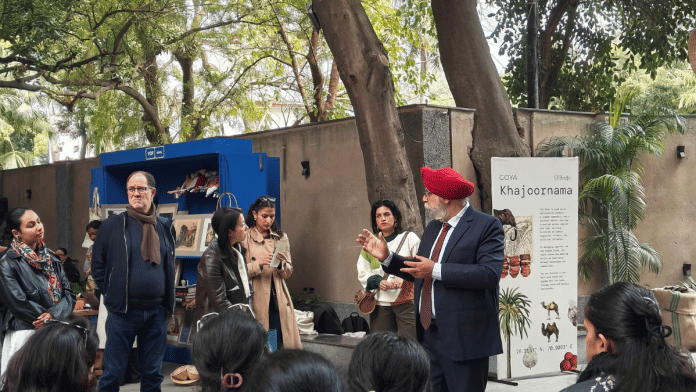



New Delhi: At 11 am on a sunny Sunday morning in an open space attached to Delhi’s Triveni Kala Sangam, filled up with attendees looking forward to not just sampling a menu of date-inspired snacks but also to know more about the fruit’s relationship with farming, climate, ritual and religion.
The curated event called ‘Khajoornama’, featured a talk, a grazing table and insight about the date industry of India, was held on 1 February, the name was derived from the Mughal adaptation of Hindi and Arabic. With farm aggregator Ajit Singh, chef Taiyabba Ali, and political scientist Sucharita Sengupta in conversation.
“Pre-Partition India was one of the top five producers of dates in the world. But after Partition, all the date-growing areas went to Pakistan; farmers here do not grow the fruit anymore,” said Batra in his talk.
Batra spoke of the many connotations that dates have, from being the blessed fruit mentioned in the Bible about the birth of Jesus to even the seed of the fruit helping those travelling in deserts, often called the “meat of the desert. The fruit symbolises peace and prosperity in the Bible. Batra also explained why it’s seen as a complete fruit, consumable in every stage of its maturity.
India is the largest importer of dates in the world, but now Indian entrepreneurs are investing money, time and energy into the practices of growing and exporting dates, from Gujarat and Rajasthan to Tamil Nadu and Kerala.
Khajoornama
Batra’s talk explained the four important stages that the fruit passes through to reach maturation – first is Hababouk, when the fruit is green and takes place roughly 4–5 weeks after pollination, followed by Khalal, to the yellow fresh fruit stage, then the semi-ripened Rutab and finally to Tamar, which is the fully ripened stage of the fruit.
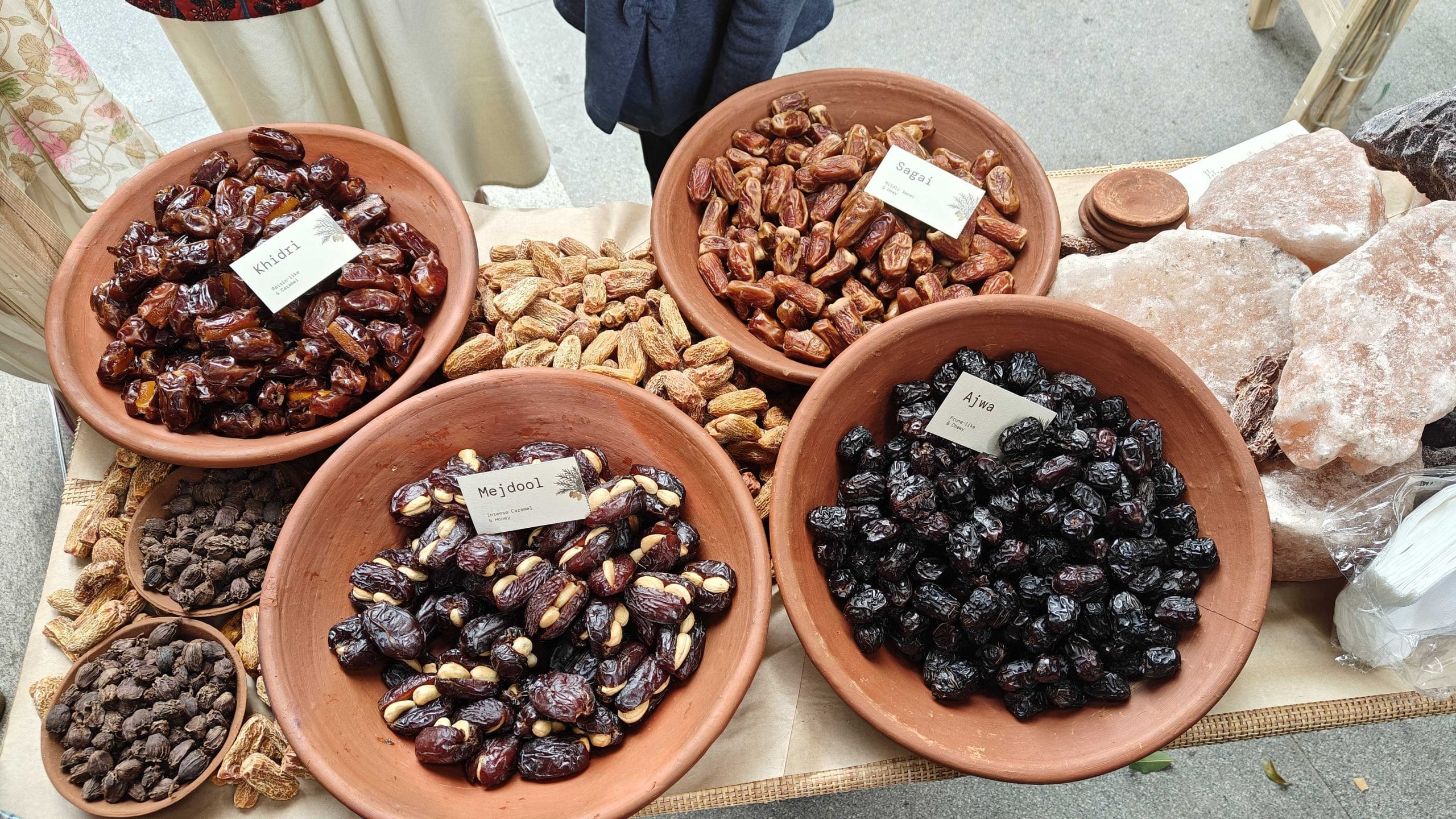
The elongated, reddish brown and medium-to-large-sized, Mejdool date, which originated from Morocco, is one of the most commercial varieties of dates grown in the world. It contains less fibre, matures mid-season and is consumed at the Tamar stage; it is often called the “king of dates”. Another popular date is Ajwa, whose significance is traced back to Prophet Muhammad planting the date palm tree and is widely consumed during the month of Ramadan, Batra explained.
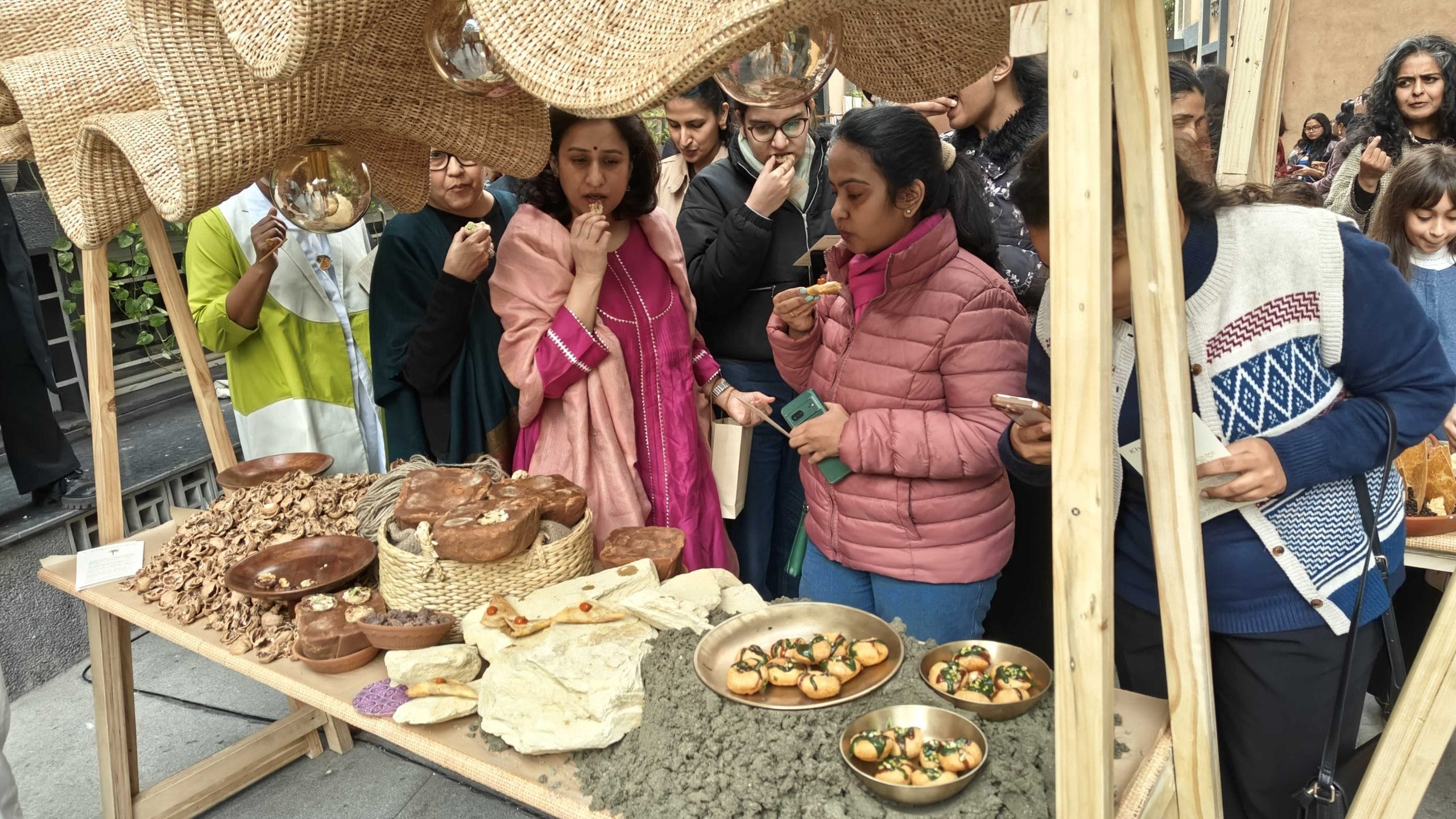
The grazing table, which displayed a variety of dates, was conceptualised by Mandavi Kanchan, founder and creative director of the artisanal dried fruits and nuts brand, Bruijn, along with designer and visual artist Shiv Kant Vyas.
Kanchan also consulted with Batra to sell dates in the Indian market.
“We started with the most popular variety called Mejdool, followed by Ajwa. We plan to introduce more medicinal variants, which would be less sweet. We started with 500 kgs a year around Covid, and now it has expanded to 2500 kgs. There is a lot of demand for homegrown dates,” said Kanchan.
The thought and effort behind the event were evident in the placement and decor. The seats were created by Priyanka Narula of The Wicker Story to match the theme of the event.
“I was inspired by muggu, to create the seating, which can be placed in a variety of combinations and also the lights, to recreate a bed of flowers, so that people could sit in an intimate setting for the event, and it gives the feel of a community. The materials used are wicker and rattan,” Narula told ThePrint.
Also Read: Himachal farmers are ditching apples for persimmons. ‘Earnings on par with JEE packages’
The grazing table
Chef Taiyabba Ali made use of a variety of dates to give a twist to some regional favourite snacks, and paid homage to the versatile fruit and its derivatives. She whipped up snacks like a walnut date fudge, combining dates and walnuts from Kashmir, the Rajasthan-inspired kharak samosa with a date filling, and achari khajoor khakra as a nod to Gujarat. The Bandel khajoor chop was a tribute to West Bengal’s famous street food, but with dates.
The food, too, creatively with shells of walnut and slabs of jaggery, to indicate items that were often exported or imported alongside dates or were by-products of the fruit. The jaggery turned out to be an object of curiosity for many, with one man in particular wondering if it was meant for eating or just decoration.
Following the talk, the food was served, and women dressed in the finest of Indian handlooms immediately placed themselves at the table, sampling the chef’s fare. The items vanished almost immediately, and servers started passing around trays of food, along with tea in kulhads (clay cups).
But beyond the food, the attendees were clearly curious to know more about the fruit, and struck up conversations with Batra, Vyas, and Kanchan.
“Dates have been seen in context with the Arab world, but Indians have been importing dates for 4000 years, from Gujarat to Malabar. But now, date products have gained popularity – like Bengal’s nolen gur, or date syrup. GI tags are helping but it is also a lot of marketing,” said Vyas.
(Edited by Insha Jalil Waziri)