





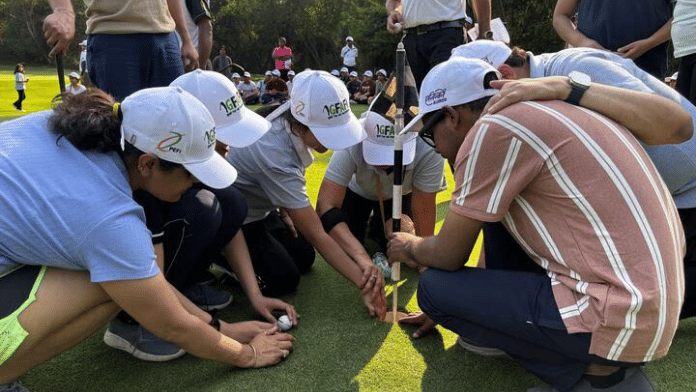



New Delhi: A visually impaired child bends over a putting green at the Delhi Golf Club as an able-bodied buddy guides her hand along the grass, helping her feel the slope before she swings. The “buddy format” was the defining feature of the Golf for All Inclusive Skill Training Camp, held from 28-3 March, where children with disabilities teamed up with volunteers to learn the basics of golf through touch, patience, and partnership.
Archana Singh, who holds a PhD in Disability Studies, started the initiative in 2012, backed up by the Ministry of Social Justice and Empowerment.
The camp highlighted that different players needed varied times to adjust to the many techniques in golf for which the buddies’ help was paramount. It allowed for one-on-one coaching and training.
For the visually impaired participants, the buddies described what the coach was teaching by making them feel it. If the coach explained the size of the golf ball then the buddy would place it in the participants palm. When measuring the distance between the hole and the putting green, the volunteers helped the participants trace the cup and edge.
Instructions were translated into touch, movement and sound for an inclusive experience.
Also Read: Who gets to be ‘normal’ at the workplace? Ask people with disabilities
The camp
“Not everybody can make a livelihood from golf. Only a tiny fraction of golfers turn professional. The point is character. The real point of this camp is to create an inclusive sporting environment where ability does not define access to sports,” Jasjit Singh, former National Coach of India (Golf), told ThePrint.
Singh, who led the sessions on core techniques, added that children were asked to maintain their own scorecards as well, so they could understand that writing a wrong score would be cheating, while accepting a correct one would teach integrity.
He highlighted that the camp only conducted beginner-level training and taught the fundamentals of golf so that everyone, regardless of ability, could participate.
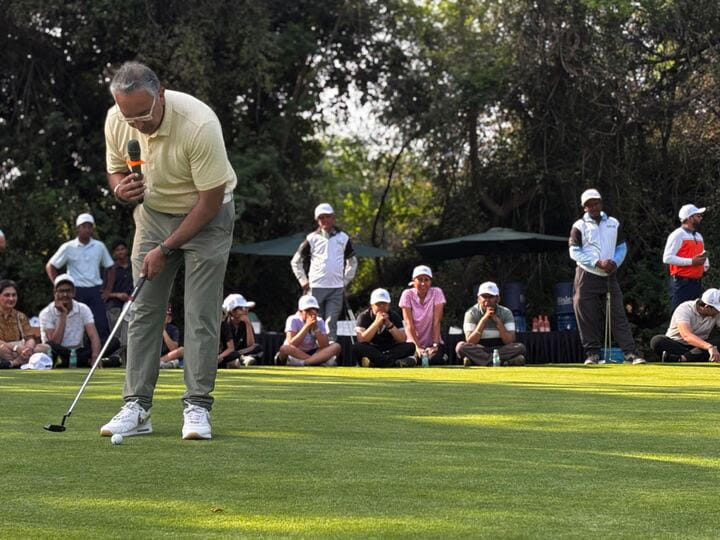
The drills were designed around basics like how to hold the club, how to stand, how to aim, how to control a short putt or how to chip the ball.
Among those present on day one of the camp to encourage young kids was Vishwa Vardhan Bhati, a one-handed athlete, who previously represented India in para-cricket before turning to golf in 2023.
He has represented India internationally, playing in the English Open for Golfers with Disability in England and the Daikin Madrid Open for players with disabilities in Spain in 2025.
Bhati explained that training at such a camp is very different from regular golf training. Able-bodied players typically have full use of both hands and complete body movement, but here, some participants play with one hand, while others face leg challenges.
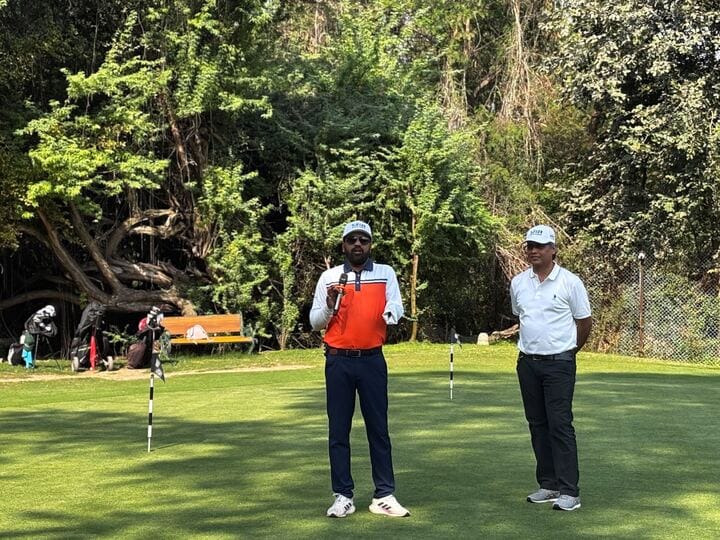
“If you see, for the other people, they are able-bodied. They have full-body movements. And in golf, you need a lot of body movements. And with these children, you need to have special skills. There are a lot of people who will be playing with one hand. They will be playing with difficulty in their leg. So, it becomes a challenge for the coach also to help them to train in a special manner.”
Bhati said that although rules and equipment are standardised for all, coaches need to adopt specialised techniques and have greater patience and skill in camps like these.
Also Read: Six disabled people picked to turn their lived reality into govt policy
An unforgettable experience
The buddy format gave some unexpected experiences to the participants.
Naureen, one of the buddies, admitted that she was a little anxious before coming to the camp. But after meeting her buddy, Radhika, who is visually impaired, Naureen said she was awestruck to see the composure with which the young girl played. She recalled that Radhika never once said, “I can’t do it.”
Radhika, who lost her vision in 2023 after suffering from brain tuberculosis, was playing golf for the first time. She had joined the camp through the National Association for the Blind in Hauz Khas.
“Earlier, I was a little edgy. I didn’t know how I would handle it. But the way she carries herself and talks, I feel comfortable with her now. I was especially curious about how visually impaired players connect with the game — how they manage and use their other senses to understand and play. That’s what intrigued me,” Naureen said.
Another enthusiastic participant was Pradeep, who has a locomotor disability. After contracting polio when he was four-and-a-half years old, Pradeep was left with a 79 per cent disability. He admitted that he never felt less than while playing gold.
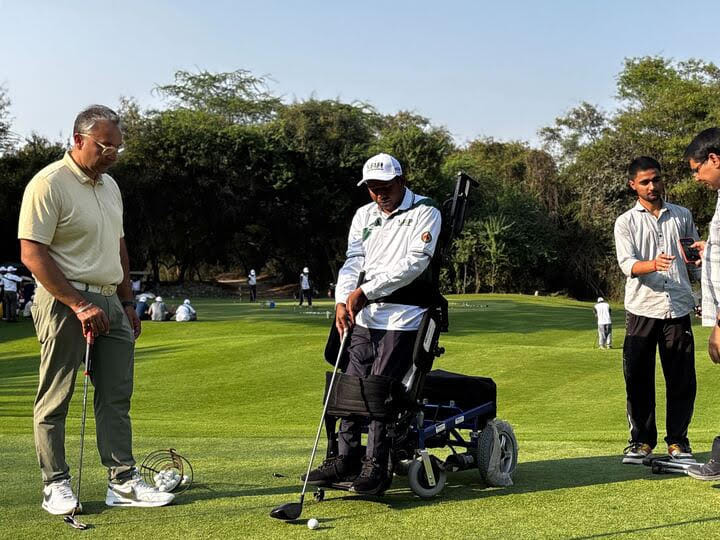
Pradeep first started playing the sport in 2012; it was introduced to him by Archana Singh. He does not use specialised equipment and could be seen using a wheelchair that another player with disabilities, Nekram, had designed to cross the greens.
“Golf is an interesting game. It helps you understand your focus, strengths, and abilities. It teaches patience and power. There is a lot you can learn from golf,” Pradeep said.
“At this camp, the trainers and volunteers have been very patient with us. They teach us properly, and because of that I could learn putting easily,” he added.
Nekram was among the several wheelchair users who had come to play golf in the first camp. He was so inspired by the game that he went on to create an innovation of his own, a standing wheelchair designed specifically for golf.
Nearly 13 to 14 years later, he brought that same innovation back to be tested in this camp.
Archana reached out to various special schools and NGOs that work closely with children with disabilities, and asked them if the children could attend the camp.
“We usually connect with special schools and NGOs that are already doing good work in this space. We tie up with them and bring their children here,” the head coach said.
(Edited by Insha Jalil Waziri)