





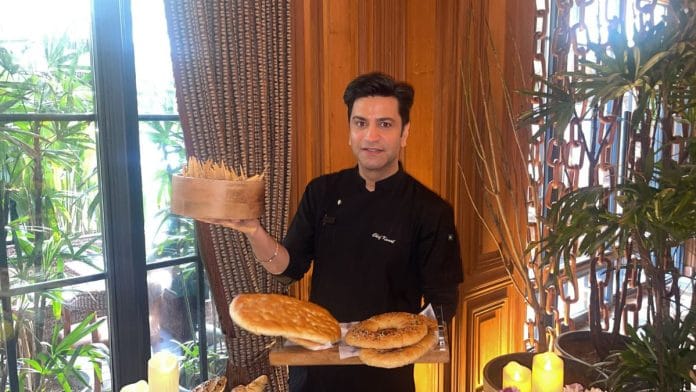



New Delhi: Celebrity Chef Kunal Kapur said that if he had to pair the flavours of Saudi Arabia with those of an Indian state, his choice would be Bihar.
The chef explained that the two cuisines share several similarities, with the primary difference lying in the type of oil they use.
“The way we make chokha, roasted aubergine mixed with onions and tomatoes, we use raw mustard seed oil, which gives it a sharp kick. Meanwhile, Saudi Arabia’s love for aubergines is not a secret. Roasted aubergine appears in popular dips like baba ganoush,” Kapur told ThePrint at the launch of his week-long The Saudi Table menu at One8 Commune on 11 December.
He added that while Saudi cuisine relies on olive oil, which is native to the region, Bihar uses mustard oil. Apart from that, the dishes often look similar. It’s the oil that changes the flavour profile.
The Saudi Table is an initiative by the Saudi Tourism Authority in collaboration with Virat Kohli’s One8 Commune in Gurugram’s Golf Course Road, to showcase Saudi flavours in Delhi NCR.
It’s part of the growing ties between the two countries. Earlier this year, Prime Minister Narendra Modi called Saudi Arabia a “trusted friend and strategic ally,” emphasising the significant expansion of bilateral relations since the creation of the Strategic Partnership Council in 2019.
India-Saudi food trade is also rapidly growing, driven by Saudi food security goals, with India becoming a major supplier of rice, red meat, sugar, infant milk powder, and seafood, among other things.
Saudi Agricultural & Livestock Investment Company (SALIC), owned by public investment, has taken a minority stake (33 per cent) in LT Foods—an Indian multinational rice brand. Multiple Indian delegations have been participating in Saudi Food exhibitions, including Saudi HORECA, Saudi Food Show and FoodEx.
Also read: When did Saudi Arabia ban alcohol? And why it is easing restrictions now
Saudi cuisine is unique
Inside the restaurant, guests are first welcomed by a grazing table that leads into an elaborate menu featuring small plates, large plates, hot and cold mezze, and desserts. The menu will be available from 12 December to 18 December.
Curated by Kapur, the menu celebrates Saudi dishes such as grilled halloumi and aubergine, cheese sambusa, za’atar manakish, pickle and labneh flatbread, kawarma meatballs, kabsa, seafood pilaf, and baklava, all presented in a community-style dining format.
Kapur noted that Saudi cuisine is often wrongly lumped together with Middle Eastern food. While the two share similarities, they are also distinctly different.
“Saudi Arabia has its own unique produce, and the dishes made from it are very distinctive. Saudi doesn’t just mean deserts. There are mountains, the Red Sea, coral reefs, fresh seafood, lamb, and a wide range of vegetarian dishes as well,” he said, describing Saudi cuisine as “produce-driven.”
Ingredients such as dates, wheat, rice, lamb, camel milk, and fresh seafood from the Red Sea form the base of Saudi cuisine. A variety of vegetables and herbs such as tomatoes, potatoes, eggplants, cucumbers, onions, parsley, dill and coriander form the backbone of everyday meals.
The food is mild, aromatic, and comforting, allowing ingredients such as saffron, cardamom, dried limes, or nuts to add flavour without overwhelming the palate.
Saudi cooking doesn’t mask the local produce with multiple layers of spice; it highlights their inherent flavours through simple techniques like grilling, slow simmering, or roasting, the chef explained.
“The cooking techniques are another common factor between the two countries,” he added.
Also read: Saudi Arabia is looking beyond oil to engage with India. Green energy to AI
‘Wearing an old glove’
Kapur is preparing for his first visit to Saudi Arabia soon. However, his understanding of Saudi cuisine already runs deep. It is mostly shaped by his collaborations with Saudi chefs and the meals he has cooked and shared in Saudi households.
The chef says he cannot ignore the natural overlap between Indian and Saudi food cultures. The two regions have traded for centuries, spices and rice being the most significant commodities, and both remain staples in Saudi kitchens today.
Kapur also pointed out that a large and long-established Indian diaspora in Saudi Arabia has enriched culinary connections between the two countries. As a result, flavours, techniques, and even meal traditions have quietly travelled back and forth for generations.
“Cooking or eating Saudi food feels like wearing an old glove. Therefore, shifting from Indian food to Saudi is seamless. You don’t feel that dramatic shift the way you feel with the Far East or the Far West cuisines. The ingredients and palate are different yet still comfortably relatable.”
For the chef, kabsa is the best example of Indian-Saudi culinary kinship.
“Indians are obsessed with biryani and pulao. Kabsa isn’t biryani, but their style of rice preparation comes very close to ours,” he said.
Chicken kabsa consists of roast chicken served with a tomato-based gravy and fragrant saffron-and-nut rice. These flavours, according to Kapur, instantly remind Indians of home.
“Saudi food is served in large communal bowls, with everyone sitting around and enjoying it together. It’s very similar to how we eat in India,” Kapur added.
Among the other highlights of The Saudi Table are kunafa and freshly made flatbreads, which the chef considers essential for anyone exploring Saudi cuisine for the first time.
He also pointed out an interesting overlap in something as simple as soups.
While daal ka shorba is not widely known across India, the flavour profile is instantly familiar because lentils are a cornerstone of Indian cooking.
“In Saudi Arabia, daal soup is extremely popular, much like tomato or chicken soup in India,” the chef said.
(Edited by Theres Sudeep)