








New Delhi: Neither a travelogue nor a memoir, a new book unpacks memory through essays about cities as disparate as Venice and Bangalore, Varanasi and Mumbai. Written over two decades and across 13 cities, Ananya Vajpeyi’s latest book is a history of time, space, and people.
The essays, some written for the book and others years earlier, are all deeply personal and intimate encounters between the author and the contemporary world. She draws parallels not only from world history but also from her own life, and they carry a deep sense of melancholy. “I am a happy person but my outlook is not happy,” said Vajpeyi.
Publisher Ritu Menon of Women Unlimited said in her introductory remarks that the book “subverts expectations, layers the city with memory, intimacy, and space, and strikes a responsive chord with the reader.”
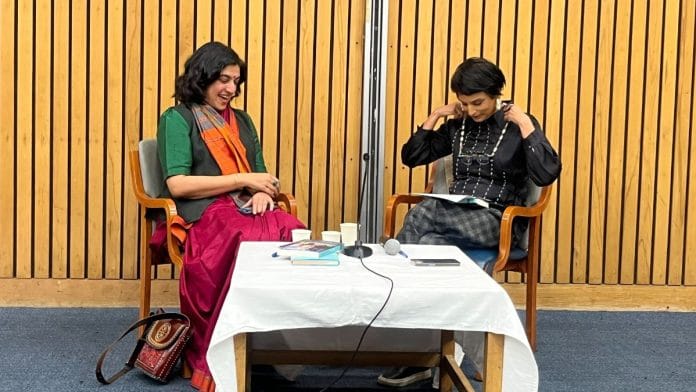
On 11 January, Vajpeyi, in conversation with writer and journalist Pallavi Aiyar, released her book, Place: Intimate Encounters with Cities, at the India International Centre in New Delhi. From psychologist Ashis Nandy, professor Zoya Hasan to political theorist Rajeev Bhargava, friends, academics, and students packed into the seminar hall on a bitterly cold winter evening for an honest, intimate, and at times deeply moving conversation.
The unhurried pace of the conversation, the thoughtful and occasionally rambling but deeply personal responses from the author, and the attentive audience made for a charming book discussion — one that was markedly different from the babel of voices that usually mark such occasions about town.
Describing the book as a “discursive mapping of cities and of personal geography”, Aiyar started off the discussion by asking why and how the book came to be written, to which Vajpeyi credited her publisher for coming up with the name, and even the title. As Vajpeyi put it, the book was largely a result of “bowing to a greater power — the editorial power” — a quip that got a quick laugh from the audience.
Aiyar went on to ask Vajpeyi about the underlying note of “melancholy” in how she unpacks the world and pointed out that, in the book, she described herself as “addicted to the pain of others”. Vajpeyi admitted, saying, “I am obsessively empathetic. It is how I experience solidarity. I am a bookworm by nature. So to have a sense of reality, of the world around me, I need to learn from people. I need to start reading them.”
Vajpeyi went on to say that she was interested in the human mind and the human landscape. “It provides perspective. People are more educational than book knowledge.”
One of the central themes of the book is a sense of loss. Vajpeyi in her blurb poses the questions: How do we lose what we lose? Why do we love whom we love?
There are multiple referents scattered across the essays — cities to books — but the most prominent is her parents. Vajpeyi said that her parents were “inseparable” from her. Her writing, she said, was “the sum of their love, it exceeds the loss of them or the end of it.”
‘A complex timeline’
Vajpeyi almost views time and space interchangeably, she walks through the past to the present. “Several things are happening at the time, on some occasions I am revisiting the place after years and so I may write about multiple visits. But I am also looking at historical material, books, personal accounts, photographs, films, etc, things that go further back than my own experience and I tie them altogether.”
She gave the example of her essay on Varanasi, ‘Kashi Karvat’. “The timeline is very complex, I am writing about my time there over the years and also reflecting on the time the poet Kabir spent there, I am mentally revisiting the space. Even if a space changes or remains the space, I am revisiting it from multiple dimensions and realities,” she said.
Vajpeyi said that she does not travel for the sake of travelling. For her, it is about connecting to the place, which entails often traveling to the same space. “My own repetitive way of travelling deepens my understanding of the space and helps keep my relationship alive both to the space and to the people. It builds a connection almost approaching belonging because it has withstood so many changes in my life. I enjoy experiencing the place from different points of view and vantages in my life,” she added.
Also read: Women voters are a political force, a ‘powerful revolution’ is underway: Shamika Ravi
Language and space
Vajpeyi in her book walks the reader through her journeys — they may be travels or they may be work and research. Aiyar questioned Vajpeyi on one such instance — her time in Bangalore studying the Sanskrit language.
She described her time learning the ancient Indian language in 1999 as one where she cried almost all the time.
“Something about it scrambled my brain. At that time, Bangalore was all about the ‘New India’ and a certain cosmopolitanism, and nobody was interested in the history of Karnataka or the Deccan or the ancient language. Nobody was interested in that except for me, and I just couldn’t fit in that world,” Vajpeyi said.
She went on to say that this was the same time when the world and the country were witnessing major historical events such as 9/11 and the 2002 Gujarat riots, “The contemporary took over. I felt even more alienated from my own historical and premodern questions that I had for my thesis. I had to respond to what was happening in society at that time.”
Vajpeyi went on to add that even the process of learning the texts was difficult because people had assumptions about it. “There is a social set of assumptions and questions of access that are built into it from which non-male and non-Brahmin users are explicitly and continuously excluded. It is patriarchal and sexist.”
She said that as someone who is committed not only to preserving the history and the texts but also to egalitarian values, it was a struggle following the two belief systems. She credited BR Ambedkar with articulating the shock she felt upon encountering these ancient texts and grappling with their nuances. “He articulates it without embarrassment and confusion because he sees himself as an outsider too. Political modernity in India is the result of coupling Gandhi and Ambedkar with caste on one hand and religion on the other.”
Vajpeyi talked about how Ambedkar was a sort of roadmap for her travels and even inspired some of the places she visited. She then went on to mention her plans for her next book on the jurist.
“Ambedkar is so scholarly in many ways, and I could easily identify with his way of thinking historically and politically, and he became a sort of beacon or lighthouse. No matter where I was going, I felt that if there was a bigger connection, I’m going to go and look at it.”
(Edited by Aamaan Alam Khan)