





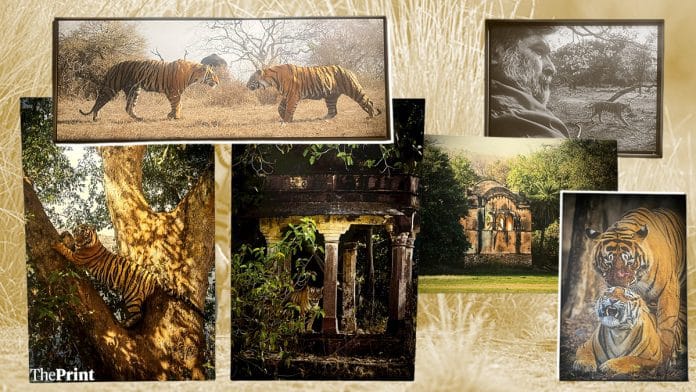



New Delhi: Environmentalists, nature-lovers and photography enthusiasts gathered at New Delhi’s Bikaner House Tuesday for the launch of ‘Ranthambhore—50 Iconic Years’, an exhibition featuring pictures from the book of the same name co-authored by Valmik Thapar and Kairav Engineer.
The exhibition is a tribute to legendary Indian conservationist and writer Thapar, who died on 31 May last year before witnessing the project’s fruition. It will be on display till 24 January, between 11 am and 7 pm at the Bikaner House.
The two-part coffee table book is the profound final collaboration with the late “Tiger Man of India” and has been curated from five decades of documentation from the Ranthambore National Park.
In 2025, Thapar said that the book contains some of the best tiger encounters he had in the last 50 years. “Such a compilation has never taken place, and I doubt if it will ever take place again. The volumes are collectors’ items,” he had said.
The books chronicle how Ranthambore went from a “one-horse town to full of horse carriages” and the smallest of the nine tiger reserves in 1976 to its present stately glory.
Engineer, a photographer and the executive director at Astral Limited, manufacturer of plastic pipes, told ThePrint that they originally had 5,000 pictures but eventually reduced the numbers. The book features contributions from more than 130 Indian and international photographers, he added.
Why Ranthambore?
The book chronicles Ranthambore’s journey over half a century, beyond just a tribal reserve, but as a place where nature and history converge.
Thapar had said that “Ranthambore is an extraordinary natural world that is magical, like no other. It is where the memories of man are entangled with the world of the tiger and the history of the area that goes back 1,700 years.”
For Engineer, the area had always been of interest. “Ranthambore has always been more than just a jungle. For those who have walked its ancient paths. Heard the alarm calls echo through the gorges and locked eyes — just for a moment with a tiger in the wild. It becomes a part of you,” wrote an inscription by the photographer.
“What drew me to Ranthambore was that it never tries to impress you. It makes you earn it. It is a forest that reveals itself slowly. You have to keep returning with patience, stillness, and without expectation, and only then does it begin to open up,” Engineer told ThePrint.
He said that the park has a “unique” character — it is not just a tiger reserve, for him, but a “living landscape” shaped by time.
It is this ideology that is visible in the pictures chosen; there is a constant overlap between nature and history, showing the rarity of the place where the “wild and the past occupy the same frame”.
“The tiger here does not just walk through wilderness, it walks through history. That overlap is also central to what the book is trying to document: 50 years of a landscape evolving, not only in terms of wildlife, but also in terms of how humans have related to this place across time,” he said.
For Engineer, the book was never about the greatest tiger sightings, but rather a representation of Ranthambore’s many truths.
Also read: 100 years of painter Satish Gujral on display—pain of Partition to hope of nation-building
The exhibition
Temporary walls encircled the outdoor seating, filled with photographs printed on canvas showing the wildness and calm of the natural world alike.
Past the bars and buffet, the first floor of the exhibit displays the “Historical Bedrock”, which traces the transformation of the park from the Mughal era to the current day. It is traced through historical maps, documents, and unique artworks and examines the “early wildlife” period, showcasing the distinctive harmony between humans and predators in the remnants of the Ranthambore Fort.
Near a winding staircase leading to the second floor is the timeline corridor that showcases all the wildlife milestones for the park. Ending with the film room, which offers a cinematic homage to the man who introduced the Indian tiger to the world’s living rooms, with rare footage and screenings of Valmik Thapar’s famous works.
The top floor is dedicated to the park’s wildlife and nature, showcasing the collective efforts of the publication. The exhibit includes images from a broad community of photographers who have explored Ranthambhore over the past 50 years. These images are paired with an audio backdrop captured in the Ranthambhore wilderness.
Shivang Mehta, Jaisal Singh, Balendu Singh, Gaurav Ramnarayan, and Tejbir Singh are among several other photographers who have been featured in the exhibition. Pictures of and by Thapar’s mentor, Fateh Singh Rathore, also adorn the walls of the exhibition. Much like the photos themselves, the artists also function as a timeline of how Ranthambore had changed over the years.
“I want people to take away a deeper understanding of Ranthambhore, not just as a destination, but as a memory of the forest captured over decades,” Engineer said.
(Edited by Saptak Datta)