





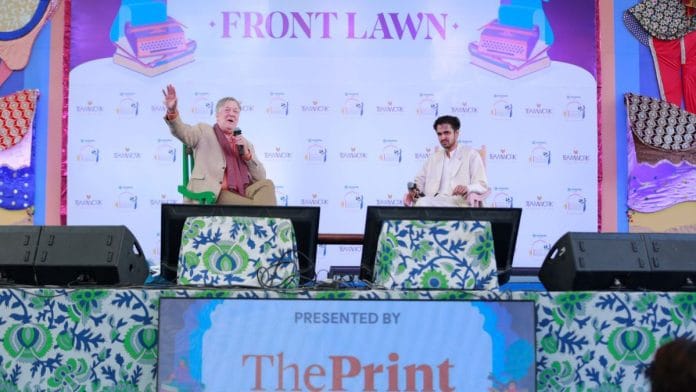



Jaipur: Apple founder Steve Jobs once told his friend, writer and comedian Stephen Fry, that he was “weird”. Fry once tried convincing Jobs that “laptop machines” was an anagram of “Apple Macintosh”.
This, however, was neither the first nor the last time the Making History author anagrammed a friend. He once told British actor Alec Guinness of Star Wars fame that his name was an anagram of the term “genuine class”. Guinness replied that he would remember Fry in his will.
Fry was in conversation with politician Anish Gawande for ‘A Bit of Fry’ session at the Jaipur Literature Festival on 16 January.
With his wit and command of the language, the author had the crowd in the palm of his hand. Thirty minutes before the session was set to end, a queue had already formed at the signing table, desperate for a piece of him.
The venue, Vedanta Front Lawn, was a spectacle to behold as fellow writers and panellists, along with fans, piled in to catch a glimpse of the star.
The name of the session was derived from the British sketch comedy television series “A Bit of Fry & Laurie” starring Fry along with Hugh Laurie. Fry was also the original host of the comedy panel show QI. Odyssey was the latest instalment in his Greek Myths series.
Gawande steered the conversation to Fry’s journey—from a man who once stole credit cards and went to jail to one of television’s most beloved figures—calling him an “unlikely treasure”. He asked Fry how he makes sense of this odyssey.
“When I look back at my time, I think the answer lies in a very strange affliction of mine, my love of language. I discovered very quickly that I was very bad at everything that mattered, especially in a boarding school where the most important thing was sports. I couldn’t run in a straight line; I’d collide with a tree. I couldn’t sing, I couldn’t clap in time to music, and I couldn’t dance. I didn’t have sports or music, but I had language,” he replied.
Fry went on to say that we are all enjoying language in different forms, either by speaking, listening or reading. “We all enjoy the nature of language. People don’t often think of language as something beautiful. But I think of the tongue hitting the roof of the mouth as something that expresses thought and feelings. It was considered elitist to an extent, but it was the only thing that I felt comfortable with. It has been my salvation. It’s everything I am,” he said.
Intellectual glands tickled
Gawande commented on Fry’s almost “ivory tower intellectual” command over the English language and asked how Fry sees the link between language and humour.
The author recalled a story from when he was around 10-11 years old, living in the countryside. He said they didn’t use the television very often, but on a rainy Sunday, he watched a film and noticed that everyone was speaking in the “most extraordinary way”. He remembered a scene where a man said, “I hope I shall not offend you if I state quite frankly and openly that you seem to me to be…” and recalled feeling as though he had been “sandbagged”.
“I didn’t know that language could do this. In fact, afterwards, I ran to my mummy and recited this to her. That’s when I found out it was Oscar Wilde’s The Importance of Being Earnest. That’s where all the uses of language sort of made manifest in the most joyful way,” Fry said.
He added that just saying “I love you” can never match up to the parcel of words in Wilde’s sentence. One is sure to be charmed by it. The Irish author and poet has greatly influenced Fry’s understanding of the literary and the physical world.
The author added that while he loves slapstick comedy, he is drawn to things that tickle the mind. And that people are more intelligent and hungry for ideas, insight and jokes that exist on the plane of thought and concept than they are often given credit for.
Also read: ‘Don’t pin all hopes on institutions’—at JLF 2026 debate of lawyers
Life behind the scenes
Fry briefly spoke about his time using substances. It was his friend and American novelist Jay McInerney who encouraged him to stop. “Stephen, when you are born you are given a swimming pool of vodka and a bathtub of cocaine, you can’t have any more than that. I think you are on your second bathtub and your second swimming pool,” Fry recalled McInerney saying to him.
“I think one can be sorrowful about the things done to oneself but ashamed about the things done to other people. You have the right to be difficult and dangerous in your own life, but not to cause trouble to others,” he added.
And while Gawande had already called the pair “champagne socialists”, Fry did say that it was this idea of not being ashamed of oneself that drove him to come out as gay in the 1980s. “I refuse to be ashamed of who I am. I can only be ashamed of what I do.”
Talking about his struggles with mental health, bipolar disorder, he recalled what his supervisor at Cambridge told him. “You’ve got a pretty good brain, Stephen, but a terrible mind.”
ThePrint is a media partner for the Jaipur Literature Festival 2026.
(Edited by Ratan Priya)