





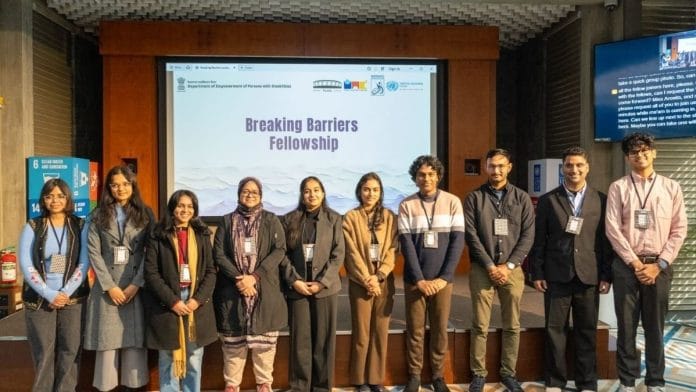



New Delhi: Six persons with disabilities, chosen under a fellowship programme, will now help the government shape policy meant to serve the disabled. But at the function to felicitate these fellows, the Department of Empowerment of Persons with Disabilities additional secretary Manmeet Kaur Nanda had a hard practical advice for them.
“The fellows will face bureaucratic hurdles, red tapism, and understand what tarikh pe tarikh mean. It is a reality of the system and we have worked with this,” said Manmeet Kaur Nanda.
With all claps and excitement, the audience welcomed the ten fellows selected for the Breaking Barrier Fellowship programme.
The cohort of 10, which also includes those who have studied the field and caregivers, will work within the Department of Empowerment of Persons with Disabilities (DEPwD) for a year.
The fellowship launched at the United Nations House in New Delhi on Friday is an initiative of the Young Leaders for Active Citizenship (YLAC), the Nipman Foundation, and the India Autism Center, in collaboration with the DEPwD. The fellows, who were chosen after a month of rigorous selection process, were introduced in the presence of Nanda, Andre M Wojnar, representative of UNFPA, Suresh Kumar Somani, Managing trustee, India Autism Centre, and Nipun Malhotra, Director of YLAC.
“The Breaking Barriers Fellows represent a generation ready to translate policy intent into lived reality,” said Wojnar.
A reorientation of disability rights
The fellowship is focused on inclusivity, with an aim to bolster the country’s commitment to the Rights of Persons with Disabilities (RPwD) Act 2016. The fellows will be placed in four major cities—Delhi, Dehradun, Mumbai and Secunderabad.
“Disability was long viewed as an individual problem that needed fixing, but we are now moving from a welfare-based approach to a rights-based environment—this is not an academic philosophy, it is a constitutional reorientation,” said Nanda.
The institutions the fellows will be working with are the Department of Empowerment of Persons with Disabilities, Pt. Deendayal Upadhyaya National Institute for Persons with Physical Disabilities, Office of the Chief Commissioner for Persons with Disabilities, The National Trust, Rehabilitation Council of India, National Institute for the Empowerment of Persons with Visual Disabilities, Ali Yavar Jung National Institute of Speech & Hearing Disabilities and National Institute for the Empowerment of Persons with Intellectual Disabilities.
Also read: Varanasi to Venice—a collection of essays traces time, space, and cities
Using personal experience
The Breaking Barrier fellowship is one of its kind for people with disabilities; it is a platform where they can bring their personal experiences and perspectives to policy-making. The fellows sitting in the second and third row were all smiles.
Niharika Mohan is a caregiver for her brother, who has autism. She wanted to bring her experience as a caregiver which has shaped how she thinks about work, care and policy.
“Caregiving doesn’t just affect personal life—it changes how you view employment, independence, and especially the realities faced by working mothers,” Mohan told ThePrint. “I wanted to explore whether policy can create real independence in the workplace for people who work, while also providing care to their loved ones”, she added.
Aquib Rahman from Kashmir wants to learn while working at the government institution and implement the same in his home state.
“This fellowship has given me the opportunity to learn systems and approaches, which I can apply back in Kashmir,” he said.
Rahman will work at the Department of Employment of Persons with Disabilities in Delhi, where he wants to promote inclusive education, especially at higher levels, where the percentage is still very low. The political science student from JNU said that in Kashmir, they do not have reliable data on inclusion, whether it is education or employment of persons with disabilities. He wants to change that.
(Edited by Theres Sudeep)