





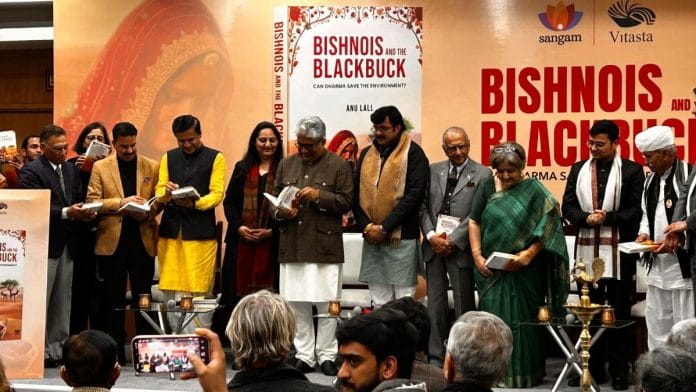



New Delhi: The Modi government is committed to protect Aravallis, said Environment Minister Bhupender Yadav at the book launch of Bishnois and the Blackbuck: Can Dharma Save the Environment by Anu Lall. He was addressing a hall full of environmental activists and members of the Bishnoi community at the Kamladevi Complex of India International Centre, New Delhi.
“There has been much discussion around the Aravalli range. I want to state clearly that the government is fully committed to its protection,” he said.
Yadav’s statement comes weeks after activists protested in Rajasthan and adjacent states against the ‘new definition’ of the forest range that encouraged widespread construction activity.
The Bishnoi community is known for resisting illegal mining, poaching and deforestation on the Aravallis.
The book traces the history of sacrifices made by the Bishnoi community to protect the environment. Lall, who took two years to finish the writing, had included the Khejarli massacre of 1730 to contemporary court battles.
The book launch was followed by an extensive panel discussion that had Lall, MK Ranjitsinh, former director of Wildlife Preservation of India, Vishal Chaurasia, founder of Hyper Quest and Lipika Bhushan, who moderated the event.
Aravallis protection
The event wasn’t like any other book launch. Activists from the Bishnoi group joined the discussion, holding banners that called for environmental protection.
“Pani ki rakhsa, jeevan ki suraksha”, “ped lagao, Oxygen pao” and more posters were hung in the room full of people. The group had arrived at the venue with the ‘no plastic use’ message. They carried water that was served in a copper container and glasses.
Lal thanked the community throughout the event.
The author said that she had spent months with the Bishnoi community, to understand their motive, their way of life and their grit to protect the animals as well as nature. She has attended their wedding, family and school functions and lived with them to understand the community.
The author recalled the Salman Khan black buck case and the imprint it had on her while she was growing up. The actor was accused of killing two blackbucks—an animal holy to the Bishnoi community—during the shooting of the film Hum Saath Saath Hain in Jodhpur in the year 1998.
Although the author does not talk about the case in the book, as the matter is subjudice, she said the case is a proof of the “Bishnoi community’s resilience”.
“It is not that the Bishnoi community gained relevance because of the Salman Khan case; the case brought fame to them, not the other way around. As a lawyer, that really intrigued me,” she told ThePrint just before the launch of the event.
In the book, Lall has also written about the deaths in the community who are considered to be “Martyrs” in the community.
The book received appreciation from the audience and the guests who had arrived for the launch.
Also read: When Fabindia-wearing Delhi elite went on a date with khajoor, a history lesson followed
Blackbuck and Dharma
The event was also about appreciating the Bishnoi community and their efforts. Ranjitsinh, who was in the panel, said that “there should be a Bishnoi minister in every state of India”, implying the community is the flagbearer of the protection of wildlife and environment in the country.
The former bureaucrat, who has spoken about conserving nature in India, said it is easiest to conserve the environment because “people have empathy for nature and there is a large degree of vegetarianism”.
“There is one community which is fighting for the protection of nature, and this is the Bishnoi,” he added. Ranjitsinh’s sentiment echoed in the room as the viewers were clapping and cheering.
(Edited by Saptak Datta)