





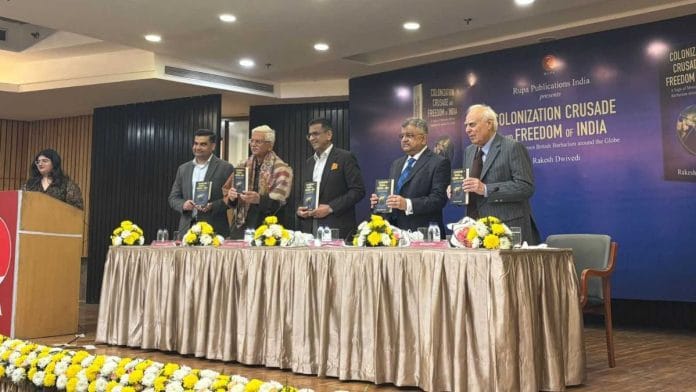



New Delhi: British scholars perpetrated an intellectual fraud by telling the world that they were civilising the colonised ‘barbarians’, senior Supreme Court lawyer and parliamentarian Kapil Sibal read out from Rakesh Dwivedi’s Colonisation Crusade and Freedom of India.
He paused mid-sentence, looking up at the audience. “Now tell me, who is uncivilised?” he added.
Sibal’s words drew nods from a roomful of lawyers at the launch of Dwivedi’s book. He was joined at the India International Centre on 6 February by former Chief Justice DY Chandrachud, solicitor general Tushar Mehta, and author Dwivedi.
Colonisation Crusade and Freedom of India challenges the idea of British colonisers’ “civilising mission”. Instead, the 421-page book argues that colonial expansion was built on economic plunder, political manipulation, and violence that reshaped countries across the world.
A day before the launch, Dwivedi read in The Times of India that US President Donald Trump is planning to install a statue of Columbus in the White House. “That has some connection with the book,” Dwivedi said.
“It was a coincidence that this book starts from the travels of Columbus and Vasco de Gama. A lot of books are written about what Nehru, Gandhi, and Jinnah—on the individuals. Some books, of course, have also been written from a geopolitical angle. But I thought that it must be traced,” Dwivedi added.
How history is told
According to Chandrachud, history is never neutral. “History is not merely a record of what happened. It is also a record of how what happened is explained. It is also about interpreting the course of events,” he said.
Many Indians grew up looking at maps and reading textbooks that described British rule through railways, administration, and governance, often without questioning who benefited from these systems. “Even today, colonial institutions are often cited as self-evident proof of benevolent governance. Railways are a common example,” Chandrachud added.
For him, the persuasive force of these accounts lay not in overt argument but in their assured tone.
“Authority appeared structured, deliberate and stabilising. Confidence is the tone of indoctrination,” he said.
Over time, repeated colonial narratives became accepted as fact. The book examines the claims by imperial writers who argue that India had no strong civilisation, and that the British Raj came about accidentally through trade. Chandrachud called Dwivedi’s book more than just a history text, as it invites readers to question long-held assumptions.
Also read: A floating house has withstood floods in Bihar for 3 years. The engineer wants to scale up
India was a global powerhouse
Mehta would like Colonisation Crusade and Freedom of India to be sold in the UK.
“I wish it [the book] were sold more in Britain than in India. They should know how their so-called conquest is perceived by the really progressive country, which became progressive after 1947. Loot was masqueraded as governance, famine as a policy, violence justified by an empire that was very good at lying to itself and also to the world,” he said.
Sibal was more pointed in his approach, and focused on the economic impact of colonial rule. He argued that India was once a global powerhouse. “By the 1700s, India accounted for nearly 25 per cent of the world’s GDP. We were exporters to the world. A maritime power with a thriving textile industry,” he said.
Colonial policies were designed to weaken local industry. “They imposed duties up to 71 per cent on Indian textiles and destroyed an entire industry.”
Sibal went on to question the popular claims about colonial “gifts”. The railways, for instance, were built to move goods to ports for British interests.
“And what did we end up with? Plunder, loot, an economy destroyed, and people subjugated.”
(Edited by Prasanna Bachchhav)
If goats could forge swords and then some goats were employed to forge millions of swords to cull the rest of goats, it does not mean that the employers of goats were being benevolent to goats by employing some of them. People do not still understand this basic tenet. This is how it still works in large parts of the world.