





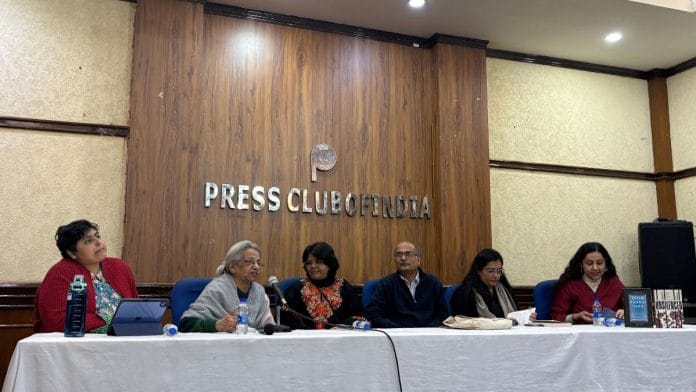



New Delhi: In prison, for all its cruelty, one can still breathe—unlike many other spaces in society. That was the unsettling truth that became the centre of a book discussion at the Press Club of India on 7 February. Writers, activists, and scholars gathered to talk about incarceration as a lived reality.
“When I went to jail, I found it very surprising that jail is also a place where you can stay. Where there are people, there will also be life, and where there is the life of women, there will be a lot of life. It is not such a scary place. This society can be understood very well from there,” said Seema Azad, author of Unsilenced: The Jail Diary of an Activist, addressing a packed hall.
The event brought together two prison memoirs–Azad’s Unsilenced, translated from her Hindi diary Zindagi Nama, and From Phansi Yard by activist-lawyer Sudha Bharadwaj. Both books were born of incarceration, and both insist that prison doesn’t erase humanity, nor does it succeed in flattening resistance.
The discussion was moderated by journalist Surabhi Kanga. Feminist historian Uma Chakravarti, researcher Mary Abraham, translator Shailza Sharma, poet Devyani Bharadwaj, and lawyer-activist Vishwa Vijay—Azad’s partner and co-accused—spoke not only of prison as an institution, but of the lives that stubbornly continue inside it.
Arrested together in Allahabad in 2010, Azad and Vijay spent over two years separated by walls, rules and weekly 15-minute meetings. They were arrested in Allahabad on 6 February 2010, by the Uttar Pradesh Police on allegations of Maoist links.
The discussion raised a larger question with the audience: What does incarceration reveal about society?
“All the women who are in jail—the only reason for them to go to jail is patriarchy. If patriarchy is removed, then many examples show these crimes would not exist in the same way,” said Azad.
Also read: Railways aren’t proof of British benevolence. History is never neutral: DY Chandrachud
Politics of survival
If prisons mirror society, then women’s prisons reveal its deepest fractures. This idea ran through Chakravarti’s reflection of her time in prison. Her conclusion was drawn after decades of interviewing women political prisoners across generations, from the Emergency to the Naxalite movement.
“To experience jail, one has to actually capture the essence of how that person experienced jail. And that is unique to their own persona and their own histories,” Chakravarti said.
She recalled an interview with Durga Bhabhi, the revolutionary often reduced to a footnote in Bhagat Singh’s story. Bhabhi’s most vivid memory of prison, Chakravarti said, was not ideological persecution but class hierarchy. Educated women were placed in B-class, the uneducated in C-class, with different food and treatment. Bhabhi’s cell was next to the morgue.
Such details rarely appear in official histories. Yet they recur across women’s prison writings, as Abraham pointed out in her overview of women’s incarceration texts in India.
“The jottings were my way of coping with incarceration, observing women, listening, and writing about them helped me get a sense of purpose. It calmed me,” Abraham quoted from Sudha Bharadwaj’s diary.
“Women’s prison texts document not only their own lived realities but also the pain and deprivations of fellow inmates around them. These texts are all political in their nature,” she said.
Abraham emphasised that most such writing comes from political prisoners because they are lettered enough to speak for those who cannot. Yet what they document most insistently is not heroism, but networks of care—women sharing food and raising children together.
Also read: New report finds the source of ‘hidden hunger’—India’s fertiliser policy is degrading soil
Love, letters and refusal to break
In these books, prison life becomes bearable through the formation of networks of solidarity. Women survive incarceration by balancing their experiences of victimhood with acts of resistance.
“Women really get help in recognising themselves there. Apart from family identity, they are called by their own names. They go to court. The judge asks them questions. They return and say very bravely—this is what the lawyer asked me, this is what I said,” Azad said.
For many, jail paradoxically became the first space where they existed as individuals.
“The home had become such a prison that when women came to the state jail, they felt free,” Azad said. “This is a very bad comment on our society.”
If Azad’s diary documents collective life inside women’s prisons, Vijay’s reading from the book brought the audience face-to-face with intimacy under surveillance.
What kept them going, Vijay said, were letters—most of which they were forced to destroy.
“We wrote many letters to each other with our feelings—sadness, love, regret—but we could not keep them. We kept reading them in fear of being snatched away in searches,” Vijay said.
He read from his book—an account of Saturday meetings, stolen flowers, handmade cards, poems smuggled through systems designed to crush tenderness.
“The walls of the jail are very high. It is still less than the height of our voice,” he said.
In jail, love became an act of defiance. So did writing, drawing, remembering seasons. “If we cried, the state liked it. If we laughed, they felt bad. So we learned to hide our emotions,” Vijay said.
Sharma spoke of encountering this emotional residue years later while translating Unsilenced.
“I thought I had understood jail diaries by reading others. But translating this book was a visceral reminder of what survives incarceration—and what does not,” she said.
(Edited by Theres Sudeep)