








Delhi: It was Lala Hansraj, an Arya Samaj leader, who gave Mahatma Gandhi the idea of incorporating a charkha in the national flag. The idea fascinated Gandhi, and he got the flag made in three hours. It had three colours: Red for the Hindus, green for the Muslims, and white for the minorities.
“Gandhi was totally taken by the idea. He rearranged the colours as white, green, and red because he said the minority, the smallest, must be taken by the bigger, and the bigger by the biggest,” said former Ambassador to the USA, Navtej Sarna, as the audience listened in rapt attention. “Hindus were the majority, so they were at the bottom of the flag. The idea was not to divide the country by community but to unite them in one way.”
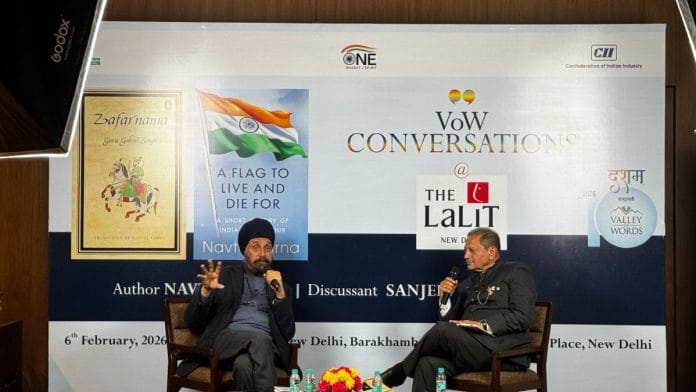
The discussion on vexillology and how the Indian flag came into being was prompted by Ambassador Navtej Sarna’s book, A Flag to Live and Die For. In conversation with him was retired IAS officer Sanjeev Chopra under the banner of Valley of Words (VOW), a literary festival held annually in Dehradun. Sarna’s translation of Zafarnama by Guru Gobind Singh was also highlighted.
The hall at The Lalit was filled with IAS officers, ambassadors, and historians who had gathered to hear the two speak.
In the book, Sarna traces the journey of an ordinary piece of cloth into the national flag. From the Mahabharata to Annie Besant’s Home Rule flag, to Mahatma Gandhi and then Jawaharlal Nehru—the flag evolved, growing stronger and more revered.
However, for the next ten years, Gandhi didn’t present the flag to the Congress officially. Yet it began flying at every Congress session because it was Gandhi’s flag. “It came to be known as the Swaraj flag, and it spread like wildfire. People marched and went to prison for the right to walk with the flag,” Sarna said.
Also read: Subhas Chandra Bose’s early portraits show why he became iconic in freedom struggle
Right to fly the flag
India’s national flag has a history of restrictions. For the longest time, it was not allowed to be used except on occasions such as Independence Day, Republic Day, Gandhi Jayanti, and Martyrs’ Week.
“So that protocol, which became the Flag Code of India in 1950, laid down some very basic rules—who can fly the flag, how it is to be flown, and what cannot be done with it. We had to make sure it’s followed properly. Otherwise, it was a punishable offence. And there are two laws governing it,” Sarna said.
And then came industrialist Naveen Jindal’s legal battle that changed the way Indians could display the national flag.
Jindal came back from America as a 20-year-old after completing his studies, where he had been gifted an Indian flag by an American. He put it up in his house there. Then, he came to India and hoisted the flag at his factory.
“The commissioner and the SP came and told him to take it down. He refused and instead filed a case. He went to the High Court, then to the Supreme Court. To cut a long story short, the government was also evolving—they set up another committee and revised the Flag Code,” Sarna said.
The Supreme Court, in 2004, declared that flying the flag was part of the fundamental right to freedom of speech and expression of any Indian citizen.
Also read: Amrita Sher-Gil and the melancholy of ordinary existence
A poetic resistance
There was another book under discussion: Zafarnama. An English translation of the 111-verse Persian poem written by the tenth Sikh Guru, Guru Gobind Singh.
Through his translation—which he described as challenging—Sarna sought to bring out the poetic genius of the Sikh warrior as he addressed Mughal Emperor Aurangzeb. It was a poetic resistance against tyranny.
“Zafarnama was a challenge, and I say in all humility that I consider it a blessing that I could attempt to work on it and translate it,” he said. Zafarnama was written by Guru Gobind Singh when he was absolutely alone. He was walking in the jungle, and had lost all his four sons, his mother, and the men who fought bravely in the Battle of Chamkaur.
“But it was not a military defeat, because he had been told to come out of the fort on a false promise sworn on the Quran by Aurangzeb’s men. When they broke that promise, it became his indictment of the lack of morality in the governance of the empire and in warfare,” said Sarna. “So he wrote this entire letter to the emperor.”
Sanjeev Chopra recited a few lines from the book to put it in context:
“Then left with no choice,
I joined battle with hordes,
Came with much deliberation amidst the arrows and the swords.
When all has been tried, yet justice is not in sight,
It is right to pick up the sword,
It is then right to fight.”
The audience applauded, visibly moved by the discussion.
(Edited by Theres Sudeep)