





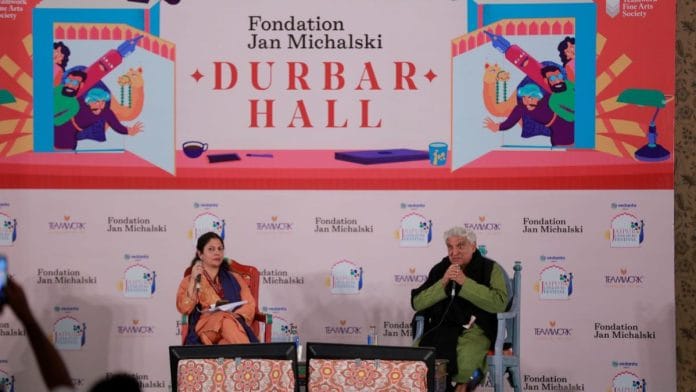



Jaipur: The Durbar Hall at the Jaipur Literature Festival was stuffed to the brim Thursday as Javed Akhtar made his way to the stage for his second session of the day. Even as the day carried on and festival goers grew weary, they were hungry for one more hit of literary genius.
Akhtar was originally supposed to be a part of only one session, but stepped in when someone dropped out at the last moment. His second session, titled ‘India in Urdu: Urdu in India’, was a masterclass in language. Akhtar was in conversation with journalist Tabeenah Anjum.
From the get-go, Akhtar made it clear that he wanted to hear the questions of the people. “You can ask any question under the sun. No question is stupid,” he said.
The poet started by explaining what makes a language—it is not the script or the vocabulary, but the grammar. “Grammar is what decides it is a language. Vocabulary can come from anywhere. How many here are aware that kamra (room) is an Italian word?”
Akhtar added that the word Autorickshaw was derived from the Greek word ‘auto’ and a shortened form of the Japanese ‘jinrikisha’, meaning ‘human-powered vehicle’. Words can come to mean anything, was his argument.
“Hindi and Urdu are the only two languages that share a grammar and syntax, which is perhaps why the Two-Nation Theory does not work. You can have different claims on lands. But you cannot divide language. Urdu is the living proof of the fact that the Two-Nation Theory is not correct,” he said.
He added that many young poets writing in Urdu are Hindu and have learned the language on their own. They are once again challenging the notion that language belongs to any one community.
Urdu in India?
Akhtar is very proud of Urdu’s history.
“We have taken a lot of it from other languages, but it doesn’t matter because we have made it ours. Hawa (wind) is a Persian word, but hawaien and hawaon are not Persian. Similarly, ameer (rich) is an Arabic word, but ameeri and ameeron are not Arabic. We have taken the nouns from different languages, but making them into adjectives is something entirely ours,” he said.
Is the Urdu script necessary for understanding the language, asked someone from the audience. Yes and no, said Akhtar.
“My books are available in both Hindi and Urdu. There is a lot of Urdu literature that is available in Devnagari. It sells more because more people can read it, but they still prefer Urdu poetry,” he added.
Akhtar brought up the 2019 incident when the Delhi High Court directed Delhi Police to avoid using archaic Urdu or Persian words in FIRs.
“Oxford University keeps adding 50 or more words to its list. The latest edition even added the word ‘jugaad’ to its list. But we are happy that we have removed 100 words. Languages cannot survive like this. Do you know, Shah is a Persian word. Will that be removed as well?” Akhtar said, cheekily referring to home minister Amit Shah and the Modi government’s crusade against Urdu.
Also read: JLF is a unique assembly of tradition and modernity, says Rajasthan CM
Religion, language, humour
Much to the poet’s pleasure and joy, the session soon opened the floor to questions, with Akhtar reminding the volunteers and organisers to make sure there are mics available for the audience.
In his usually jovial manner, Akhtar insisted that the audience members sitting up front be given priority lest they get upset and become violent. At one point, he chose to answer more questions, rather than recite his poetry.
When a young man asked Akhtar about his views on agnosticism, he said the concept didn’t make sense to him.
“While I understand someone who is a theist or someone who is an atheist, but this agnostic, I don’t understand. For me, agnostic is the same as ‘slightly pregnant’. What is that? Either you are, or you are not,” Akhtar said to a round of laughter.
“If anyone has gained control of their senses, then of course, they’ll become an atheist,” he added.
At times, Akhtar’s Q&A session resembled a stand-up act done in Ganga-Jamuni Tehzeeb. At other moments, it seemed more of a baithak where one is receiving advice from their elder.
“It was time to face the reality, English is no longer the language of England, it is the universal language. So the onus of responsibility lies on one’s parents and family members to teach the younger generation their mother tongue. Institutions and families can divide the job… Instead of wasting time teaching the child religion, teach them a language,” Akhtar said.
The final question of the evening was about the secret to his good health. “It’s very simple—an irregular diet, sleep when you want, eat what you want, especially ice cream.”
ThePrint is a media partner for the Jaipur Literature Festival 2026.
(Edited by Prasanna Bachchhav)
Must confess to being agnostic. Inclined towards atheism nowadays, seeing the depredations religiosity is causing, but find it safer not to risk divine wrath if there really is someone up there in the clouds.