





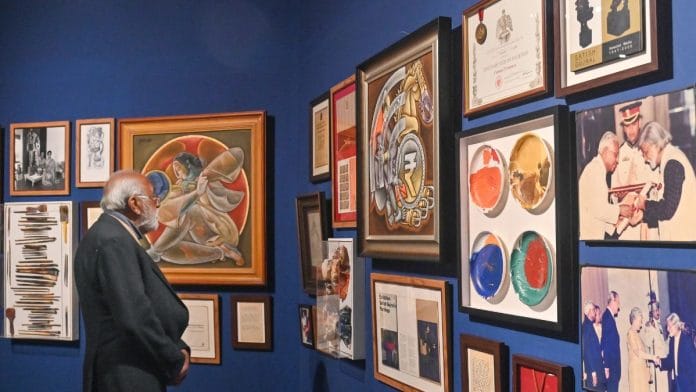



New Delhi: A retrospective of Satish Gujral’s artworks is an evocation of an era, a century marked by the pain of Partition to the hope of nation-building years—all laced with a deeply private trauma and self-examination. One of the most intense modern painters of India, Gujral’s paintings stand as an evidentiary witness today.
“Satish Gujral 100: A Centenary Exhibition”, begins with a portrait of his father, Avtar Narain Gujral, and concludes in a reimagined version of the artist’s studio. The exhibition, at Delhi’s National Gallery of Modern Art, traces Gujral’s long artistic journey. Far ahead of his time, Gujral experimented across mediums, weaving his work with political and social issues.
The exhibition is open for visitors from 15 January to 30 March.
“He works with extraordinary mediums, materials, and subjects, and all of his art remains closely connected to what he sees around him—especially questions of nationhood and nation building,” said Kishore Singh, curator of the exhibition and an art critic.
Also read: Bengaluru artists brought art out of the white cube. Now they want crowds like in IPL
Painting pain
The exhibition opens with an immersive audiovisual installation of water flowing through a mountainous landscape, introducing visitors to Gujral’s partial hearing loss and how it shaped his artistic sensibility.
At the age of eight, Gujral’ fell in the water while jumping between rocks in Kashmir. The incident left him medically deaf. Art became his primary language for processing and expressing pain.
The exhibition is divided into 15 sections, each dealing with Gujral’s experiments as an artist.
The second section titled “Loneliness and Strife: The Mexico Year”, is filled with paintings from 1952, when Gujral travelled to Mexico on a scholarship, awarded by the Mexican government for cultural exchange. It allowed him to study under famous muralists Diego Rivera and David Alfaro Siqueiros. He also became friends with Frida Kahlo in the last six months of her life.
It was in Mexico that he received formal training in modern muralism, becoming the first Indian artist to do so. But he started painting only after coming back to India.
His journey as an artist involved a lot of introspection, which he expressed through the self portraits. The exhibition brings together three self-portraits, each of them marks a different phase of Gujral’s life.
These self-portraits used a palette of earth tones. They look almost carved rather than painted. Most of the portraits are part of his Partition series. They have fractured and eroded faces.
During the Partition, when the entire country was going through the pain of separation, Gujral was collecting that pain and expressing it through portraits of himself and others.
“Mourning En Masse”, what Singh describes as the jewel of the exhibition, is one of Gujral’s most powerful works. The painting is not large in size, but profoundly evocative, and captures the shared pain of the time. A woman, covering her head, with a distorted face—the portrait expresses grief and pain of Partition.
It’s part of the section called “A Dark Midnight: The Partition Series”, which displays works that were painted in the 1950s.
MP Gupta, who knew Gujral for over 30 years, says what stands out most about Gujral is the way he transformed the pain of Partition into art.
“He thought deeply before creating, and that reflection made his work truly unique,” Gupta told ThePrint. “Whether it was in painting or architecture, Gujral brought originality, he turned experience and memory into powerful artistic expression.”
He drew portraits of Jawaharlal Nehru, Indira Gandhi and many more. The portraits did not showcase the grandeur of their power, but showed them as ordinary people. Few of his paintings are exhibited in the Parliament.
Also read: 24, Jor Bagh gets its last hurrah—the art space that became a metaphor for Delhi
Experiments with form
Throughout his life, Gujral experimented with various forms of art—painting, sculpture, architecture and more.
In Untitled Ganesha, he combines charred wood with leather, to depict the violence that India was witnessing during anti-Sikh riot.
It’s part of the section called “The Making of Political Art: Emergency and Delhi riots”. Between the 1960s and 1970s, Gujral started experimenting with wood, sawdust, letters, and words. He experiments with abstract and then shifts to figurines.
Gujral did not limit himself to politics and social issues, he also delved into the cycle of life. He painted birth, death and renewal.
Gujral used dark reds, browns, and bruised flesh tones to suggest heat, violence, and vulnerability. He did not show desire as intimacy, but raw, confrontational and deliberately unsettling.
Shashi Kumar, one of the visitors, could not choose a favourite among the exhibited artwork. “He was a genius, he painted for more than 75 years, the portraits of politicians are gripping,” he said.
(Edited by Theres Sudeep)