





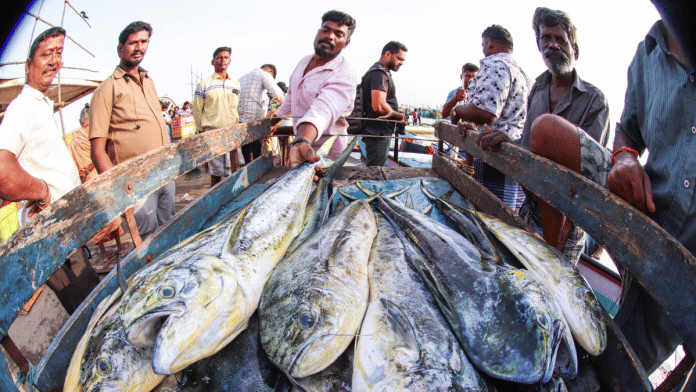



Hyderabad: The Union Budget’s record allocation of Rs 2,760 crore for the fisheries sector and a host of supportive measures—including higher duty-free import limits, creation of 500 reservoirs, and support to fish farmer producer organisations (FFPOs)—will help strengthen the marine industry, seafood companies and marine produce exporters said.
Collectively, these measures are expected to reduce input costs for processing units, support compliance with stringent norms imposed by importing nations, and maintain international food safety standards, thereby helping small fish farmers improve overall efficiency and boosting the competitiveness of India’s seafood exports.
After the imposition of US tariffs late last year, Indian seafood exporters began shipping their produce to the UK, Japan, South Korea, the European Union, and Australia.
To increase domestic production and exports of seafood, Finance Minister Nirmala Sitharaman said in her Budget speech that the government would introduce an enabling framework for sustainable harnessing of fisheries from the Exclusive Economic Zone (EEZ) and High Seas, with a special focus on the Andaman & Nicobar and Lakshadweep Islands.
According to data released by the Press Information Bureau, India is the world’s second-largest fish producer, and aquaculture and seafood exports are valued at Rs 60,000 crore.
“While I am yet to read the fine print of the whole regulation, the raise in the duty-free import limit from 1 percent to 3 percent for seafood processing needs to be seen in the context of facilitating increased exports,” said Pavan Gunturu, national president of the Seafood Exporters Association of India.
“The tariff relief measure addresses supply chain issues and could add to the headwinds we are already enjoying with exports to countries other than the US.”
To augment exports, specified inputs used for seafood processing will enjoy a higher duty-free rate from 2026 onwards. The increase to three percent will be calculated on the previous year’s export turnover.
However, on the proposed export of frozen food onboard fishing vessels, he said the move could only benefit fishermen who have large shipping vessels.
“The Budget lays the groundwork for India to emerge as a serious global player in advanced and sustainable aquaculture. The relaxed import norms for processing inputs will directly improve efficiency, traceability, and global market access,” said Aditya Rithvik Narra, founder and managing director of SmartGreen Aquaculture.
Also Read: Budget’s Rs 10,000 crore bet on maritime sector with push for containers, ports and waterways
Supporting start-ups
To create new export opportunities beyond territorial waters for fishers, the Union Budget 2026-27 proposed that fish caught by any Indian vessel in the EEZ or in the high seas will be made duty-free.
The landing of such fish at foreign ports will be treated as the export of goods, and safeguards will be put in place to prevent misuse during fish catch transit or transshipment.
Seafood and seafeed manufacturers in Andhra Pradesh and Odisha, India’s largest seafood exporting states, welcomed the government’s move to support 200 start-ups in the fisheries sector, a first for this industry.
They called the strengthening of the fisheries value chain in coastal areas a significant intervention, as both these states have long coastlines.
According to data from the Department of Fisheries, Animal Husbandry and Dairying, India’s fisheries production has witnessed sharp growth over the last decade. Annual fish production increased by more than 106 percent, from 95.79 lakh tonnes in 2013-14 to a record 197.75 lakh tonnes in 2024-25.
Seafood exports have doubled from Rs 30,213 crore in 2013-14 to Rs 62,408 crore in 2024–25, reinforcing India’s position as a leading global seafood exporter.
Other industry associations, such as the Compound Livestock Manufacturers Association of India, have welcomed the move on developing 500 reservoirs and Amrit Sarovars, expecting the policy measures to enhance employment opportunities.
“As part of this initiative, the start-ups in the fisheries sector will be supported, with domain expertise being onboarded to drive innovation, technology adoption and enterprise development,” the minister said in her Budget speech.
(Edited by Sugita Katyal)