








New Delhi: New ‘ecologically sustainable’ mountain trails will be developed as tourist destinations in Himachal Pradesh, Jammu and Kashmir, Uttarakhand, and even the Araku Valley in the Eastern Ghats, Finance Minister Nirmala Sitharaman announced in her Union Budget 2026-27 speech. Beyond these natural sights, she also proposed developing 15 archaeological sites, including the Indus Valley Civilisation sites such as Lothal, Rakhigarhi, and Dholavira, as important ‘cultural tourism destinations’.
Sitharaman said that the government plans to provide ‘world-class’ trekking and hiking experiences in the country. This includes building mountain trails in the hilly states; sea turtle trails near coastal nesting sites in Odisha, Karnataka, and Kerala; and bird watching trails in the Pulicat Lake in Andhra Pradesh and Tamil Nadu. Budget 2026 has a new focus on eco-tourism.
The 15 proposed cultural tourism destinations include the Sarnath Stupa and Hastinapur in Uttar Pradesh and the Leh Palace in Ladakh. The Budget announcement said these will be developed into ‘vibrant, experiential’ destinations featuring curated walkways, interpretation centres, and conservation labs.
“Budget 2026 reflects a strong recognition of tourism as a strategic pillar for economic growth, employment generation, and regional development,” Mahesh Iyer, managing director and chief executive officer at Thomas Cook India, told ThePrint.
He also welcomes the rationalisation of Tax Collected at Source (TCS). “The simplified flat 2 per cent TCS on overseas tour programme packages replaces the earlier two-tier structure, easing compliance and unblocking cash flows for travellers,” he added.
Also read: What is CCUS technology and why did Sitharaman push for a Rs 20,000 crore investment?
Buddhist circuits, hospitality institutes
India has a prominent position in the global tourism landscape and is ranked 39th on the World Economic Forum’s Travel and Tourism Development Index of 2024. According to the tourism ministry’s India Tourism Data Compendium 2025 report, the country saw a foreign tourist footfall of over 20 million in 2024, earning $35 billion in foreign exchange earnings from tourism.
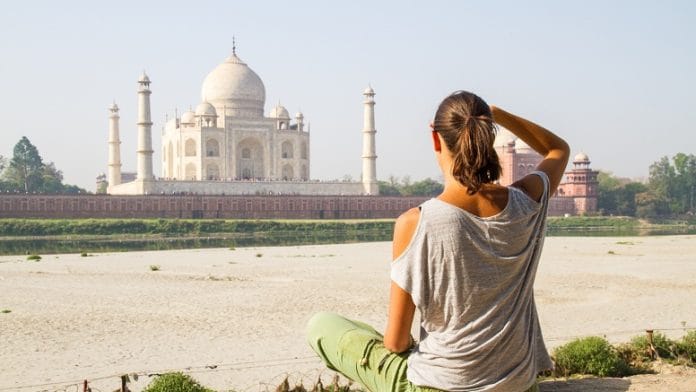
In terms of domestic tourism, Uttar Pradesh and Tamil Nadu stood out as the top destinations, and there were 2.95 billion domestic tourism visits in the country in 2024. The Taj Mahal remained the top destination for domestic and foreign tourists alike, but increasing numbers also went to the Sun Temple in Odisha, Qutub Minar in Delhi, Bibi ka Maqbara and Ellora Caves in Maharashtra, as well as the Charminar in Telangana.
The Budget proposed developing ‘Buddhist Circuits’ in the Northeast, which would include preserving existing temples and monasteries as well as developing pilgrimage amenities.
The announcements reflect the government’s broader focus on the tourism sector, which, Sitharaman said, has major potential for employment generation, forex earnings, and expanding the local economy.
Data from the tourism ministry shows that in 2023-24, the sector generated approximately 84.6 million jobs, and contributed over 5.22 per cent to India’s Gross Domestic Product (GDP) in that time period.
As part of its tourism push, the government plans to upgrade the current National Council for Hotel Management and Catering Technology (NCHMCT) in Noida to set up a new National Institute of Hospitality. An autonomous institution under the tourism ministry, the NCHMCT is a nodal body that regulates how hotel management, hospitality training, and education are imparted in Indian institutes.
The new National Institute of Hospitality will act as a ‘bridge’ between academia, industry, and the government.
Budget 2026 also proposed a new pilot scheme to upskill 10,000 tourist guides in 20 sites across the country. This scheme is expected to launch a 12-week intensive training programme, which will be conducted in a hybrid mode in association with an Indian Institute of Management.
On the digital level, a new proposal for the National Destination Digital Knowledge Grid was floated, which will document all places of historical, cultural, and spiritual significance. Sitharaman said that the endeavour would increase job opportunities for local historians, content creators, and technology partners.
According to Iyer, while the Budget reinforces tourism’s role in driving inclusive growth, more could have been achieved.
“A higher marketing outlay towards promoting ‘Incredible India’ could have delivered a powerful double-barrel impact by complementing infrastructure development with stronger global visibility,” Iyer said.
(Edited by Prasanna Bachchhav)