





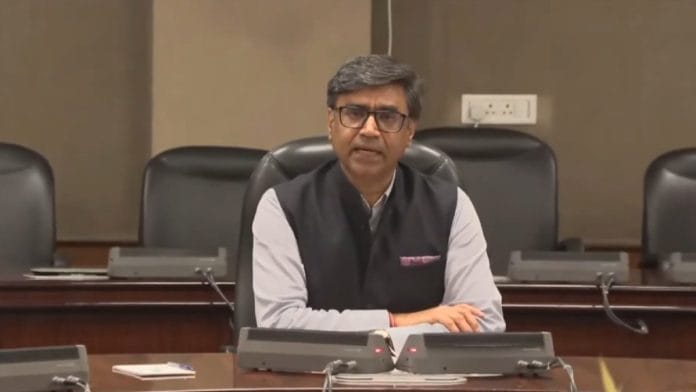



New Delhi: India’s energy purchases will be dictated by “national interest”, including “adequate availability” and prevailing global oil prices, Foreign Secretary Vikram Misri said Monday.
“What I can firmly and confidently say is that whether it is the government or indeed our business, at the end of the day, national interests will be the guiding factor for us in our choices,” Misri said during a special briefing on the visit of the President of Seychelles, Patrick Herminie, to India.
The remarks by India’s foreign secretary came after US President Donald Trump on Friday claimed that India had committed to making no further purchases of Russian oil, as a reason to remove the 25 per cent tariffs imposed on Indian exports to America. The punitive tariffs were imposed at the end of August 2025, as India’s largest source for crude emanated from Moscow, following the steep discounts due to the ongoing Russia–Ukraine war.
The removal of tariffs came ahead of an India-US joint statement on an interim agreement for a trade deal, which sees New Delhi eliminate or reduce tariffs on a number of goods from Washington in exchange for tariff cuts to 18 per cent on a number of Indian merchandise exports to the US.
Misri said that when a country is dependent to the extent of 80-85% on an imported resource, concerns about the possibility of inflation driven by energy costs are “natural”. “So, it’s not surprising therefore that our foremost priority is to safeguard the interests of Indian consumers insofar as energy is concerned—to really ensure that they receive adequate energy at the right price and through reliable and secure supplies. And our import policy insofar as energy is concerned is therefore driven entirely by these objectives,” he added.
Misri explained the global economy has faced “significant uncertainties”, which have had a “major impact” on the “stability of global energy markets”. He said, “India certainly—and I would imagine a lot of countries around the world, if not every country—have a shared and common interest in ensuring stable energy prices and secure supplies”.
He said that since India is a developing economy and not just one of the largest consumers of energy, but also a “stabilising factor” in global energy markets, it has to be “conscious about resource availability”.
The current phase of the Russia–Ukraine war began in February 2022 and led to a steep rise in energy prices as Western countries sought to cut their imports of Russian energy goods. The US and the rest of the G7 countries imposed a price cap on Russian oil to degrade Moscow’s revenues from the sale of energy resources, while focusing on stabilising global energy markets.
India stepped in and started bulk purchases of Russian oil, which grew to $56 billion in the 2024-2025 financial year, as global energy markets calmed down, while New Delhi received a stable source of crude. However, Misri, underlined that for India a “diverse” basket of energy sources is necessary to prevent any one country from dictating New Delhi’s energy needs.
“You are aware that India is a net importer in the oil and gas sector. And that’s one reason why we import energy from multiple sources. So, as I mentioned earlier, the key drivers of our energy policy are adequate availability, fair pricing, and reliability of supply,” said Misri.
He added: “So, if you look at the data—and I’m sure you’re looking at the data on a constant basis—you will see that we import crude oil from dozens of countries. We are neither dependent on any single source for this, nor do we intend to be.”
The foreign secretary further added that “depending on objective market conditions” the sourcing of energy may vary from time to time. The Indian approach is to maintain “multiple sources of supply and diversify them as appropriate to ensure stability.”
However, the foreign secretary made it clear that the actual sourcing decisions are made by the companies, both private and public sector firms, based on the “market conditions, availability at any given point in time” after assessing the “risks” and “costs.”
Misri did not rule out oil purchases from Russia, indicating that companies will assess risks and take business decisions accordingly.
“And obviously, all of these companies also have their own internal accountability-related processes to look at and certain fiduciary responsibilities in the market,” said Misri.
Two of Russia’s largest oil firms, Rosneft and Lukoil have been sanctioned by the US since October 2025. While Indian firms have since curtailed their purchases of Russian oil from these firms due to the risk of secondary sanctions, crude from Moscow continues to flow to India, albeit at reduced numbers.
India is willing to open negotiations with Venezuela to import crude, and had large investments in the South American country before the US imposed sanctions in 2018 and 2019 and once again in 2024.
(Edited by Shashank Kishan)
Also Read: Indian refiners avoid Russian oil in push for US trade deal