





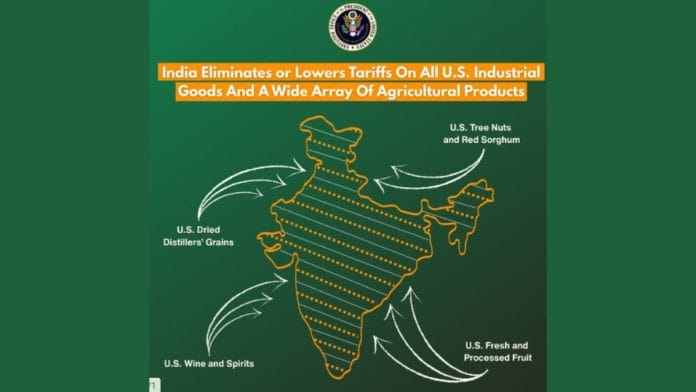



New Delhi: When the Office of the United States Trade Representative (USTR) released a post on X to promote India-US trade post the new deal, an unusual detail stood out. More than the areas of trade, it was the map that caught the attention of many.
The post had a map to promote the agreement, which depicts India as a single, undivided territory. It mentions that India had lowered tariffs on US industrial goods like tree nuts, sorghum, grains and wine.
The outline includes the entire region of Jammu and Kashmir, without demarcations separating areas administered by Pakistan or China. For many, the cartographic choice stood out more than the commodities listed.
One X user noted, “More than almonds and sorghum, the real win is the map USTR used. Whole India shown as one, including areas under Pakistan’s or China’s occupation, without cutting them out. That’s more diplomatic than any statement. Touching hearts big time!”
The United States has long sought to maintain formal neutrality on territorial disputes between India and Pakistan, particularly over Kashmir, often using dotted lines or disclaimers to indicate contested boundaries. The absence of such markers in this instance has, therefore, attracted attention, even as officials have offered no public comment on the map and there is no indication of a policy shift.
India maintains that the entire state of Jammu and Kashmir is an integral part of the country.
In 2011, the official website of the U.S. Department of State displayed a map of India that showed Pakistan-administered Kashmir as part of Pakistan, without acknowledging India’s claim over the region.
That map, hosted on the State Department’s website under its “Diplomacy in Action” banner, differed from India’s official map. While it included a notation recognising India’s claim over Aksai Chin, a region administered by China, it made no such acknowledgment for Pakistan-administered Kashmir, neither marking it as disputed nor reflecting India’s stated position.
A 2012 MEA statement said: “The Government has consistently rejected incorrect depiction of India’s borders on maps used by the US government. It has used every opportunity to convey to the US side its concern in this regard, and has asked that these maps be corrected.”
Following protests regarding previous errors, the U.S. State Department had updated its maps to reflect a neutral position on Kashmir, using a dotted line to represent the 1972 Line of Control.
(Edited by Viny Mishra)
Also read: Despite what Trump says, Russian oil imports to India can’t be wished away after US trade deal
It could just be a mistake ? I won’t be too excited but it’s fun to see some outrage on the other side.