








Ottawa: Canada has said it believes New Delhi is no longer involved in facilitating crimes on Canadian soil, marking a diplomatic reset ahead of Prime Minister Mark Carney’s visit to India.
Senior Canadian officials, briefing journalists in Ottawa, told CBC Wednesday they are “confident that the activity is not continuing”.
The statement draws a clear line under the position of the previous Liberal government led by Justin Trudeau, which had alleged that Indian officials were linked to the killing of Hardeep Singh Nijjar—an India-designated terrorist shot dead outside a gurdwara in Surrey, British Columbia, on 18 June 2023.
Those allegations triggered a prolonged diplomatic chill between the two countries that persisted until Carney assumed office in March 2025.
India had rejected Trudeau’s charges at the time as “absurd and motivated”, and accused the former Canadian prime minister of “smearing” New Delhi for “vote bank politics”.
India’s High Commissioner to Canada, Dinesh Patnaik, reiterated that position to ThePrint earlier this week. “We are giving them whatever is necessary. We have told them very clearly, India does not do things like this. This is really absurd and preposterous, the allegations made by a former prime minister, but I will not go into that,” he said.
On bilateral cooperation, Patnaik added: “Whatever material we have, if any evidence we have, we are cooperating with them [Ottawa].”
Four individuals of Indian origin are currently facing charges in the Nijjar killing, with the case proceeding through the Canadian judicial system.
The broader picture was further complicated earlier this month when Indian national Nikhil Gupta pled guilty in a US court to charges of conspiracy to commit murder-for-hire.
Gupta was held for an alleged plot to assassinate Gurpatwant Singh Pannun, another Indian-designate terrorist in the US. Former Research and Analysis Wing (R&AW) official Vikash Yadav has been linked to that plot. India has set up a high-level inquiry into these US allegations.
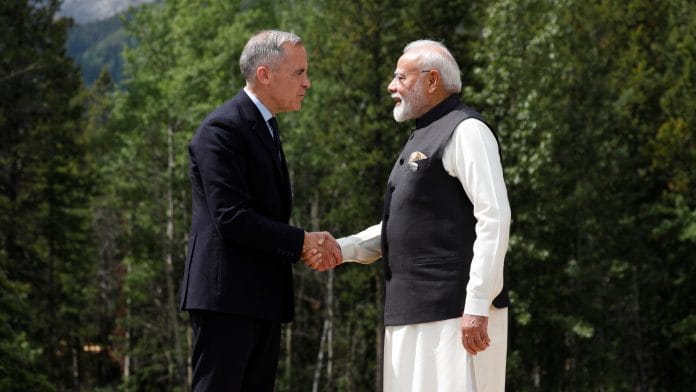
Despite this fraught backdrop, Carney’s approach has found acceptance with the Indian government. During their meeting on the margins of last year’s G20 summit in South Africa, Carney and Prime Minister Narendra Modi were focused on economic outcomes.
Issues surrounding Sikh separatism and the activities allegedly involving Indians were separately channelled through the countries’ security establishments. India’s National Security Adviser Ajit Doval and his Canadian counterpart, then-National Security and Intelligence Adviser Nathalie G. Drouin, met earlier this month and agreed to appoint liaison officers in each other’s missions.
Drouin has since been appointed Canada’s envoy to France and Monaco.
Carney arrives in Mumbai Thursday accompanied by a business delegation and senior ministers, with New Delhi also on the itinerary. The visit is expected to yield a raft of agreements, including a long-pending deal for the sale of uranium worth $2.5 billion, as well as accords in energy, education and advanced manufacturing.
The economic stakes are considerable for both sides. Canada has roughly $108 billion invested in India, of which around $55 billion originates from the Canadian pension system—channelled into assets ranging from airports to highways.
For Canada, India’s market of 1.4 billion people is central to its strategy to reduce dependence on the United States, which currently absorbs over 70 percent of Canadian merchandise exports.
US President Donald Trump’s tariff offensive has compounded the pressure on Ottawa’s economy, sharpening its urgency to deepen ties with alternative partners. After India, Carney is set to travel to Australia and Japan before returning to Ottawa.
The reporter was in Ottawa at the invitation of Global Affairs Canada.
(Edited by Prerna Madan)