





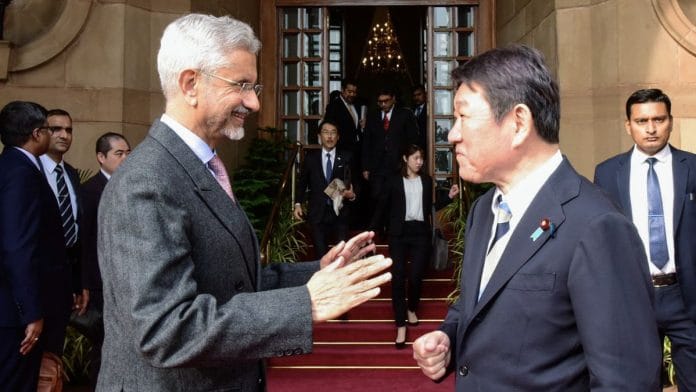



New Delhi: Defence and economic security figured heavily in the talks between Indian External Affairs Minister S. Jaishankar and Japanese Foreign Minister Toshimitsu Motegi Friday.
The two ministers, who held discussions for over two hours, agreed to take a number of steps including the establishment of a joint working group on critical minerals to build more resilient supply chains, as well as planning for a second economic security dialogue.
Discussions on the potential transfer of technology of the Unified Complex Radio Antennae (UNICORN) were held between Jaishankar and Toshimitsu Motegi during the 18th India-Japan Strategic Dialogue, co-chaired by both ministers.
”Since current international society is facing unstable situations due to supply chains, it was decided to establish a more stable supply of critical minerals and energy resources. We agreed to hold economic security between the private sectors of the two countries. We have to identify the potential challenges that the private sector is facing,” Toshihiro Kitamura, the official spokesperson in the Japanese Foreign Ministry said at a press briefing held in the national capital.
He added: “We would like to hold the very first private sector dialogue on economic security. We also are trying to hold a second economic security dialogue between the two governments based on the possible outcomes of the private sector economic dialogue.”
For Tokyo, the diversification of its supply chains is key, given the ongoing tensions with Beijing over the security of Taiwan—the self-governing territory located in East Asia. Toshihiro Kitamura highlighted that Tokyo is looking to de-escalate tensions with Beijing, while urging Taiwan and China to resolve their differences through dialogue.
“It is true that the ties between China and Japan are becoming more tense. China is strengthening their rhetoric against Japan. We are trying to correct those kind of baseless statements made by the Chinese side. We do not want to respond to their escalation,” said the official spokesperson for the Japanese Foreign Ministry.
China recognises Taiwan as a part of its country, a position supported by over 180 countries, including India. New Delhi and Tokyo also focussed on creating tangible outcomes for the joint vision document announced by India and Japan last year during Prime Minister Narendra Modi’s visit to the country. As a part of the document, in particular the mobility portion, Tokyo is set to welcome a number of Indian personnel working in the artificial intelligence sector this year.
On defence ties, Toshihiro Kitamura was clear that many areas of cooperation are under discussion between the two countries, but the focus is to complete a “flagship project” such as the transfer of the UNICORN radar to the Indian Navy.
Randhir Jaiswal, the official spokesperson for the Ministry of External Affairs, also highlighted that discussions between Jaishankar and his counterpart revolved around defence.
“Defence collaboration was an important element of our cooperation and this was an element discussed between the two foreign ministers. There are several projects under consideration,” Jaiswal said at a regular briefing Friday.
However, the issue of tariffs imposed by US President Donald J. Trump did not figure in the discussions between Jaishankar and Motegi, the Japanese spokesperson said. The two leaders looked at measures instead to ensure continued US engagement in the Indo-Pacific, including the Quad.
There have been worries over Trump’s potential withdrawal from the region, however, the Japanese spokesperson made it clear that Tokyo is not worried about disengagement by the US from the region.
The Japanese foreign minister is in India for a three-day visit that began on 15 January. He is set to depart New Delhi on 17 January, after the completion of the trip. Toshimitsu Motegi also called on Prime Minister Narendra Modi Friday, a meeting that lasted for almost an hour.
Japanese Prime Minister Sanae Takaichi is expected to call a snap general election in the first week of February, according to reports.
(Edited by Viny Mishra)
Also read: Indo-Pacific security demands a strong India-Japan relationship