





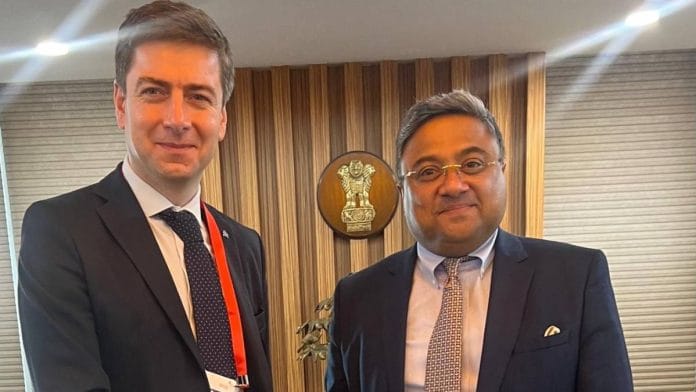



New Delhi: India and the European Union’s (EU) growing convergence in strategic sectors such as defence and security, particularly, transfer of technology, faces increasing scrutiny regarding New Delhi’s long-standing defence ties with Moscow, Lithuanian diplomat Laimonas Talat-Kelpša told ThePrint in an exclusive interview Friday.
Talat-Kelpša, Political Director in the Lithuanian Ministry of Foreign Affairs, and a former ambassador to India, highlighted that the Security and Defence Partnership inked between New Delhi and Brussels last month shows a growing relationship in sensitive areas between the two sides. But, he said, there remain questions over “guardrails” to protect European technologies from reaching Russian hands.
“Imagine a situation when a Lithuanian company develops some defence or security technology, which is good, which could be scaled up, which could be better produced in India at a better cost. But how would any Lithuanian institution, export licensing institution, for example, give permission for transferring this technology to India without answering the question first, whether that technology later will not be, you know, landing in the hands of Russia or China or any other autocratic regime,” Talat-Kelpša explained.
“So, these are security concerns which Lithuania takes very seriously. And Lithuania is not an isolated case in this particular situation. I believe that every reasonable member state would ask this question because the major security threat emanating from Russia is the key factor in deciding how Europe thinks of its own security.”
The discussions surrounding India-EU defence ties have emerged, in particular, after the signing of the Security and Defence Partnership at the end of January alongside the free trade agreement (FTA). The two sides have launched negotiations for sharing of intelligence agreement as a way to step up security cooperation.
The pact, one of nine the EU has signed with third countries, potentially allows India access to the EU “ReArm Europe” network, which could see potential joint production and procurement in defence technologies. The Polish government, for example, received around 44 billion euros in funding from the EU for defence and has broached a potential partnership in this regard with India, as reported by ThePrint.
However, India still gets around 35% of its military technologies from Russia, which is a point of concern for a number of European countries, said Talat-Kelpša, and was raised with Brussels ahead of the signing of the security and defence pact.
“So, creating guardrails, how to ensure yourself against this kind of risk is a big issue. This is where we will need to have a discussion, a profound discussion with Indian decision-makers. But I’m sure this goodwill and good faith that we have created with the free trade agreement and negotiations for that purpose is definitely a solution, an acceptable solution,” said the Lithuanian official.
People familiar with the matter pointed out that India has a robust defence partnership with France and Germany and strong “end-user agreement” terms that have protected European technologies in the defence sector.
The security and defence partnership is part of India’s efforts to increase its “global reach” in defence technologies and platforms, given the advanced technological expertise available within the EU currently, one of the persons said.
Talat-Kelpša met with Sibi George, India’s Secretary (West) in the Ministry of External Affairs Friday, where the two engaged on a number of issues, including the Russia-Ukraine war and increasing economic and political engagements.
“I was also open in my meetings with Indian interlocutors today. But I believe it’s a very fresh situation at the moment. Security-defence partnership has just been concluded, what, one week ago. So definitely we’ve been raising that issue not only as Lithuania but as different representatives of different member states in internal discussions in Brussels,” Talat-Kelpša told ThePrint.
“Some of those concerns have been already alleviated, some remain. Again, that we concluded the security-defence partnership shows the good faith and goodwill on our side.”
Lithuania is set to send a delegation of officials for India’s AI Impact Summit later this month and there is an expectation in Vilnius of a potential visit by External Affairs Minister S. Jaishankar later this year. Two earlier visits had been postponed due to unavoidable circumstances.
Talat-Kelpša sounded an optimistic note that the India-EU FTA will be ratified by the EU Parliament without delay. EU’s other major trade deal announced last month with South American nations part of MERCOSUR has been delayed through a referral for judicial review by the EU Parliament.
“What is important in this case is that negotiations have been concluded in good faith. Both sides have shown a considerable leap in trust, in trusting each other and also in willingness to make this deal happen. The geopolitical environment, in a way, pressured us in a positive way to move faster than expected,” said Talat-Kelpša.
Also Read: Wines, gems & surgical equipment set to get cheaper. The big gains for India & EU from historic FTA
Russia-Ukraine war
Lithuania, a Baltic state, shares the border with Russia to its west—the Kaliningrad Oblast, an exclave Moscow controls since the end of World War II—which is viewed as a threat to the EU member-state.
The Russia-Ukraine war, which is almost four years long now, set Vilnius on the path of upgrading its defence architecture, particularly after the annexation of Crimea in 2014. The full-scale war ongoing since 2022 has seen Vilnius reconstruct its economy to manage a growing defence budget.
However, differences remain between New Delhi and Vilnius over the war. India has maintained that “dialogue and diplomacy” are the only solutions to the conflict. India has also bristled when European countries highlighted its ties with Russia, most recently when Polish Foreign Minister and Deputy Prime Minister Radosław Sikorski visited New Delhi last month. Jaishankar called out the “selective targeting” of India’s continued trade with Moscow by European nations.
“If Lithuania or the European Union sees Russia as a threat and India treats Russia as a business opportunity, how about the situation when India sees China as a threat and the European Union considers China as a business opportunity? So, in both situations we’re a little bit uneasy. And then we understand that some kind of restructuring, rebalancing is required,” said Talat-Kelpša on the subject.
The Lithuanian official also highlighted India’s silence on the targeting of Ukraine’s energy infrastructure in the last couple of months by Russia. The attacks have left millions of Ukrainians without electricity in the midst of winter, when temperatures fall well below freezing. Lithuania has referred the attacks to the International Criminal Court (ICC) for investigation as a war-crime.
“Well, one thing which is critically important in this particular moment within the setting of Russia’s ongoing aggression against Ukraine, is Russia’s continued bombing and destruction of Ukraine’s energy infrastructure. And to understand the criticality of this situation, just imagine what it takes to live in the conditions of zero or below zero temperature,” said Talat-Kelpša.
“This is not tolerable. Lithuania has filed a special request at the International Criminal Court asking to start an investigation into the war crimes happening in Ukraine of that scale.”
Talat-Kelpša further raised the question to the Indian population at-large: “Are you okay with this?” Around 20 million people in Ukraine out of a population of around 37 million people are without electricity, he added.
“You have 20 million people put in a refrigerator for such an active period of time. I mean, imagine the scale… in proportion to India, (if) there were like 800 million people staying under such non-endurable conditions.”
(Edited by Nida Fatima Siddiqui)
Also Read: ‘Expect India to keep Europe’s security interests in mind’—EU envoy ahead of Putin’s Delhi visit