








Montreal: Canada has been unambiguous about its support for the “unity” of India, while the reset begun by Prime Minister Mark Carney has a lot to do with the potential for a deeper trading relationship between the two countries, former Canadian foreign minister Stéphane Dion said in an exclusive interview with ThePrint Friday.
“I think from the Indian perspective, it was the sense that Canada was ambiguous about Indian unity, and Canada was saying not at all. We are supporting a united India. It’s key for us. And from the Canadian perspective, the very serious concern that some services in India interfered in Canada in a way to interrupt the life of a fellow citizen, a Canadian fellow citizen, which was a very, very grave accusation. There was a sense that the government of India was not cooperating enough to go to the bottom of this issue,” Dion said.
The former foreign minister and Liberal Party leader added: “So that was a very serious disagreement between the two countries. But now our two leaders, Mr Carney and Mr Modi, they want to go ahead positively and to be sure that we’ll have no negative aspects in our relationship because we have so many things to do together for trade, for the economy, for geostrategic security. So India and Canada need to be strong partners, and we are determined to make sure that this visit of Prime Minister Carney will help that, and will be key for that.”
Dion led Canada’s foreign ministry for a year during previous Prime Minister Justin Trudeau’s tenure, before being sent to the European Union as a special envoy and later Ottawa’s ambassador to France and Monaco.
Trudeau’s tenure at the helm of power in Ottawa witnessed the cratering of ties between Canada and India over the killing of Indian designated terrorist Hardeep Singh Nijjar, who was killed outside a gurdwara in June 2023. Trudeau alleged that Indian agents were linked to the killing, a charge New Delhi denied.
India has maintained that the Trudeau government engaged in a smear campaign against New Delhi as a part of his own vote bank politics. The indication emanating from New Delhi was that Trudeau had not been serious enough about India’s concerns over the growing space given to Sikh separatists in Canada.
“The misunderstanding, I think it’s because in Canada, it’s a free country. It’s like India, it’s a democracy. And so people may have different views. They are not necessarily the same view as the government, but the government itself was not ambiguous and will never be,” said Dion.
He added: “United India is key for Canada, it’s key for the world, and we have no ambiguity about that. I cannot tell you that 40 million Canadians agree with what I have said. Some of them may want India to break up, as many Canadians want Canada to break up, by the way.”
The former leader of the Liberal Party highlighted that while it is alright to be a “separatist” in Canada, pointing to the tenuous relationship between Ottawa and the province of Quebec, which saw a close secessionist referendum in 1995, it in no way influences Canada’s recognition of a united India.
‘Indian reset not just due to US’
Under Carney, Ottawa has sought to recast the relationship with New Delhi as one based on the potential for deeper trading ties between the two countries. Canada has been facing a number of tariffs from its closest political and economic partner, the US, and that has added impetus to Canada’s outreach to India.
“I have no doubt that even if we had a President of the United States who was more—I would say, normal—Prime Minister Carney would be very willing to improve the relationship with India anyway. But it’s an additional motivation,” said Dion.
He added: “The US today is not so reliable. Canada knows that we’ll always need to have a strong relationship with the US, but we want to be less dependent, and for that we need to strengthen our relationship with Europe, with South America, with Africa, with the Indo-Pacific, and key relationship with the biggest democracy of the world, with India.”
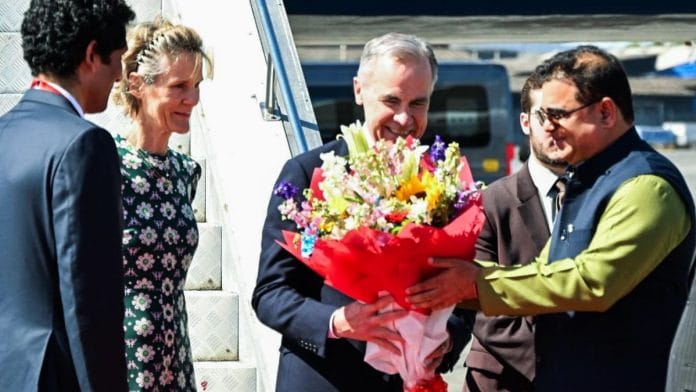
Carney landed in India Friday and is set to depart Monday. He will push the business relationship forward in Mumbai before heading to New Delhi to hold bilateral talks with Prime Minister Modi.
The incumbent Canadian Prime Minister has also pushed forward for a deeper defence and strategic partnership, with an announcement is expected on the signing of a terms of reference to open negotiations for a comprehensive economic partnership agreement (CEPA).
“We want to make sure that Canada and India are cooperating on these issues. You mentioned critical minerals. As you know, the country that has almost a monopoly on it today is China, and that’s a concern for India and for Canada,” said Dion.
He added: “We need to bring the resources to the market, and Canada has a lot of these resources and we have a lot of expertise in India as well. So why not work together, not to replace China, but at least to make sure that China is not the only player.”
Trade in goods and services between India and Canada grew to $30.8 billion in the last year. India is also one of the largest destinations for Canadian investment in recent years, with pension funds operating in the North American country investing roughly $55 billion into various Indian projects.
Canadian private equity is also extremely active in investments in India, with the total investment by various sources from the North American nation totalling roughly $108 billion in 2024.
(The reporter was in Canada at the invitation of Global Affairs Canada)
(Edited by Viny Mishra)
Also read: ‘India no longer facilitating crimes in Canada’—Ottawa ahead of Mark Carney’s visit