





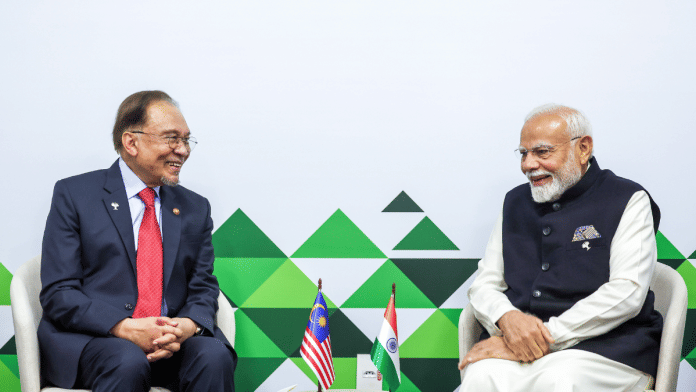



New Delhi: Prime Minister Narendra Modi’s visit to Malaysia from Saturday will focus on defence cooperation, including a potential sale of Dornier aircraft and upgrades for Malaysia’s Sukhoi Su-30 jets. There are also plans to link Unified Payments Interface (UPI) with Malaysia’s payments system and deepen cooperation in semiconductors and advanced technologies
The visit, Modi’s third to Malaysia, is set to see a full review of the entire gamut of ties between New Delhi and Kuala Lumpur that has deepened in the last few years. The National Payments Corporation of India (NPCI) is set to sign an agreement with PayNet Malaysia, the country’s national payments network, which could potentially lead to UPI being available for use in the Southeast Asian nation.
In the strategic sectors, specifically defence cooperation, India is looking at the potential sale of Hindustan Aeronautics Limited (HAL)-made Dornier aircraft to Malaysia, along with potentially upgrading and maintaining Kuala Lumpur’s Sukhoi Su-30 multirole fighter aircraft, P Kumaran, India’s Secretary (East) said at a special press briefing Thursday.
“Malaysia also has Scorpene submarines. We are looking at opportunities to try and collaborate, especially in terms of mid-life upgrades, retrofitting etc. You had also mentioned the potential for collaborating on SU-30 aircraft. Malaysians have that aircraft and so do we. We have offered proposals for modification, upgradation and mid-life maintenance. We are also looking at potential for supply of naval platforms by Indian shipyards,” said Kumaran.
The other sector expected to see an agreement is semiconductors. Kumaran highlighted Malaysia’s “very strong semiconductor ecosystem,” while explaining that New Delhi is in “the process of establishing a multi-layered collaboration arrangement” through a government-to-government memorandum of understanding (MoU) with Kuala Lumpur.
Modi is set to depart India Saturday morning and return mid-day Sunday for a two-day visit. He had earlier visited the country in 2015 and in 2018 for a brief stop-over to congratulate then Prime Minister Mahathir Mohamad. Modi skipped the Association of Southeast Asian Nations (ASEAN) summit hosted by Kuala Lumpur last year, which led to the timing of this bilateral visit.
Malaysian Prime Minister Anwar Ibrahim had made a state visit to India in 2024, and after skipping the ASEAN summit, Modi had made him a promise that he would visit the country in early 2026.
Kuala Lumpur is India’s third largest trading partner in ASEAN, with bilateral trade reaching $19.85 billion in the 2024-2025 financial year. India remains one of Malaysia’s top ten global trading partners, which indicates the growing economic relationship between the two countries.
India and Malaysia also have mechanisms to settle trade in Indian Rupee (INR) as well allowing settlements in other currencies from 2023. India has also become one of the largest sources of tourists for the Southeast Asian country, with roughly 1.4 million tourists making the trip to Malaysia last year.
Kuala Lumpur is a BRICS partner country and has been keen to join the 11 member organisation. However, Kumaran ruled out any expansion of the organisation this year under India’s chairship.
“As of now, the understanding I have is that there is no immediate initiative to expand the BRICS membership. We’ve just had a round of expansion…From what I have gathered, the general feeling in BRICS is that it is a time to consolidate after a round of expansion, and to make sure that the new members are fully integrated into the various BRICS structures,” said Kumaran.
Also Read: Malaysia is raising the white flag on the road to failed statehood
AITIGA review to be discussed
While trade between India and Malaysia remains robust, New Delhi has been urging ASEAN to review the ASEAN-India Trade in Goods Agreement (AITIGA). Malaysia is the current chair of the review mechanism, and discussions on the agreement is set to figure during discussions between the two leaders.
“The AITIGA review process is on. We’ve agreed on the terms of reference, and the colleagues from the Ministry of Commerce have been engaged with the ASEAN group, exploring various options to try and create a better balance in the trade between India and ASEAN. There are technical elements being discussed in terms of offering more lines under a liberalized regime between India and the ASEAN,” said Kumaran.
He added: “I think there is a broad sense that the overall, the average tariff in the ASEAN has to improve compared to the existing level plus also they want to try and stipulate a minimum percentage of tariffs for each country to open up, as a result of which we can achieve better balance overall between India and ASEAN…I don’t think there is anything ready as an outcome for this visit as far as AITIGA is concerned.”
The original agreement was set to liberalise tariffs between India and the 10-member ASEAN organisation on roughly 4,000 tariff lines. However, while a number of countries have eased tariffs for Indian imports, at least two – Indonesia and Vietnam – have not opened their economies to the extent expected by New Delhi.
AITIGA – the foundational agreement for a free trade area between India and ASEAN, has seen trade grow between the region and New Delhi in a manner that is heavily skewed towards the Southeast Asian nations. India is also worried about the rules of origin protections within the agreement, with a perception that third countries have been able to sell goods to India via the ASEAN member-states with tariff benefits.
Between 2011 and 2023, India’s annual trade deficit with ASEAN grew from roughly $7.5 billion to $44 billion. Indian imports from ASEAN grew by around 234 per cent while its exports to the region grew by only around 130 per cent, indicating the structural issues with deal, as ASEAN countries continue to delay tariff eliminations based on agreed terms.
(Edited by Shashank Kishan)
Also Read: Malaysia of 2018 has learnt lessons from India of 1977. And, so should we