





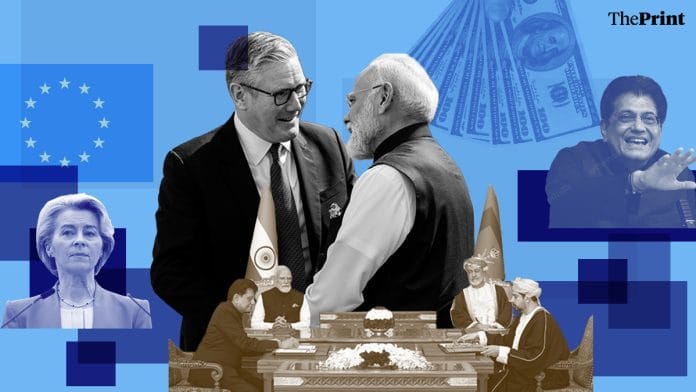



New Delhi: India’s 2025 diplomatic efforts have seen the announcement of three free trade agreements (FTAs) and signing of another two with the United Kingdom and Oman, as New Delhi seeks to expand its trading partnerships with developed markets.
Earlier this month, India announced the conclusion of negotiations with New Zealand for a trade deal that is expected to be signed by the first quarter of next year, while negotiations with the European Union have moved forward at real speed over the last 12 months.For New Delhi, the past 12 months has seen its diplomacy evolve around trade, with its highs and lows in many aspects related to FTA’s or staving off tariffs imposed by US President Donald Trump.
At the start of 2025, India had three operational free trade agreements, with the UAE, Mauritius and Australia, while a fourth with the European Free Trade Association (EFTA) had been signed and was awaiting ratification by all member-states of the regional trading organisation.
The year began with two major trade announcements—opening of negotiations for the “first tranche” of a bilateral trade agreement with the US following Prime Minister Narendra Modi’s visit to Washington on 13 and 14 February.
President Trump often talks about MAGA.
In India, we are working towards a Viksit Bharat, which in American context translates into MIGA.
And together, the India-USA have a MEGA partnership for prosperity!@POTUS @realDonaldTrump pic.twitter.com/i7WzVrxKtv
— Narendra Modi (@narendramodi) February 14, 2025
The second announcement came a week later, following the visit of the College of Commissioners of the European Union (EU) led by Commission President Ursula von der Leyen to New Delhi. One of the major outcomes of that visit was the setting of a deadline to conclude negotiations for a FTA within a year.
India and the EU are seemingly on path to achieve that goal with expectations high for an announcement regarding the FTA during von der Leyen’s likely visit to New Delhi next month for the India-EU Summit.
However, the negotiations with the US have stalled, despite early positivity. India has made what it considers as its “final” offer as a part of the negotiations for a “first tranche” of a larger bilateral trade agreement. The lack of agreement so far has seen the US first impose a 25 percent tariff on Indian imports and later an additional penalty of 25 percent duties for New Delhi’s continued purchase of Russian oil.
For India, any part agreement with the US would involve the removal of the additional penalty duties even as New Delhi has to an extent scaled down its purchases of Russian oil, especially after Washington imposed sanctions on two of Moscow’s largest energy companies—Rosneft and Lukoil.
The deals that have been achieved in 2025 are set to see Indian exporters gain a number of benefits, especially in the British market and potentially even expand its footprint in Oceania with the deal with New Zealand. The deal with Oman comes on the backdrop of the challenges India and Türkiye are currently facing in its ties, allowing Indian exporters another source of marble for example.
Also Read: India and US inch towards first tranche of trade deal, focus on mutual tariffs and oil
India-UK CETA
The first trade agreement to be announced this year is the India-UK Comprehensive Economic and Trade Agreement (CETA). Announced first on 6 May, a day before Operation Sindoor, the deal is India’s first bilateral trade deal with an European nation. New Delhi’s earlier deal with EFTA, is with the trading organisation and its member-states.
Agriculture, textiles, plastics, marine products, chemicals and engineering goods are some of the sectors where Indian exporters are set to see major gains. Indian goods face an average tariff of roughly 15 percent currently and under the CETA will fall to around 3 percent. The overall potential gain in two-way trade is roughly $33 billion.
Around 99 percent of tariffs covering Indian exports are set to be eliminated. The UK firms, especially those in the financial services sector, are set to be treated on par with domestic firms by the Indian government once the deal comes into force.
India is also set to eliminate duties on roughly 90 percent of goods, with around 85 percent of tariff lines becoming duty free in the next decade. Moreover, British automakers are set to see tariffs drop from 100 percent to 10 percent along with the introduction of a quota.
Indian textiles are set to see gains especially against Bangladeshi exports with the elimination of tariffs in this sector. The deal also sets a blueprint for the ongoing negotiations with the EU, especially as India has given a number of concessions in thorny sectors such as automobiles and liquor.
India-Oman CEPA
Prime Minister Modi travelled to Oman earlier this month to witness the signing of the Comprehensive Economic Partnership Agreement (CEPA) between New Delhi and Muscat. The deal is a second for India in the region following the agreement with the UAE in 2022.
Bilateral trade stands at $10.61 billion as of the 2024-2025 financial year and is set to expand under the terms of the CEPA. Indian exporters are set to gain duty free access to 96 percent of tariffs lines and a further 2 percent of duties will be eliminated over a period of time.
The key gain for India is the ability to import raw marble from Oman. In 2019, the West Asian kingdom imposed a ban on exports of raw marble exceeding three centimetres. Around 55 percent of marble imports come from Türkiye, with the figures touching $339.81 million in the last financial year.
The other major gain is for India’s services sector. Services trade with Oman stood at roughly $665 million in 2024, while Muscat imported services of $12.52 billion in the same period. The gain in services along with mobility options, offers Indian firms further access to the West Asian market.
There is hope in the two governments to operationalise this deal within the next three months, indicating that it is likely to be the first of the new trade agreements to come into force.
India-New Zealand FTA
Days after the India-Oman CEPA, New Delhi announced the conclusion of negotiations for a FTA with New Zealand. Negotiations began earlier this year. The deal is undergoing final legal review and is set to be signed before the end of the first quarter of 2026.
The deal will see 100 percent market access for Indian goods to the New Zealand market once the deal comes into effect. India will eliminate duties on 70.03 percent of its tariff lines for goods from New Zealand. The deal excludes access to the Indian market for a number of agricultural products, animal products, vegetable products, artificial honey, copper and aluminum.
India is also set to gain in the mobility sector, with a more predictable visa regime for students and workers. Wellington has promised to invest $20 billion in India over the next 15 years, with a claw-back mechanism in place in the event these investments do not materialise.
The deal faces domestic issues within New Zealand, with Foreign Minister Winston Peters announcing that his party, New Zealand First, will not support the agreement. The mobility agreements and exclusion of dairy exports has led to criticism within New Zealand’s domestic polity.
What next?
With the new year on the horizon, India’s list of FTAs is expected to grow. The first deal likely to be announced will be the India-EU FTA at the end of January. India and Canada are set to agree to terms of reference for a trade deal before the end of the first quarter of 2026, giving New Delhi a potential trade deal with another developed nation.
Other deals with announced timelines include the expansion of the Preferential Trade Agreement (PTA) currently in place between India and Mercosur—the South American trade organisation that has Argentina, Bolivia, Brazil, Paraguay and Uruguay as members. During the visit of Brazilian Vice-President Geraldo Alckmin to New Delhi in October, it was agreed to conclude negotiations for the expansion of the India-Mercosur FTA within a year.
Negotiations are also ongoing between India and Chile for the expansion of the existing PTA between the two nations. Terms of reference for a trade deal between India and Israel was also agreed, with negotiations set to begin in the new year, while New Delhi’s negotiations with the Eurasian Economic Union (EAEU) led by Russia is also expected to pick up steam in 2026. Not to forget, the ever elusive trade deal with the US.
(Edited by Tony Rai)