





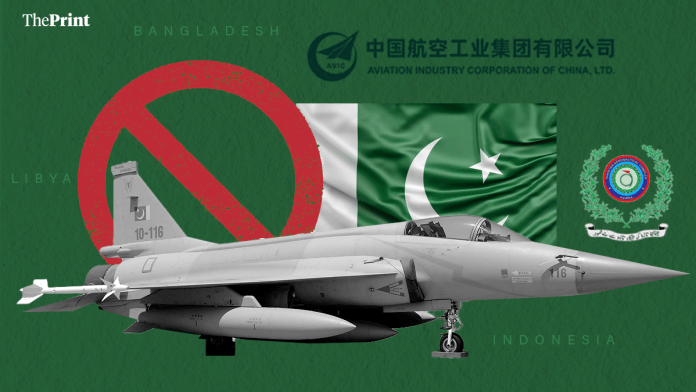



New Delhi: Pakistan has done it again. Its JF-17 fighter, a Sino-Pak joint product, has “bagged” fresh export contracts—at least on paper, at air shows, and in media reports quoting ‘highly placed sources’ in the Pakistani military.
Each announcement follows a familiar script. Words like “interest”, “intent” and “potential” are liberally sprinkled in media reports originating from Pakistan, and even in official statements.
Such has been the reporting around Pakistan’s JF-17 that even the country’s Foreign Ministry appeared blindsided and admitted it was “unaware” of any talks with Saudi Arabia to convert around USD2 billion in Saudi loans into a JF-17 fighter jet deal.
This clarification came following a report by international news agency Reuters that Pakistan and Saudi Arabia are in talks to convert about $2 billion of Saudi loans into a JF-17 fighter jet deal.
Interestingly, it has largely been Reuters which has been reporting on the purported deals that Pakistan has struck, or is in the process of striking. These reports make one think the fighters are flying off shelves across continents.
In a series of news articles, mostly citing sources and some official claims, since 22 December last year, Reuters has reported on deals with Bangladesh, Saudi Arabia, Sudan, Indonesia and the Libyan National Army (LNA).
Adding to the narrative on Wednesday, Pakistan’s Minister of Defence Production Raza Hayat Harraj told the BBC in an interview that many countries are in discussion, and “when these aircraft are delivered, the world will know which countries have bought them”.
Perhaps the most startling claim has been a deal with Khalifa Haftar’s Libyan National Army, despite the United Nations arms embargo on the African nation since 2011. Citing Pakistani military sources, Reuters reported that Pakistan had signed an arms agreement worth over USD 4 billion with the LNA for 16 JF-17 fighter jets and 12 Super Mushshak trainer aircraft.
The claim raises obvious questions. How is Pakistan—part of the UN Security Council and also of the UN sanctions committee—entering into a military contract with a country under a UN arms embargo?
Each rumoured deal is treated as a geopolitical masterstroke by Pakistani media and by some international outlets, and as proof that Pakistan’s defence industry has “arrived”.
The absence of signed contracts is brushed aside as confidentiality. After all, true success, it seems, is best measured not in aircraft delivered but in headlines generated.
Officially, Pakistan has exported jets to only two countries and the experience has been a bitter one.
In July 2015, Myanmar ordered 16 Block 2 JF-17s from Pakistan and China for approximately $560 million. Till date, the Myanmar Air Force has taken delivery of 7 JF-17 Block 2s, including 5 JF-17s and 2 JF-17Bs, all of which remained grounded till at least November last year because of technical issues and spare parts availability.
In 2021, the Nigerian Air Force (NAF) inducted three JF-17 Thunder fighter jets acquired from Pakistan.
On 6 June last year, Pakistan announced that it had secured a contract to supply 40 JF-17 Block 3 aircraft to Azerbaijan for $4.6 billion, which builds on an initial agreement signed between Pakistan and Azerbaijan in February 2024, valued at $1.6 billion, for an unspecified number of JF-17 Block 3 fighter jets, alongside training and armaments.
Sources in the Indian defence and security establishment said that there is no doubt that Pakistan is promoting the JF-17 for possible sales. However, they added that these ’embedded’ media stories are just “trying to project Pakistan’s claims of victory in Ops Sindoor to deflect the attention from the hammering it got”.
Sources in Pakistan closely following the developments said that Field Marshal Asim Munir is upset with the focus being on J-10s and hence the aim is to build a propaganda base around JF-17.
They also said that selective leaks to the media on JF-17 is also a way to troll India.
Interestingly, while Pakistan claims the JF-17s performed well against India, sources in the Indian defence and security establishment said that it was the J-10C that was in action.
“Give credit where it is due. J-10s were leading the fighter package of the Pakistan Air Force,” a source explained, adding that JF-17s kept itself at bay while J-10s engaged on day 1 of the conflict.
Schematics aside, for all practical purposes Pakistan lacks the capacity to deliver aircraft at the pace suggested by its claimed contracts.
According to estimates, Pakistan Aeronautical Complex (PAC), Kamra, which manufactures the JF-17, can produce around 20–25 aircraft a year.
Javed Hasan, a Pakistani economist, took a dig at media reports surrounding the purported deals. “One begins to detect a pattern: the same agency that floated the ‘Trump to Islamabad’ story in September 2025. In an age of transactional superpowers, is the real currency not the meeting that happens, but the one merely rumoured to be imminent? Might this also apply to the JF-17 sales to Saudi Arabia—phantom jets, eternally on the horizon?” he said in an X post.
Nearly a month on from @Reuters 17 Dec scoop—‘Field Marshal Asim Munir is expected to fly to Washington… for a third meeting [with Trump] in six months’—the diary remains stubbornly blank.
One begins to detect a pattern: the same agency that floated the ‘Trump to Islamabad’… pic.twitter.com/UTEzx2i0lo
— Javed Hassan (@javedhassan) January 12, 2026
He went on to highlight the production capacity. He calculated that 16 JF-17s heading to LNA, a potential $2–4 billion deal with Saudi Arabia (which, even at a conservative $50–100 million per unit export price, despite production costs closer to $25 million, implies at least 20–40 jets), a sale of 40 JF-17 Block IIIs to Azerbaijan comes to about 76–96 jets earmarked for export in the coming few years, on top of domestic requirements.
“And it is not as if Pakistan builds every aspect of the aircraft,” a defence source said. “Major airframe sections, the avionics suite and the radar come from China. The engine comes from Russia. Even if Pakistan wants to ramp up production, it will have to wait for engines.”
Aircraft manufacturing, the source added, is not a tap that can be turned on overnight. “It requires sustained investment, tooling and skilled manpower.”
The JF-17 Block III, the sources said, is even more dependent on China due to its AESA (Active Electronically Scanned Array) radar and advanced avionics, even though the share of locally manufactured structures has increased.
Also Read: Is Pakistan arming jets with nuclear missiles? JF-17 photographed with Ra’ad-I, says US think tank
What is JF-17
The aircraft is jointly manufactured by the PAC and China’s Chengdu Aircraft Corporation (CAC). The two countries had signed an agreement in the late 1990s to develop the aircraft, with the first flight taking place in 2003. It entered the Pakistan Air Force in 2007.
While JF-17 makes the bulk of the PAF’s fighting squadron, with the numbers set to go up further with older versions being replaced by the Block III, the aircraft is not used by the Chinese.
Sources said that even if China helps Pakistan increase its production capacity, the issue will be that of engines. The JF-17s use Russian RD-93 engines and the latest Block III uses an upgraded RD-93 MA which has a higher thrust output.
China has tried to use its own WS-13 engine on the JF-17s but Pakistan has gone back to the Russian one due to reliability issues.
As ORF notes, in 2007 and 2010, Rosoboronexport reached deals to export 250 RD-93 engines to China, with an option for an additional 400 units and the right to transfer them to third countries, including Pakistan.
Following the Russia-Pakistan military cooperation agreement of November 2014, Pakistani officials claimed that they would be able to purchase these engines directly from Russia, expressing interest in training engine specialists there and seeking Moscow’s assistance with the modernisation of the Pakistan Aeronautical Complex’s engine-repair facilities.
However, there has been no public confirmation that Russia has entered into any such arrangement beyond the delivery of engines and spare parts, and even these are exported to Pakistan via China.
The sources said that in most likelihood, the engines are delivered to Pakistan via China which then takes care of the payment and offers Moscow the window to deny any direct supply to Pakistan.
This is an updated version of the report.
(Edited by Ajeet Tiwari)
Also Read: Bangladesh-Pakistan look to expand ties to defence procurement as Dhaka shows ‘interest’ in JF-17s
Pakistan may be struggling to keep up production but they are still winning the PR war and continue to generate interest and customers. Meanwhile HAL Tejas continues to struggle to secure even a single foreign buyer. India needs to really step up its game.
JF 17 is selling like hot cakes whereas Tejas has no takers except for the IAF whose hands are tied by ‘atmanirbharta’.