





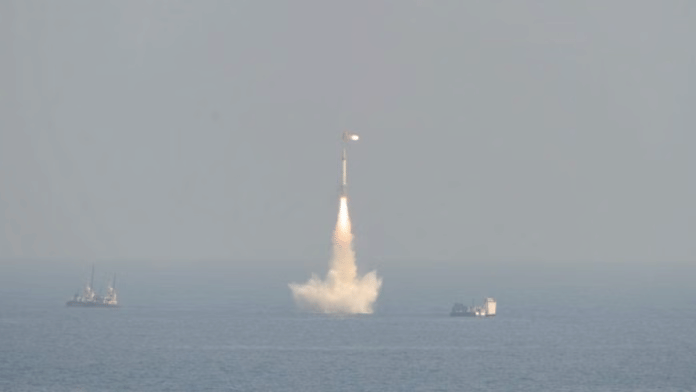



New Delhi: The second successful test of India’s K4 Submarine Launched Ballistic Missile (SLBM) has created a flutter among the Pakistan establishment-linked strategic security community, with a former army brigadier dubbing the launch as “a red flag for global stability”.
Zahir Kazmi, Arms Control Adviser at the Strategic Plans Division of Pakistan’s National Command Authority–in charge of Islamabad’s nuclear weapons programme–has criticised the test alleging that it is not just a boost to India’s sea-based triad, but also risks arms race in the Indian Ocean Region.
“India’s nuclear enterprise far exceeds regional needs: ~150 warheads, fissile stocks for 138-213 more, Agni-V ICBM (7,000+km), upcoming Agni-VI. This buildup risks an arms race [in the] IOR [Indian Ocean Region],” the retired brigadier, who had also previously served as the Director General of Arms Control and Disarmament Affairs at the Strategic Plans Division, posted Friday on ‘X’
“Threading into maritime domain: India plans 6 SSBNs & 6 SSNs by 2030s, with S4-class (7,000-tonne) vessels like Aridhaman nearing ops. Tech mosaic — Russian reactors (83MW PWR from OKBM Afrikantov), Akula-derived quieting, Thales sonar influences, Western COTS guidance. This creates quasi-continuous at-sea deterrent, compressing sanctuaries for China & beyond.”
The reactors for India’s nuclear submarines were developed by the Bhabha Atomic Research Centre (BARC) in Mumbai. The 83 MW pressurised water reactor helps power the INS Arihant and INS Arighaat, both of which roughly weigh 6,000 tonnes.
Kazmi further highlighted that India’s doctrine as perceived in the security circles in Islamabad has shifted since Operation Sindoor, from land-air operations to sea-led operations including the deployment of Carrier Strike Groups along with INS Vikramaditya in the Arabian Sea and BrahMos-equipped ships, “undermining” deterrence capabilities.
India’s latest K-4 SLBM test from INS Arighaat (3,500km range) isn’t just a boost to its sea-based triad — it’s a red flag for global stability. As I detail in my @CISS_Islamabad Insight paper, India’s nuclear enterprise far exceeds regional needs: ~150 warheads, fissile stocks… pic.twitter.com/hA3bmkUg3Q
— Zahir Kazmi (@zahirhkazmi) December 26, 2025
Pakistan has been focusing on developing various delivery systems for its own nuclear missiles in recent years. It first test fired Babur-3, a Submarine Launched Cruise Missile (SLCM), in 2017 and later in 2018.
With a range of around 450 km, the Babur-3 is designed to be launched horizontally through submarine torpedo tubes rather than a canisterised vertical launch mechanism. The tests for Babur-3 were conducted from a submerged platform and designed for Pakistan’s current submarine fleet, which consists mainly of the French designed Agosta-class submarines operated by its navy.
On Tuesday, India test-fired K4 missile from the nuclear-powered submarine INS Arighaat off the coast of Vishakhapatnam. The defence ministry has not released any official statement regarding the test.
First tested in November 2024, K4 has a range of roughly 3,500 km. It offers India a longer range than the K15 missile that had a range of roughly 750 km. The K4 gives India the potential to cover all of Pakistan and also a large part of China in terms of range.
As for India’s nuclear strike capabilities, it offers greater range, especially as a part of second strike capabilities from sea, as a part of the country’s doctrine. India is one of the few countries to be able to launch nuclear missiles from land, air and undersea.
The induction of the INS Arihant in 2016, completed India’s nuclear triad, giving its military a fool-proof second strike capability. India maintains a strict no-first use policy with regards to nuclear weapons.
Currently, India operates two nuclear ballistic missile submarines (SSBN)—INS Arihant and INS Arighaat—while a third—INS Aridhaman—is set to be inducted soon. INS Arihant was designed to launch K15, while INS Arighaat can launch both K15 and K4 missiles.
Kazmi takes note of India’s growing naval capabilities and recently signed agreements with the US such as COMCASA (Communications Capability and Security Agreement) and BECA (Basic Exchange and Cooperation Agreement for Geospatial Intelligence) as actions eroding the Nuclear Non-Proliferation Treaty (NPT).
Pakistan renewed its own foundational defence agreement with the US in August 2023. The two countries first signed the Communication Interoperability and Security Memorandum of Agreement (CIS-MOA) in 2005 for a period of 15 years. The US-Pakistan CIS-MOA lapsed in 2020 and was eventually renewed three years later. Such agreements allow for the sale of American defence equipment to foreign countries.
“Do India’s opacity, revisionist behavior (NFU contradictions, hedging) make it a reliable partner in any regional or extra regional alliance? How? Is it a net security provider or disruptor? Its drift towards compellence and first strike is potentially a liability that may entangle IOR’s non-littoral nuclear powers in crises!” Kazmi said.
However, it must be noted that Pakistan has been focused on developing its own nuclear arsenal, with an estimated 170 stored warheads, according to the Stockholm International Peace Research Institute (SIPRI).
Islamabad has also been working closely with China to expand its own naval capabilities with at least four Hangor-class submarines set to be inducted into the Pakistani Navy in the next few years.
Ties between India and Pakistan remain tense, following the 87-hour conflict in May 2025. India launched Operation Sindoor targeting nine terrorist complexes across Pakistan and Pakistan-occupied Jammu and Kashmir in retaliation to a terror attack in Pahalgam on 22 April that killed 26 people.
(Edited by Tony Rai)