




When a crypto project fails, it usually happens the same way, not because there was no demand, but because the system couldn’t handle it. Networks stall. Transactions freeze. Rewards glitch. And when that happens, trust evaporates, price tanks, and the momentum dies.
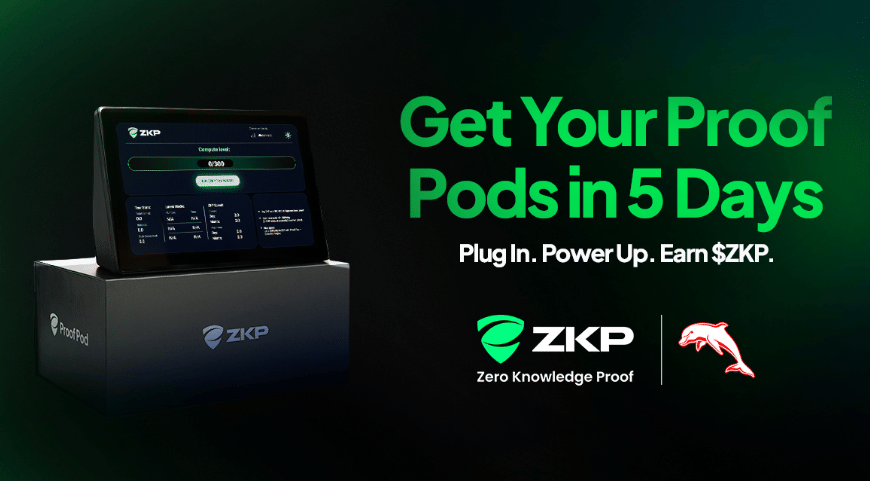
Zero Knowledge Proof (ZKP) is doing something most presales don’t: spending $17 million before launch to stop all of that from happening. While other projects direct early funding toward marketing or vague roadmap goals, ZKP is already funding infrastructure designed to reduce failure rates. These aren’t just technical redundancies. ZKP calls them Proof Pods, a structured, budgeted mechanism built to mitigate stalls, absorb risk, and maintain continuity even under stress.
And while the price is still being discovered through its live Initial Coin Auction (ICA), early participants are entering at a stage where failure-mitigation is already paid for. That’s not typical. That’s timing leverage.
Proof Pods Flip the Presale Playbook
Most crypto presales follow the same model: sell tokens first, build later, scale maybe. In that model, the biggest risk is hidden, technical breakdowns that only show up after people have committed money. The downtime, the failed blocks, the missing rewards, all of it gets patched in public.
ZKP’s Proof Pods flip this script completely. They’re not a feature. They’re a $17 million structural layer whose sole job is to keep the system running even when it’s under load, stressed, or being hit with real transaction volume.
That changes the incentive math. It means early buyers aren’t just betting on “future delivery.” They’re participating in a system that’s already funded its disaster recovery strategy, before the token price goes into open-market price discovery. The infrastructure is real. The funding is already deployed.
This is also why ZKP is being named among the best crypto presales right now. Analysts and early community members are pointing to the Proof Pods system as the core differentiator that could protect the network from the same failure spirals that took down previous early-stage projects.
100x to 10,000x ROI Potential, If the System Holds
Presales often promise scale. ZKP funds stability.
And in a market cycle where infrastructure reliability is back in focus, after months of high-profile network failures, that decision may turn out to be the single most valuable factor separating short-term hype from long-term upside.
If ZKP’s Proof Pods work as designed, they won’t just prevent failure. They’ll enable sustained demand without technical degradation, and that’s where the math shifts.
The Initial Coin Auction is live. Daily price discovery is moving. Token distribution is ongoing. But the big difference is that ZKP isn’t building to survive launch. It’s already built to survive post-launch scaling.
With analyst projections circling a potential $1.7B raise, and risk-mitigation already hardcoded into the architecture, the window for entry may be structurally mispriced today. That’s what creates asymmetry.
If demand scales and the system holds, early participants could see 100x to 10,000x potential ROI over the long term, not because of speculation, but because the design prevents the failures that kill so many others.
Presales Fail When They Break. ZKP Is Paying to Not Break.
ZKP isn’t betting on trust. It’s buying it.
$17 million into Proof Pods isn’t a gimmick. It’s a budget line for system survival. And that might be the most underpriced signal in the current presale market. This isn’t marketing spend. This is failure insurance.
For anyone searching for the best crypto presales to enter right now, the question isn’t just about upside. It’s about what stands between the project and collapse. ZKP is answering that question in advance, and paying to prove it.
The auction is live. The system is real. The safety nets are already funded.
And the price? Still discovering.
Find Out More about Zero Knowledge Proof:
Website: https://zkp.com/
Auction: https://auction.zkp.com/
ThePrint BrandIt content is a paid-for, sponsored article. Journalists of ThePrint are not involved in reporting or writing it.