





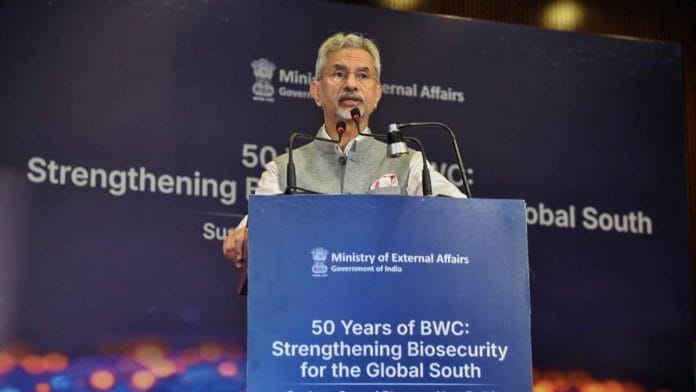



New Delhi: External Affairs Minister S. Jaishankar Monday warned of the potential misuse of biological weapons by “non-state actors”, underlining that “bioterrorism” is a serious concern while urging for reformation of the global structures managing such weapons.
“Misuse by non-state actors is no longer a distant possibility. Bioterrorism is a serious concern that the international community has to be adequately prepared for. Yet the BWC (Biological Weapons Convention) still lacks basic institutional structures,” he said, addressing a conference in the national capital on 50 years of BWC, with a focus on strengthening biosecurity for the Global South.
The BWC effectively prohibits the development, production, acquisition, transfer, stockpiling and use of biological and toxin weapons. It contains 15 articles and currently has 189 states party to it. Four additional states have signed but not ratified the treaty.
“It (BWC) has no compliance system, it has no permanent technical body and no mechanism to track new scientific developments. These gaps must be bridged in order to strengthen confidence,” he asserted.
The minister further warned that the rapid development of science and technology has made the manufacture of sophisticated biotechnology tools easier and reduced costs for “sequencing and synthesis”.
“It is clear that whether a biological threat is natural, accidental or deliberate, it moves fast; it defies borders, and it can, and has overwhelmed systems,” Jaishankar said, pointing to the COVID-19 pandemic in 2020-2021 that led to shutdowns across the globe.
The pandemic saw millions die, while governments had to take a number of measures to curb the spread of the virus, showcasing the gaps in public health systems.
The BWC came into effect on 26 March, 1975, while the main agreement was opened for signatories from 1972. India ratified the treaty in 1974.
New Delhi has a “robust legal and regulatory” framework to implement the provisions of the United Nations Security Council Resolution 1540 that prohibit the proliferation of nuclear, chemical and biological weapons to non-state actors.
“India is committed to ensuring the non-proliferation of sensitive and dual-use goods and technologies, and we have a well-established record in that regard. Consistent with our offer to share knowledge and technical expertise on relevant areas and as a contribution to the international non-proliferation architecture, India has been organising an annual disarmament and international security affairs fellowship programme since 2019,” said Jaishankar.
“Now, not only is India a party to the multilateral treaties of the BWC and the CWC (Chemical Weapons Convention), but also an active member of three key multilateral export control regimes: the Wassenaar Arrangement, Missile Technology Control Regime and Australia Group,” he added.
The Australia Group, an informal grouping of 43 member-states, including India, is the most pertinent of the export control regimes, as it focuses on the non-proliferation of chemical and biological weapons in particular.
Principal Scientific Adviser to the government, Ajay Kumar Sood, and chairman of Defence Research and Development Organisation (DRDO) Samir Kamat were part of the gathering at the conference, along with the chair of Australia Group.
Jaishankar announced India’s support for “international cooperation and assistance enabling exchange of materials and equipment for peaceful use”.
“We have proposed a national implementation framework that, inter alia, covers identification of high-risk agents, oversight of dual-use research, domestic reporting, incident management, and continuous training. India has voiced that assistance during biological incidents must be fast, it must be practical, and it must be purely humanitarian,” the minister said.
“We must modernise the convention, we must keep pace with science and strengthen global capacity so that all countries can detect, prevent and respond to biological risks. India stands ready. We remain a trusted partner to the Global South and a committed supporter of global biosecurity,” he added.
(Edited by Nida Fatima Siddiqui)
Also Read: Gujarat ATS bust ‘ricin terror plot’: What is ricin & what makes it so deadly