








By Guy Faulconbridge and Anton Kolodyazhnyy
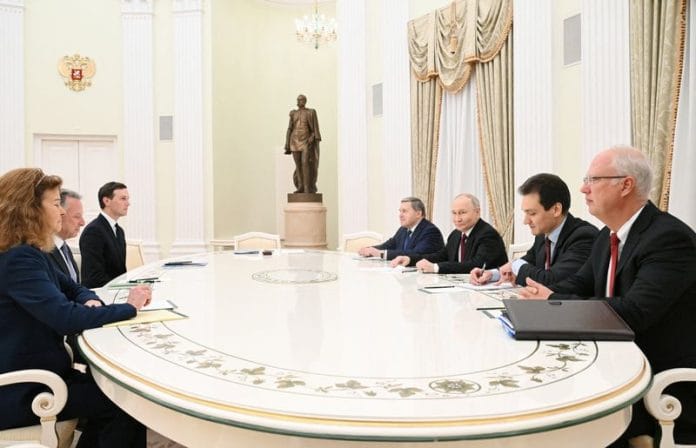
MOSCOW, Dec 2 (Reuters) – Russian President Vladimir Putin met U.S. President Donald Trump’s special envoy Steve Witkoff and son-in-law Jared Kushner in the Kremlin on Tuesday for talks on a possible way to end the deadliest European conflict since World War Two.
Just before the meeting, Putin warned Europe that it would face swift defeat if it went to war with Russia, and he dismissed European counter-proposals on Ukraine as being absolutely unacceptable to Russia.
Trump has repeatedly said he wants to end the war, but his efforts, including a summit with Putin in Alaska in August and meetings with Ukrainian President Volodymyr Zelenskiy, have not brought peace.
A leaked set of 28 U.S. draft peace proposals emerged last week, alarming Ukrainian and European officials who said it bowed to Moscow’s main demands on NATO, Russian control of a fifth of Ukraine and restrictions on Ukraine’s army.
European powers then came up with a counter-proposal, and at talks in Geneva, the United States and Ukraine said they had created an “updated and refined peace framework” to end the war.
TALKS ONGOING
A smiling Putin told Witkoff he was glad to see him and asked him about his and Kushner’s walk around Moscow, which included a stroll across Red Square past the mausoleum of Soviet founder Vladimir Lenin to the towers of the Kremlin.
“It is a magnificent city,” Witkoff told Putin, along with foreign policy aide Yuri Ushakov and Putin investment envoy Kirill Dmitriev. Both sides had interpreters.
The Kremlin talks were ongoing late into the Moscow night after more than three hours.
“Our people are over in Russia right now to see if we can get it settled. Not an easy situation, let me tell you. What a mess,” Trump said at a cabinet meeting in Washington, adding that there were casualties of 25,000 to 30,000 per month in the war.
U.S. Secretary of State Marco Rubio, who has led efforts to recraft the original peace plan to account for Ukrainian and European concerns, said Witkoff was trying to end the war.
PUTIN ACCUSES EUROPEANS OF TRYING TO BLOCK PEACE
Just before the Kremlin meeting, Putin accused Europe of seeking to undermine Trump’s peace efforts by making proposals that it knew were unacceptable to Russia.
“They are on the side of war,” Putin said of the European powers. “We can clearly see that all these changes are aimed at only one thing: to block the entire peace process altogether, to make such demands which are absolutely unacceptable to Russia.”
Putin said Russia did not want war with Europe, but that if Europe started one, it would end so swiftly that there would be no one left for Russia to negotiate with.
Putin threatened to sever Ukraine’s access to the sea in response to drone attacks on tankers of Russia’s “shadow fleet” in the Black Sea. Ukraine’s Foreign Minister, Andrii Sybiha, said Putin’s remarks showed he was not ready to end the war.
Russian forces control more than 19% of Ukraine, or 115,600 square km (45,000 square miles), up only one percentage point from two years ago, though they have advanced in 2025 at the fastest pace since 2022, according to pro-Ukrainian maps.
But nearly four years into the Ukraine war, Russia has failed to conquer Ukraine, a much smaller neighbour that has been supported by European powers and the United States.
Zelenskiy, speaking in Dublin, said everything would depend on the talks in Moscow but that he was afraid the United States could lose interest in the peace process.
“There will be no easy solutions … It is important that everything is fair and open, so that there are no games behind Ukraine’s back,” he said.
PUTIN SEES POSSIBLE ‘BASIS FOR FUTURE AGREEMENTS’
Putin has said the discussions so far are not about a draft agreement but about a set of proposals that he said last week “could be the basis for future agreements.”
Putin has said he is ready to talk peace, but that if Ukraine refuses an agreement, then Russia’s forces will advance further and take more Ukrainian territory.
Russia invaded Ukraine in February 2022, triggering the biggest confrontation between Moscow and the West since the depths of the Cold War.
Conflict first erupted in eastern Ukraine in 2014 after a pro-Russian president was toppled in Ukraine’s Maidan Revolution. Russia annexed Crimea and Moscow-backed separatists battled Kyiv’s armed forces in eastern Ukraine.
In video footage released on the eve of Witkoff’s visit, Putin hailed what his commanders said was Russia’s capture of the city of Pokrovsk in eastern Ukraine as an important victory after a prolonged campaign.
Ukraine’s military told Reuters its forces were still holding the northern part of the city and had attacked Russian forces in southern Pokrovsk.
U.S. officials have put the casualty toll in the war at more than 1.2 million killed or wounded. Neither Ukraine nor Russia discloses its losses. The conflict has also caused widespread destruction in Ukrainian towns and cities and forced many people from their homes.
Since the U.S. draft proposals emerged last month, European powers have been trying to bolster Ukraine against what they see as a punitive peace deal that could open Russia to U.S. investment in oil, gas and rare earths and return Moscow to the G8.
Key Russian demands include a pledge that Ukraine would never join NATO, caps on the Ukrainian army, Russian control of the whole of Donbas, recognition of Russian control of the regions of Crimea, Donbas, Zaporizhzhia and Kherson, and protection for Russian speakers in Ukraine.
Ukraine says these would amount to capitulation and leave it vulnerable to eventual Russian conquest, though Washington has also floated a 10-year security guarantee for Kyiv.
Ukraine and European powers view the war as an imperial-style land grab by Moscow and have warned that if Russia wins, then it will one day attack NATO members. Zelenskiy says Russia must not be rewarded for a war it started.
(Reporting by Guy Faulconbridge; Editing by Timothy Heritage, Gareth Jones, Rod Nickel)
Disclaimer: This report is auto generated from the Reuters news service. ThePrint holds no responsibility for its content.